He’s photographed war zones, slums, disasters – and for the World Cup, he’s showing off ‘soccer everywhere’
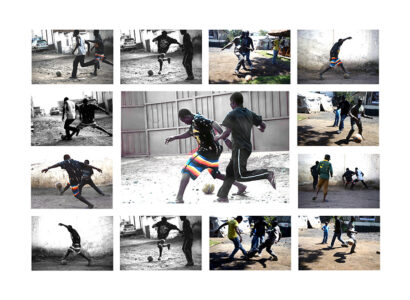
photo by: Contributed/Gary Mark Smith
A ‘photo quilt’ by Gary Mark Smith shows street soccer scenes in the Democratic Republic of the Congo.
“It’s not good for printing,” this photo that Gary Mark Smith took of a few boys on the streets of Tangier, Morocco.
It’s not violent or dark or frightening, like so much of the stuff he’s seen in nearly half a century of photographing the most dangerous streets on Earth. But it’s not good for printing, because of what the boys are doing – they’re kicking around a bottle cap.
They’re playing soccer with a ball almost too tiny to spot.
“Everywhere I’ve ever been, I find soccer,” Smith says.
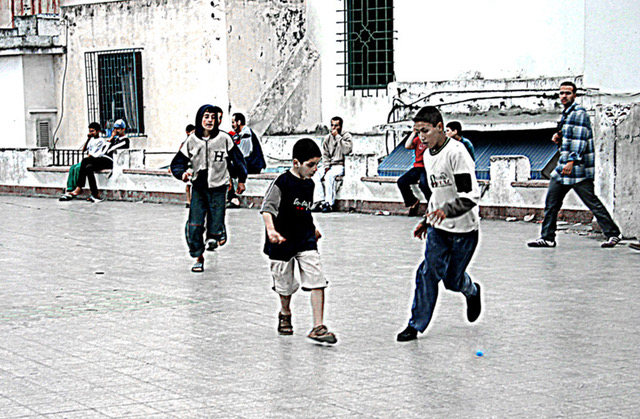
photo by: Contributed/Gary Mark Smith
Children kick a bottle cap around in Tangier, Morocco, in this photo by Gary Mark Smith.
It is, after all, the world’s most popular sport. And when it takes over Lawrence and the Kansas City area this summer during the 2026 FIFA World Cup, Smith’s images of soccer at its most basic will be on display in downtown Lawrence for tens of thousands of Lawrencians and international visitors to see.
Smith, who’s published seven books of street photography, is one of six artists selected this year for Lawrence’s annual Unmistakable Public Art Exhibition, which has a special soccer theme this year for the World Cup. The other five artists are Alicia Kelly, who’s creating vinyl window displays inspired by a soccer ball texture; sculptors Randall Warren and Nathan Pierce; muralist Javy Ortiz; and Tim Hossler, who will create a variety of wearable artworks like jerseys and scarves.
Smith says his art isn’t what you would expect when you hear “public art.”
“Public art is only sculpture and murals,” he said. “And they don’t include murals much in that show … they want sculptures on Mass. Street.” Photographers, he said, weren’t part of that world.
“But I had these soccer photos from all over the world, and I had the vision of ‘soccer everywhere.’ And I knew I had a really great bunch from Congo,” he said.
Those photos were taken during his time embedded in a U.N. peacekeeping mission in the Democratic Republic of the Congo in 2015, and they would become his entry in the exhibition, titled “Soka Kila Mahali,” Swahili for “Soccer Everywhere.”
Smith likes to arrange his photos in grids, and this is one of thousands he says he’s done. “The grids are made to look balanced as a whole,” he said, “and you get into them, and each picture is pretty cool. You know, you start looking at each picture individually, and you realize that they’re all good pictures. None of them are just slop.”
But to really see what’s so special about the photos, you need to know something about the “danger streets” they were photographed in.
“There’s three kinds of danger streets,” Smith says. “There’s natural disaster, there’s war, and there’s poverty.”
Which kind is a street in Goma, Congo?
“Uh,” he says, “It’s the worst place on Earth. It’s all three of those.”
The natural disaster is the Nyiragongo volcano just a few miles away, which is one of the few volcanoes on Earth with a persistent lake of lava. When it erupted in 2021, many the city’s inhabitants tried to flee to Rwanda, whose border it sits on.
The war started after the Rwandan genocide of the ’90s. “Thirty-five years, 6 million dead, 9 million displaced,” Smith says. “It’s the most ignored war in the world. … People ignore it, because it’s just Africa.”
The poverty is immense: according to the nonprofit Opportunity International, nearly 75% of people there live on less than $1.90 a day.
“And even in a place like that, you can find soccer,” Smith says. “… All these danger streets I’ve been to, soccer everywhere.”
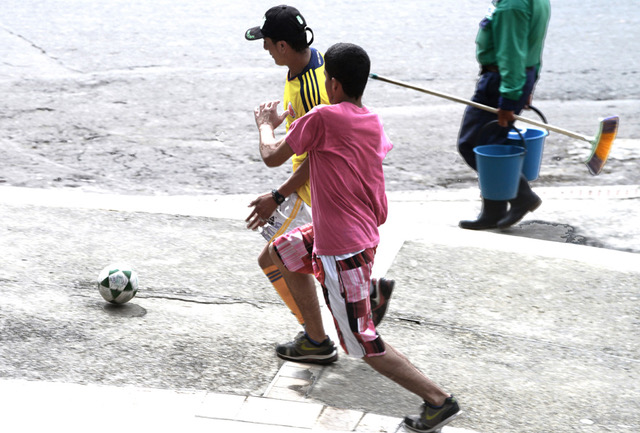
photo by: Contributed Photo/Gary Mark Smith
People in Colombia play street soccer in this photo by Gary Mark Smith.
Not ‘stereotypical’ public art
“Soccer everywhere” could just as easily be a slogan for the World Cup, which this year brings together countries as big as Brazil, Australia or the U.S. and as small as Curaçao, Haiti or Cabo Verde.
But public art isn’t always that diverse, and you’ll hear that from both Smith and the city’s public arts leadership. Until 2025, the summer exhibition was known as the Outdoor Public Sculpture Exhibition, and it only included sculptures, which Porter Arneill, an assistant director of Parks, Recreation and Culture for the city, says are a more “stereotypical” kind of public art.
Smith thinks that his medium almost prevented him from getting a spot in the exhibition. He was watching when the Lawrence Cultural Arts Commission was taking its vote in December. They had to narrow it down to the top six works, he said.
“And I was number six. And it was because I wasn’t a sculptor.”
As he recalls it, one member of the commission was even “bagging on” his and another artist’s work during that meeting. Smith sees in that another instance of people not caring about the poorer parts of the world. “We don’t care about Africa,” he said.
In the December meeting, the commission did discuss whether Smith’s work and the No. 5 work, a sculpture by Nathan Pierce, were good fits for the exhibition. The commissioners talked a lot about the fact that the exhibition was expecting new works created specifically for it; Pierce’s sculpture was already made, and the photographs from Congo were taken in 2015.
One cultural arts commissioner, Matt Gaus, said that while he liked Smith’s photos themselves, “the description in the proposal threw me a little bit off, like emphasizing that this street is the most dangerous place on Earth.” Gaus characterized that as “at best a little sensationalistic, at worst maybe something a little … unsavory.”
Not everyone on the commission felt that way. Commissioner Monique Mercurio said she thought Smith’s artwork “speaks volumes.”
“It shows contrast, what the picture is, and what it celebrates, and, you know, that moment – in balance of, you know, that dark, scary, poor place on Earth,” Mercurio said. “I think that in itself is art and makes you think and … makes you uncomfortable.”
When Lawrence learned that it would be hosting an African country’s team, Algeria, Smith’s photos seemed even more fitting. At a Lawrence City Commission meeting, Ruth DeWitt of Explore Lawrence said the national team, established shortly after Algeria won its independence from France, has always been a huge part of the North African country’s identity.
“Learning how Algeria, how soccer is very much part of their independence, and the fact that these young kids in the Congo are playing soccer on the street is really beautiful,” Arneill said at the Cultural Arts Commission’s March meeting on Wednesday.
The city is still working on finding sites for the exhibition entries. Smith says he’s heard that his photos might be displayed on “a large television set inside a window, inside a storefront somewhere on Mass. Street.” Arneill on Wednesday said window spaces might not work out, but that another possibility might be a wheat-paste poster version of the photos on the wall of the U.S. Bank building at Ninth and Mass. or elsewhere in downtown.
It’s not the kind of art the city’s used to finding a spot for.
“It’s mixing up our own program, which I think is a good thing,” Arneill said of the mix of entries in December. “And that’s something I’ve been encouraging, is not doing just stereotypical public art alone, like sculpture.”
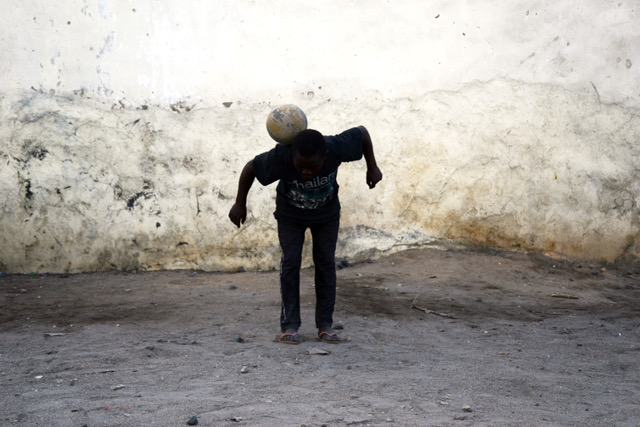
photo by: Contributed Photo/Gary Mark Smith
A street soccer scene from Goma, Congo, photographed by Gary Mark Smith.
‘All the way in’
Smith’s own story is anything but stereotypical.
In his teens, he was a marathon runner, he said. But he had an operation on his leg when he was 19, and the cast was too small for the swelling.
It crushed his nerves “all the way down to the toes.”
“I’m gonna be in pain the rest of my life,” he said. “There’s no cure. I’m gonna be on the most potent opiates the rest of my life, I’m gonna be stoned the whole time – what kind of life is this? So I decided I was gonna kill myself.”
He didn’t actually do that, of course. Instead, he decided to become “the pioneer of global street photography.”
“Once I decided that I wasn’t gonna kill myself, I was gonna put the fearlessness of suicide into my artwork,” he said.
Smith’s work and other things in his life have nearly killed him before. “I should be dead six – some of my friends tell me 11 – times over.”
“I was struck by lightning twice, when I was 15 and 20.”
“I was bitten by two poisonous snakes.”
“I fell off a 35-foot cliff ice climbing.”
“I was swept nearly a mile down a river in a flood. Got out of it.”
“That’s the only one I consider close to death,” he said. “Nine out of 10 people struck by lightning live. Almost everybody bit by snakes lives. You know, I don’t even consider those close.”
He’s had times where he’s left home “almost sure I wasn’t coming back,” because he knew he’d be going “all the way in” to get his shots.
When Smith went to KU and was a photographer at the Kansan, he said, he was nominated for a Hearst Award, a prestigious college-level journalism award, for doing work in war zones in El Salvador. “The Hearst board refused to judge me, because they said they didn’t want to encourage college students going to war,” he said. He thinks there was more to it than that, though: “It was really because it was the Reagan administration, and my work was human rights.”
“I had enough courage” to be a journalist, he said. “I had more courage. Papers wouldn’t have let me do what I did. And neither would academia.”
Smith tells a story about photographing in a favela, a Brazilian slum.
“I went into the slum, and, like I said, I picked a fight with a drug lord,” he said. “I made them beat me, I took nine punches, they kidnapped me, and that’s the way I got (to the drug lord.) Drug lords don’t have media departments. They hate photographers. And so that’s why I had to do it that way.”
In the favela, the gangs work unopposed by the cops. “When they do drug deals in the slum, cops never go there,” Smith said. A dealer sets up shop, sitting at a crate and selling the merchandise. On either side of him are guys with .45 pistols concealed in their belts, and farther away are machine gunners who keep watch for rival gangs or other unwelcome visitors.
There’s a sign nearby that translates from Portuguese as “Attention: Men Working.”
Smith shows up there and begins photographing a street sweeper. “The one thing I photograph and am known to photograph is street sweeps,” he said. “And a street sweep shows up. It’s like magic!”
He knows the danger he could be in if his plan doesn’t work. Years earlier, a Brazilian photographer got caught taking pictures of a deal, he said. “They chopped off his legs, they chopped off his arms, burned his body still alive at the stake. I knew that going in.”
Soon, a few gang members notice him photographing and confront him.
“They said, ‘Let me see those pictures.’ I said no. And boom, they were on me,” he said. They punch him in the head five times, a few more times elsewhere on his body. One of them grabs his camera, hanging by a strap from his neck, and pulls on it.
He tries to show them an identification card (in one of his books, he explains that he had it made himself as part of this plan) that says in Portuguese that he’s doing an art project in the slums. The men release him, and then one of them gives the others a sign.
“It was like synchronized swimming,” he said, as they pulled up their shirts and showed their .45s.
At moments like this, Smith said, “I have a saying: The bad don’t f— with the crazy.”
So he pulled up his shirt and jiggled his belly around.
“They busted out laughing,” he said. “So the violence was over.”
They “kidnapped” him for an hour, he said, but after that they took his camera and gave it to the drug lord, just as planned. “The drug lord, when he was analyzing what he should do with me after I challenged him, sees that in my camera there’s a picture of a street sweep,” Smith says. “So I’m not taking pictures of his drug deal. I’m taking pictures of the street sweep.”
Just a few days earlier, thousands of troops had been sent into the favela to capture this drug lord, Smith said. That doesn’t normally happen. The drug lord escaped it by hiding in the trunk of a car.
But after the gang took Smith’s camera, the drug lord threw a huge party – “a $20,000 party with a samba band, open barbecue, open alcohol” – and invited Smith.
“There was two reasons for that party,” Smith said. “One of them was to meet me. That’s what threw the party into action. But the party was really about him proving to his people that he wasn’t scared.”
“That’s how we met, in the middle of all that, and he gave me my camera back and gave me permission to photograph his slum.”
The street sweeper, like the soccer players in Congo, is the type of subject Smith really likes: people in inhospitable places who “get it done” regardless.
“All my books are about life in places that I’ve been to, and that’s what makes them valuable is because nobody does what I do, nobody gets into where I get into,” Smith said.
“That’s what Gary Mark Smith does. He goes to places and shows people getting it done in spite of what’s happening.”
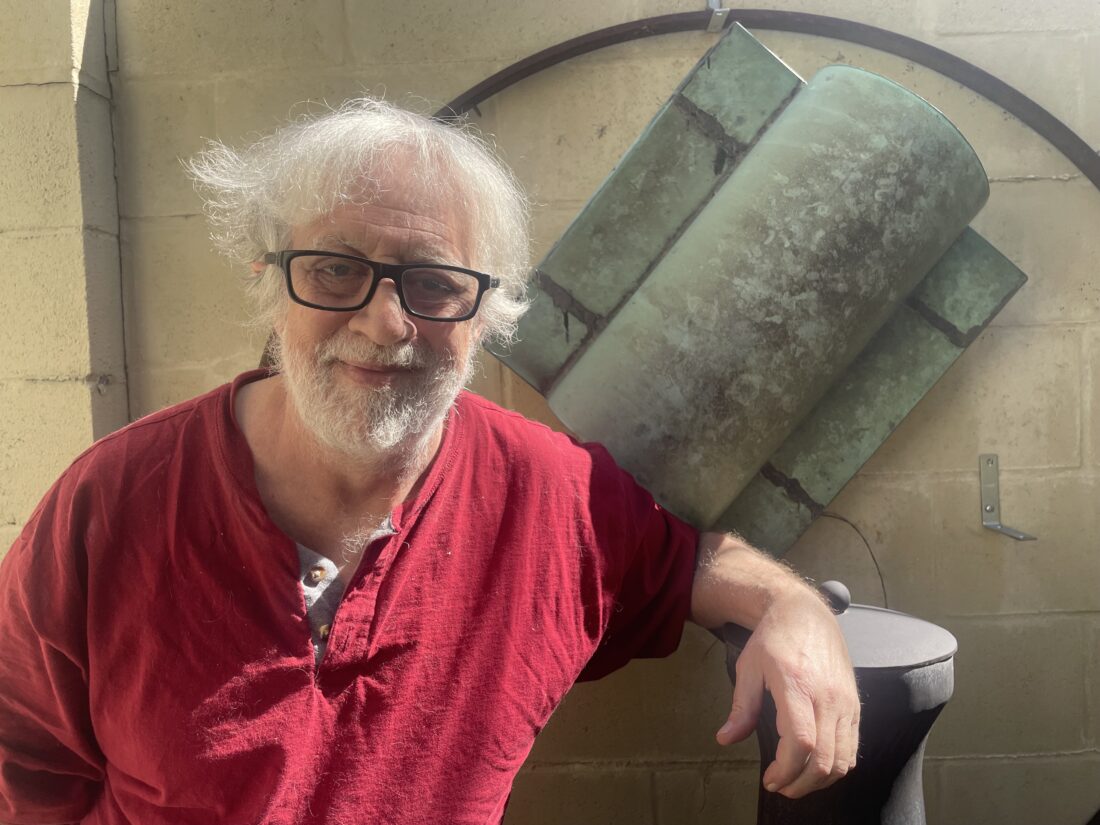
photo by: Sylas May/Journal-World
Gary Mark Smith poses Thursday, March 12, 2026, outside his home studio in Lawrence.
‘100 years worth of work’
It’s been almost 50 years since Smith started working as a photographer – or has it been 100?
“I work 80 hours a week,” he said; it keeps his mind off his pain. “Because of that, I’ve had double the career, actually, that a person could have for those 50 years. I’ve worked 100 years worth of work.”
That’s almost as many years as countries he’s been to.
His 100th was Suriname, which he went to because “nobody knows where it is.” (If you’re among them, you’re not alone – he thinks 99 out of 100 people couldn’t tell you that it’s in South America and not Africa.)
“I went there because nobody goes there, and that’s what Gary Smith does,” he says.
His 101st was the Caribbean island of Curaçao, because it was on the way home.
When he got back from that trip, he said, he was “sick of traveling,” something that’s happened a few times before.
“I’m travel-weary,” he says.
He is planning one more trip, though, when that 50-year anniversary comes in 2028. He knows how he’s going to end half a century of stories.
First, with 10 days in Brazil. Five of those will be in São Paulo to see one of his proteges, University of Kansas alumna Sarah Stern, who now works as a public relations leader for Netflix’s South American division.
The other five will be in Rio, where a gang threatened to behead him once.
“When I’m there in Rio for five days, I’m going to spend the whole time on Ipamena Beach, ’cause I love Ipanema Beach,” he says. “But I’m gonna spend an hour in the favela just pissing off the gang.”
“They call me ‘The Ballsy American,’ you know?” he says. “So I’m gonna go in there for an hour, just to get the word out – ‘The Ballsy American’s back! What should we do with him?’
“And then I’m gonna go back to Ipamena Beach.”
After that, it’ll be five days in Amsterdam, “which was my first international place I focused on,” and then five in New York City, where his 50-year career began, 75 miles away from the farm where he grew up.
And then, it’ll be back home.
“When I get home, the day I get home, Dec. 22, 2028, and that will be the day I started my career,” he says. “I’ll come in the house with my suitcase, I’ll pet the cats and lie to them like I always do that I’ll never leave you again. And then I’m gonna retire the 50-year project.”
He won’t have seen everything. “I’ve only been to 101 countries” he said. “… And when it comes down to it, I’ve only been to two places in each of those, rather than the thousand places that are in each place.”
But he’ll be grateful to have seen more of the world than most people, and glad to finally, formally settle down.
“Been to 101 countries, I wouldn’t live anywhere but Lawrence, Kansas,” he said. “I love this place.”
City Government
With new murals, Junior Girl Scouts and Jewish congregation hope to turn bland buildings ‘into something beautiful’

60 people from 23 states have applied for Lawrence’s city manager position, mayor says
City of Lawrence will soon start application process for a construction manager for Fire Station 6
Survey respondents think Lawrence is doing well on arts and culture, not so well on economy

Rising Rates: A three-part investigative series examines why Lawrence water and sewer bills have been soaring