HeadQuarters Kansas has fully transitioned to 988, improving funding while keeping local response
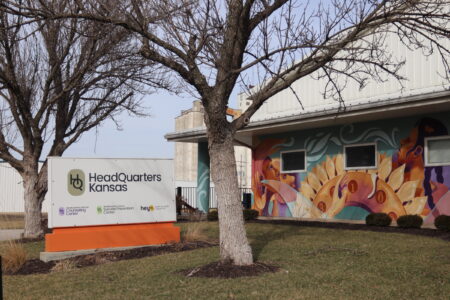
photo by: Josie Heimsoth/Journal-World
HeadQuarters Kansas, 2110 Delaware St., is pictured in February 2026.
HeadQuarters Kansas has fully transitioned to the national 988 Suicide and Crisis Lifeline, a move officials say improves funding stability while keeping callers connected to local counselors.
In December, HeadQuarters Kansas had announced that it would be discontinuing the use of Douglas County’s local crisis line as it shifted to the nationally supported 988 Suicide and Crisis Lifeline, as the Journal-World reported.
988 was launched in 2022, and its purpose is to provide easy and quick access to mental health crisis support 24/7. The people who answer the phone are trained counselors in a nationwide network of local crisis centers. When individuals dial 988 from 102 counties in Kansas, including Douglas County, they will reach HeadQuarters Kansas counselors in Lawrence who understand Kansas communities and can connect callers to local resources.
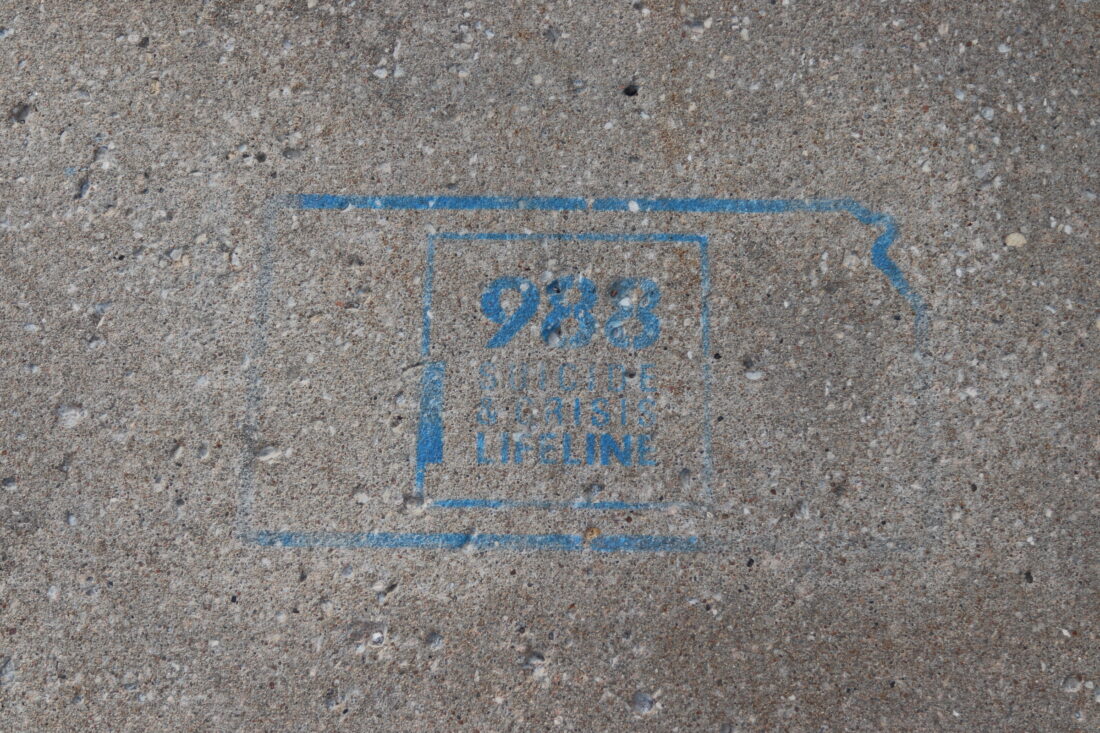
photo by: Josie Heimsoth/Journal-World
“988 Suicide Crisis Lifeline” is outlined in blue outside the HeadQuarters Kansas building.
The only callers in the state who would not be transferred to HeadQuarters Kansas would be state residents living in Johnson, Sedgwick and Wyandotte counties – all of which have their own call center.
The transition to 988 became effective on Dec. 31, 2025, and when individuals called the local line, 785-841-2345, they received a message instructing them to call the national crisis lifeline.
However, Megan Bridges, director of crisis services at HeadQuarters Kansas, said that message was only in place for about a month.
“The transition happened January 1 at midnight, so rolling into the new year, where if someone called the local line, they would hear a prompt and it would say, ‘This line is no longer in service. Please hang up and dial 988,'” Bridges said. “So from January 1 to February 3, that ran as that prompt.”
Bridges said on Feb. 3, that is when the local crisis line’s prompt changed to where callers could press a button to be directly connected to 988. From there, if individuals reside in the 102 counties, they will be connected to counselors at HeadQuarters Kansas.
Dan Watkins, interim director of HeadQuarters Kansas, said now there is no longer a need to discontinue the local crisis line because it’s still serving as a resource to get callers connected to the resources they need. People just get connected a little differently.
HeadQuarters Kansas, 2110 Delaware St., is pictured in February 2026.
Watkins told the Journal-World the reason the organization fully transitioned to 988 was financial.
“At one point, the county funded some of our operations, and in our budget discussions with them, we’ve talked about transitioning to 988 because it’s a national line and it’s known,” Watkins said. “As people become more aware of it, it’s easier, so the idea was always to transition.”
Watkins said the organization wanted to transition to 988 because then they could get a higher percentage of their budget through the crisis line’s funding source, the state of Kansas. He said before the transition, the organization received about $3.25 million from the state, and now the organization has received around an additional $400,000, increasing to $3.65 million.
“We got a $4 million budget, and we need to be reimbursed for the cost of operating it, and by switching to 988, we’ve got a higher rate of reimbursement,” Watkins said.
•••
Since the suicide and crisis lifeline became available, there has been a steady increase in calls. Bridges said there was a huge increase in calls to HeadQuarters Kansas when the lifeline launched, and over time, that number significantly increased.
A report detailing actions taken by the Kansas 988 Coordinating Council in 2025 also included data on the 988 Lifeline in the state. The report said the number of routed calls – the calls answered by a crisis center located in the same state as the caller – climbed from 2,751 in January 2025 to as high as 3,796 in October 2025.
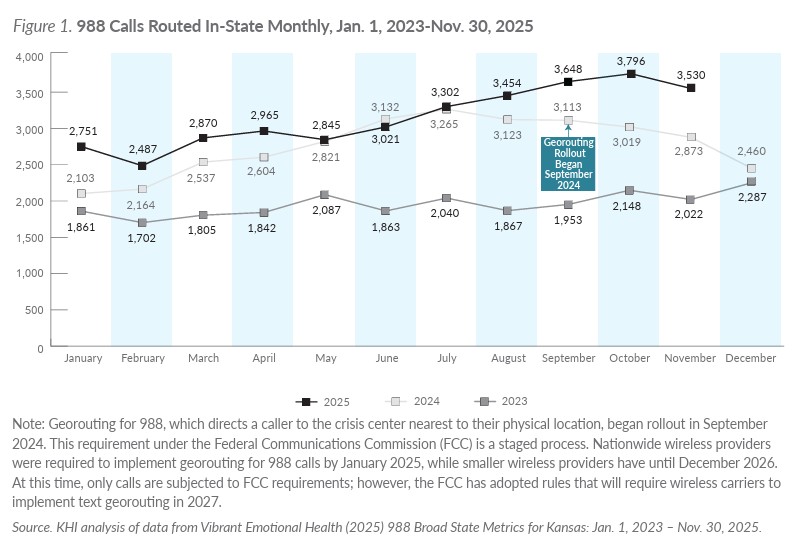
photo by: Screenshot from 988 Coordinating Council report
988 calls routed in-state monthly, Jan. 1, 2023 – Nov. 30, 2025.
In 2025, the council focused on strengthening coordination across Kansas’ crisis response system and evaluating future needs as 988 call volume and public awareness continued to grow. In doing so, it provided some recommendations to the 2026 Kansas Legislature.
The council recommended increasing the budget for 988 operations and related crisis services, either by raising the current $10 million cap on the 988 Fund to $13 million or identifying alternative or supplemental revenue sources, such as allocating a percentage of state lottery proceeds or sports betting revenue to the 988 Fund.
Additionally, the council recommended revisiting a discussion of using a telecommunications fee as an additional, stable funding stream to support ongoing 988 operations, technology and workforce needs. It also recommended extending the 988 Coordinating Council beyond June 30, 2026, to provide continued oversight, coordination and system development.
Currently, there is no Kansas bill advancing or being considered by the legislature that directly changes the 988 system.
But even as the state and the nation continue to promote 988 and there have been increases in calls over time, still, not everybody is aware of it, Watkins said.
“We’re building awareness around 988 in addition to answering the calls,” Watkins said. “But Douglas County happens to be a very active county in terms of its commitment to meeting behavioral health crises … and we’re a part of the crisis systems operation team with Douglas County.”
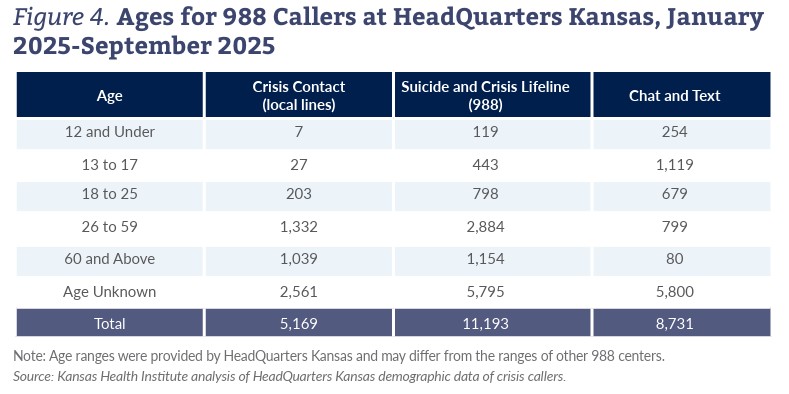
photo by: Screenshot from 988 Coordinating Council report
The ages of HeadQuarters Kansas callers from Jan. 2025 – Sept. 2025.
Bridges added that the county has a growing network of crisis response options and often prioritizes care-first interventions.
“We can counsel as best we can, but we know we have a mobile response team through (the) Bert Nash (Community Mental Health Center),” Bridges said. “We know we have these least invasive options to get someone to safety or to a safer place rather than immediately jumping to police … We have a Treatment & Recovery Center … Douglas County is ahead of many counties nationwide.”
Other News
HeadQuarters Kansas has fully transitioned to 988, improving funding while keeping local response

Lawrence High School to host its annual formal wear drive to make prom accessible for students
Haskell Foundation announces creation of fellowship program that aims to advance clean energy development for tribal communities

Iranians in Lawrence area express relief, joy at ayatollah’s demise, hope intervention leads to democracy
‘Every kid can bring something to the table’ for Eudora’s Scholars Bowl team, which just won its 3rd straight state title