A ‘blood moon’ will arrive just before dawn in Lawrence, but clouds are expected to get in the way of viewers
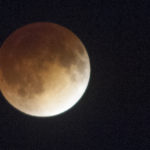
photo by: Richard Gwin
A "blood moon" glows at 2:15 a.m. in the southern sky over Lawrence in April 2014.
Early risers in Lawrence may have the chance to see a total lunar eclipse on Tuesday morning, although cloudy skies are expected to obscure the view.
Also known as a “blood moon,” the eclipse is expected to make the Moon appear a dark reddish-orange around 5:33 a.m. in Kansas, with totality lasting from roughly 5:04 a.m. to 6:03 a.m.
The event will be happening during a difficult time though, as clouds may block the chance for Kansans to see the eclipse. In Lawrence, there is around a 50% chance of rain from when the eclipse will take place along with areas of fog in the morning.
“It’s not looking great for viewing the lunar eclipse,” Nathan Griesemer, a meteorologist with the National Weather Service Office in Topeka, said. “We’re probably going to have just a whole deck of clouds over us, so you’re probably not going to be able to see the sky, which is kind of the unfortunate part.”
While solar eclipses are not safe to view with your eyes, lunar eclipses are and don’t require any safety equipment like filters or glasses. During a lunar eclipse, the Earth’s atmosphere bends red sunlight towards the Moon while scattering away blue light, which causes the red color. The lunar eclipse only occurs when there’s a full Moon, and its tilted orbit aligns perfectly with Earth’s shadow.
“(O)ur planet blocks most of the Sun’s light from reaching the Moon, and the light that does reach the lunar surface is filtered through a thick slide of Earth’s atmosphere,” according to the National Aeronautics and Space Administration. “It’s as if all of the world’s sunrises and sunsets are projected onto the Moon.”
Here is a full timeline of the lunar eclipse, according to NASA:
• 2:44 a.m. – The Moon will enter the Earth’s penumbra, which is known as the outer part of the shadow. The Moon will also begin to dim.
• 3:50 a.m. – The Moon starts to enter Earth’s umbra – where the Sun is completely blocked – and a partial eclipse begins. As the Moon moves into the umbra, it will appear as if a bite is being taken out of the lunar disk. The part of the Moon inside the umbra will look very dark.
• 5:04 a.m. – The entire Moon is in the Earth’s umbra. The Moon appears in the reddish-orange color. NASA encourages people to use binoculars or a telescope for a better view. If people are taking a photo, they are encouraged to use a camera on a tripod with exposures of at least several seconds.
• 6:03 a.m. – The Moon starts to exit the Earth’s umbra, and the red color will fade. Now, it will appear as if a bite is being taken out of the opposite side of the lunar disk from before.
• 7:17 a.m. – The Moon is in Earth’s penumbra again, and the Moon is slightly dimmed.
• 8:23 a.m. – The lunar eclipse ends.
The next total lunar eclipse will not be viewable from North America until December 2028, according to timeanddate.com.
Other News
A ‘blood moon’ will arrive just before dawn in Lawrence, but clouds are expected to get in the way of viewers

Annual Kansas Craft Brewers Expo featuring 38 state breweries to be held this weekend

Former police officer on the front lines of Jan. 6 tells large Lawrence crowd to protest, make noise and film it all
New Choice Campus at Centennial to offer personalized, flexible path for Lawrence high schoolers

A Lawrence dance company performance to serve as item drive to support domestic violence center