

For Theatre Lawrence’s ‘The Mountaintop,’ actor had to find a vulnerable, human way to play MLK
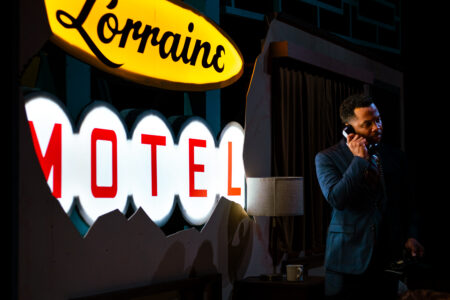
photo by: James Diemer/Theatre Lawrence
Tyson Williams rehearses a scene from "The Mountaintop" at Theatre Lawrence. The show opens Jan. 30, 2026.
Actor Tyson Williams has spent a lot of time looking for Martin Luther King Jr.
He’ll be playing the civil rights leader on stage next week, and he’s searched for him in articles, in recordings, in the motel in Memphis where King was assassinated.
In his imagination, the one place he finds King over and over is in the audience.
He asks himself: If King were there for Theatre Lawrence’s production of “The Mountaintop,” what would he want to see?
“I don’t think he would be in the audience to see himself,” Williams said. “That wasn’t the man that he was.”
Or, at least, not the image of himself that everyone knows from the speeches and the photos. “The Mountaintop,” which opens Friday, Jan. 30, at Theatre Lawrence, is a two-person play in which a vulnerable King has a conversation in his room at the Lorraine Motel with a maid the night before he dies, talking about his work and the future of the movement that he won’t be there to see.
Director Darren Canady said the playwright, Katori Hall, wanted to challenge the legendary images that come to mind when we think of King.
“Katori’s goal was for us to not see sort of the images, sort of the black-and-white images of the March on Washington and even the film that was taken of the ‘Mountaintop’ speech” – the speech the play was named after – “but to really think about King as a person, as a man.”
Canady has some experience with thinking about King in this way. He is a playwright himself, and he helped create a podcast called “Day of Days” about a conversation between King and fellow activist Howard Thurman in a hospital room in 1958, after an attacker stabbed King with a letter opener.
“We don’t know what Howard and Martin said in that hospital after the stabbing,” Canady said. “And we don’t know for sure what might have occurred that night before Dr. King’s assassination.”
But in both cases, we do have some clues to what King was thinking.
One of them is the “Mountaintop” speech, given at the Black church known as Mason Temple in Memphis, Tennessee. It’s the final speech King ever gave, taking place on April 3, 1968, the day before his death.
And one of the first things Canady did was have the actors listen to it in its entirety.
‘You can feel the work’
After listening to the speech, Canady said, Williams easily picked up on something about King.
“Tyson said, ‘He just sounds so tired,'” Canady recalled.
King wasn’t just tired, Williams said; he was fearful, anxious and stressed. “He was very well aware” that there were threats on his life, Williams said – on the way into Memphis, King’s plane had to be swept for bombs.
“Because of all of the threats, he became a very anxious person,” Williams said. “… His belief and conviction to make a difference, tied with the threats that he was getting, really had an impact on his mental health.”
You can feel the psychological burden King is carrying in the recording of the “Mountaintop” speech, Canady said – “you can feel the fatigue. You can feel the work. You can feel the care-wornness.”
For an actor, it can be a challenge to portray a historical figure’s inner state in that way. Williams noted that it is “very hard to really dive deep into a person’s personal life that was 60 years ago.”
“I’ve had to research other people that were close to him and kind of get their accounts,” Williams said. A particularly important source of these accounts, he said, was Ralph Abernathy, a fellow civil rights leader who was one of King’s closest friends.
But even when you can’t get accounts from the important people in the story, you can go to the important places. And that’s what Williams and co-star Himee Kamatuka did. They asked Theatre Lawrence to send them to Memphis.
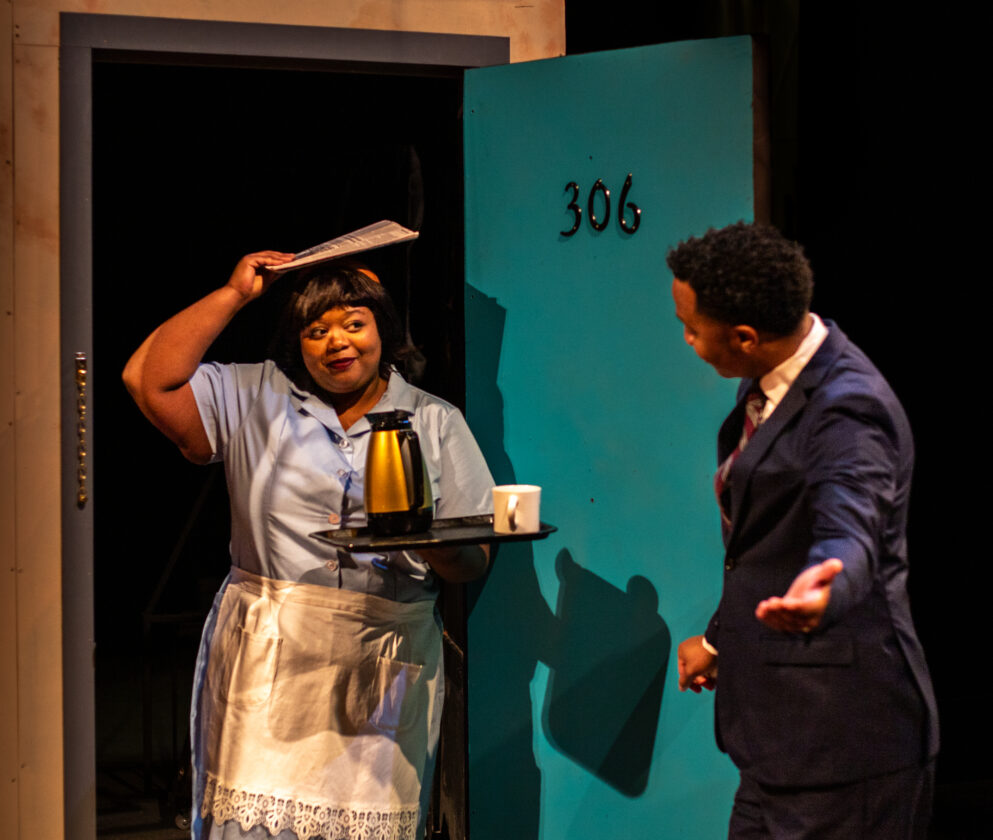
photo by: James Diemer/Theatre Lawrence
Tyson Williams and Himee Kamatuka rehearse a scene from “The Mountaintop” at Theatre Lawrence. The show opens Jan. 30, 2026.
On location
The ensuing trip “really catapulted our research,” Williams said. “… We went to all of the significant places there, and not just the touristy places.”
King came to Memphis because of the ongoing sanitation workers strike there, in which thousands of Black workers were taking part. The strike’s epicenter was the Black church known as Clayborn Temple. Just two days before King’s death, a funeral was held there for Larry Payne, a Black teenager who was killed by police during the demonstrations.
Clayborn Temple was one of the sites the actors visited on their trip. And they also went to the Lorraine Motel, which Williams said was “unbelievable.”
When he first saw it, he said, there was a particular kind of disbelief. The motel “kind of sits down” below the surrounding area, he said, and it looked like a very risky place for someone in fear for his life to stay.
The Lorraine Motel had a pool, a place to play billiards, home-cooked meals, and it was owned by a Black couple, Williams learned. But, Canady said that even though it was a nice motel and one of the few places in Memphis that Black visitors could stay, “it’s a motel, nevertheless. So, not a very large room, and the set reflects that.”
Might King have been wrestling with guilt in this small motel room?
Canady says one thing the play “does very eloquently is think about the guilt that Dr. King may likely have carried.” He may have felt it for Larry Payne, or he may have felt it more generally “for asking people to put their lives on the line,” Canady said.
The character that Kamatuka plays, Camae, is a maid at the motel who’s come to deliver King’s room service. During her conversation with King, Canady said, “She’s challenging him to sit in that guilt and to really reckon with the portions of the movement that aren’t as successful, that are frustrating. And she’s calling these things out in really powerful ways.”
The play shows King’s rage and frustration, Canady said, and has moments that show other facets of King as a man and not a legend. Mention is made of his “smelly marching feet,” for instance – “because he’s been traveling,” Canady said.
“What Katori is getting at,” Canady said, “is the very real human inside the icon.”
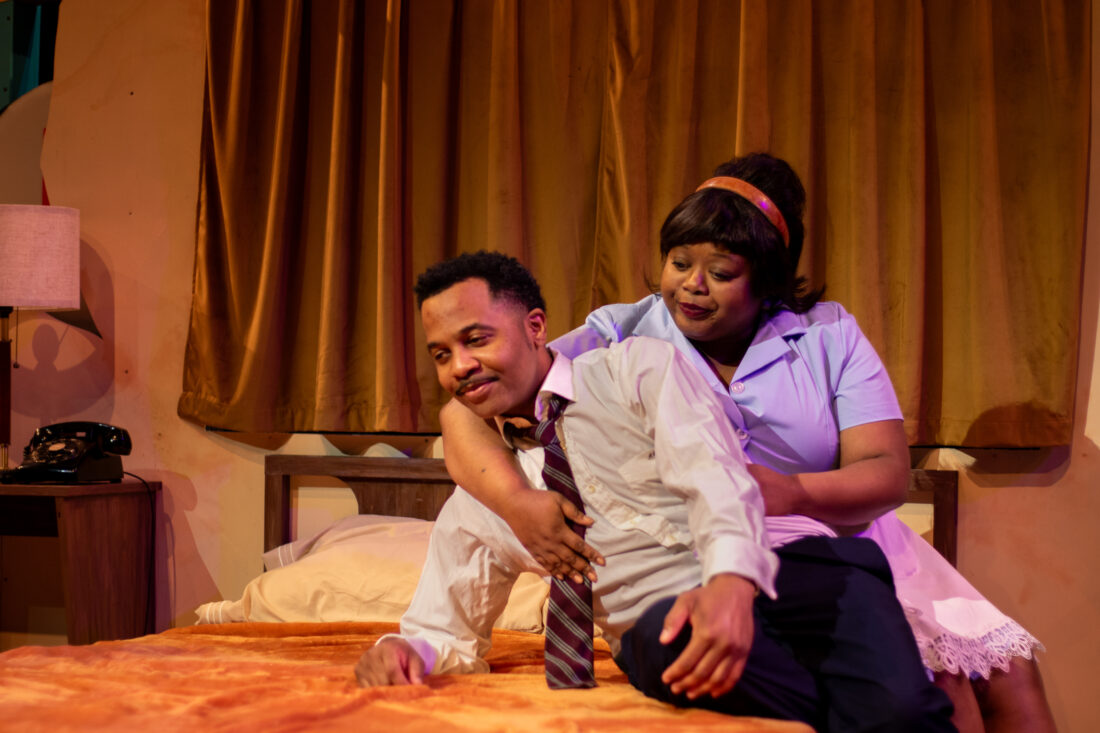
photo by: James Diemer/Theatre Lawrence
Tyson Williams and Himee Kamatuka rehearse a scene from “The Mountaintop” at Theatre Lawrence. The show opens Jan. 30, 2026.
Passing the baton
That human may have been exhausted on the evening of April 3, 1968. Williams said that at this point, King was “not always in a mood where he wanted to be around people.”
But when King needed to, he could still be a powerful orator and leader, and in the “Mountaintop” speech, he did that without a script. Williams said he was surprised to learn that the famous speech, given before thousands of people, wasn’t written down in advance.
“He kind of just walks in, takes the podium and gives this entire speech off the cuff,” Williams said.
Did King have a sense that any speech he gave might be his last?
“He could have never predicted,” Williams began, then quickly amended it: “Well, he might have predicted. But who would have ever known that that would have been the last time that we heard him?”
King reflects on some of these things in the play, and on what will happen to the movement when he’s gone. One image invoked is that of passing a baton, and Canady said that image is “apt.”
“We understand the baton as part of a relay,” Canady said. “And a leg that’s not the anchor leg. None of us are running the anchor leg. We’re taking the baton from someone else and we’re going to be passing it on.
“And I do think that the play, in a really beautiful and theatrical way … really does ask the audience to think about, where do you stand in that relay, that relay for justice, that relay for righteousness – that King was called into and was also called into passing the baton,” he said.
Williams has spent time thinking about how people should pass that baton, too. Most Americans could probably recite some of King’s famous phrases by heart, he said – at the very least, they know “I have a dream.”
“But those aren’t just words,” he said. King wanted his words to spur people to action.
So what would King want to know, sitting out there in the dark auditorium at Theatre Lawrence next week? Williams thinks he knows.
“Have my words been heard?” Williams said. “And are they marching forward?”
“The Mountaintop” opens Jan. 30 and has performances scheduled through Feb. 8 at Theatre Lawrence, 4660 Bauer Farm Drive. For ticket information, go to theatrelawrence.com.
Arts and Entertainment

Events: St. Pat’s celebrations, Eagle Day, theater, dance, music and more

Theatre Lawrence’s production of ‘The Cottage’ is a little bit Noel Coward, a little bit John Cleese

KU’s University Theatre will open spring season with ‘Corners Grove’

City leaders discuss how to strengthen existing public art funding program and make it more flexible

Annual Kansas Craft Brewers Expo featuring 38 state breweries to be held this weekend
Viola Davis receives prestigious Chairman’s prize at NAACP Image Awards
LOS ANGELES (AP) — Viola Davis delivered a powerful speech about self-worth, resilience and collective progress ...