2 Lawrence residents file suit over Kansas law that restricts bathroom use and invalidates driver’s licenses
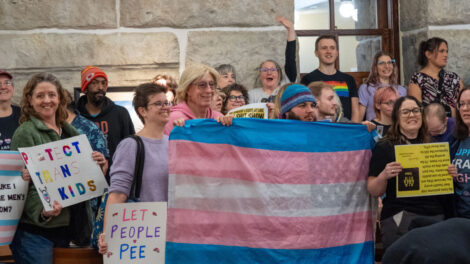
photo by: Sherman Smith/Kansas Reflector
A group of trans activists pose for pictures on Feb. 6, 2026, at the Statehouse in Topeka. They rallied in opposition to Senate Bill 244, which restricts bathroom use and bans changes to gender markers on driver’s licenses and birth certificates.
LAWRENCE — Two transgender men from Lawrence are suing the state over a new law that invalidates driver’s licenses and restricts bathroom use based on sex assigned at birth, citing numerous constitutional rights and fear of violence.
The American Civil Liberties Union and Philadelphia-based Ballard Spahr law firm filed the lawsuit on the men’s behalf late Thursday in Douglas County District Court. The lawsuit also asks the court to block the law from taking effect while the case is being argued.
They argue that House Substitute for Senate Bill 244, which took effect Thursday, violates constitutional rights to personal autonomy, privacy, equity, due process and freedom of expression.
“By invalidating Plaintiffs’ licenses and barring them from restrooms that align with their gender identity, SB 244 demeans their personhood, obstructs their ability to participate equally in public life, and exposes them to heightened risks of harassment and violence by forcibly outing them as transgender,” attorneys argued in their request for a temporary injunction.
The law also violates a provision of the Kansas Constitution that requires statutes to have only one subject, they wrote. The first part of the law deals with government documents while the second part deals with private spaces in public buildings.
The Legislature adopted the law through a series of procedural moves that were designed to minimize public input and opposition: A rushed hearing on a bill to regulate gender markers on driver’s licenses and birth certificates, an unscheduled move to add a provision that unleashes vigilante policing of bathrooms, the shuffling of legislation from a House to Senate bill, an immediate vote in both chambers, and silenced debate when overriding the governor’s veto in the House.
“The Act targets transgender Kansans across multiple, unrelated domains of their lives,” the lawsuit says. “This sweeping law restricts transgender individuals from obtaining driver’s licenses reflecting their gender identity and bans transgender people from accessing restrooms or other single-sex spaces in a range of public places including libraries, courthouses, state parks, hospitals, and interstate rest stops.”
The bathroom restrictions apply to buildings owned or leased from the government, even if they are controlled by private entities, the lawsuit says.
The plaintiffs are two transgender men from Lawrence, identified by the pseudonyms Daniel Doe and Matthew Moe, who were both assigned female sex at birth. They both have birth certificates from another state, legally changed their names in 2020, and work in government-owned buildings where they consistently use the men’s bathroom.
By continuing to use the bathrooms they have used for years without incident, they argue, they would be breaking the law. They could be fined or charged with a crime, and they can be sued by anyone who claims to be “aggrieved” by their presence in the bathroom. If they begin to use the bathrooms associated with the sex they were assigned at birth, they will be forcibly outed as transgender, subjecting them to harassment and possible violence.
And, the lawsuit says, they may still be sued by “aggrieved” individuals who assume they are in the wrong bathroom because they both appear to be men.
In a sworn statement attached to the lawsuit, Daniel said he was raised in southern California in “an extremely religious family” and knew from a young age that he was transgender. He said he moved to Kansas to attend college in 2014, found “my true self” and gained access to gender-affirming medical care. Only his family and close friends know he is trans.
“That is one of the reasons I am proceeding under a pseudonym in this case,” he said. “I do not want to publicly reveal that I am transgender. I want to protect my privacy, and to protect myself from harassment, violence, and discrimination, as well as retaliation for trying to protect my rights. I am also worried about backlash against my fiance, family, and employer if people learn I am transgender.”
Matthew said in a sworn statement that he has lived openly as a man since starting college in 2019. He said he has been harassed in bathrooms before and that being outed as transgender would be alienating, isolating and dangerous.
“I want to protect my privacy, and to protect myself from harassment, violence, and discrimination, as well as retaliation for trying to protect my rights,” he said. “I am also worried about backlash against those close to me if people learn I am transgender.”
The lawsuit, supported by documentation from medical professionals, explains that a person’s gender identity “is their deeply felt, internal sense of belonging to a particular gender.”
Everyone has a gender identity. Cisgender people have a gender that aligns with their sex assigned at birth. Neither cisgender nor transgender people can change their identities as if they were flipping a switch.
The incongruence between gender identity and sex assigned at birth can cause stress known as “gender dysphoria.”
“Being transgender is not in and of itself a medical condition to be cured,” the lawsuit says. “But untreated gender dysphoria can result in significant lifelong distress, clinically significant anxiety and depression, self-harming behaviors, substance misuse, and suicidality.”
The ability to change a gender marker has significant social, legal, and safety implications for transgender people, the lawsuit says.
“Transgender people experience incredibly high levels of discrimination and violence,” the lawsuit said. “But being able to live in society in accordance with their gender identity is a critical determinant of health and well-being for transgender people. Policies that require transgender people to use restrooms and hold identity documents consistent with their sex assigned at birth contribute to worsened mental health, in part because of harassment or ridicule, denial of service or access to facilities, or violence.”
There is no evidence that restricting bathroom usage promotes public safety.
Attorneys argue the new law is the latest attempt by the Legislature to leverage “the state’s power to attack transgender Kansans.”
They said laws passed in recent years “excluded transgender students from full participation in school, deprived transgender adolescents of health care, and targeted transgender individuals in jails, among other indignities.”
“Now, over the Governor’s veto, the Legislature has passed Senate Bill 244, yet another law that singles out transgender people for discriminatory and dehumanizing treatment,” they wrote. “This latest attack on transgender people’s right to exist in civil society poses an imminent threat of irreparable harm to Plaintiffs.”
State Government
2 Lawrence residents file suit over Kansas law that restricts bathroom use and invalidates driver’s licenses

Trans Kansans struggle with ‘cruelty’ as driver’s licenses, birth certificates are invalidated

KU leaders reject pay proposal from faculty union; administration says it will seek an impasse in negotiations if deal not reached in 7 days

KU research dollars set a new record in 2025; university conducted more than $600M in research activities
Kansas House dramatically amends bill aimed at constraining local property tax increases