With its ‘friendly farmers with friendly wine,’ the Kaw Valley could soon be an official viticultural region
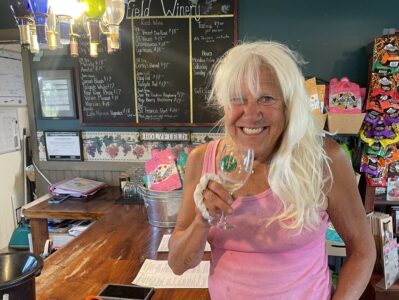
photo by: Sylas May/Journal-World
Michelle Meyer of Holy-Field Vineyard and Winery sips a Valvin Muscat wine on Friday, Aug. 28, 2026.
Meet Valvin Muscat – sweet, flowery, “insane,” a bit of a heartbreaker, “kind of a pain in the kazoo,” if you ask Michelle Meyer.
“But boy, do they taste good,” she says after she cuts a cluster of the golden-green grapes off the vine at Holy-Field Vineyard and Winery in Basehor and pops one in her mouth. “They make incredible wine.”
Even if you’ve tasted a lot of wine, you might not have met Valvin Muscat before. It’s not like the grapes in California wines, Meyer says – nothing she grows is.
“We’re not growing Cab Sauv and Merlot and Chardonnay here,” she says. “… We’re growing French hybrids, and, to tell you the truth, this grape isn’t even that commonly grown in the Midwest.”
The Kansas River valley, like anywhere else that makes wine, has its own grapes, its own soil and water characteristics, its own climate. Unlike California’s Napa Valley, though, it doesn’t have an official designation as a wine region that it can advertise on its bottles.
But in a few weeks, that might change.
After years of research, networking, even political organizing, the Kaw River Valley is now one step away from earning federal recognition as an American Viticultural Area, or AVA. It’s a designation that area farmers, including a group called the Kansas Viticulture and Farm Winery Association or KVFWA, have been seeking since at least 2016.
An AVA is not just a marketing gimmick – it’s tightly regulated by a federal agency, the Alcohol and Tobacco Tax and Trade Bureau, or TTB, and establishing one is a process that can take years. And the Kaw Valley AVA would be the first such designation in the state of Kansas.
To get here in a state where wineries weren’t even allowed to operate until the 1980s took some big changes in the Legislature; intensive studies of terroir, or the characteristics of local geography that shape how a wine tastes; and years of waiting with no word at all from the officials in D.C.
Scott Kohl, a winemaker who taught in Highland Community College’s viticulture program before it was shut down last year, was one of the many farmers, scientists and advocates involved in getting the process to this point.
He said that an AVA is not just wine-industry inside baseball. If it’s approved, it will help the entire region market itself as a tourist destination. It will get more attention to the unique styles of wine and the specific grapes that are grown here.
And it’s something that the whole agricultural economy can benefit from.
“It’s not just about grapes and wine,” Kohl said. “It’s about fruits, it’s about farming, it’s about tourism, and it’s a bigger thing than just grapes.”
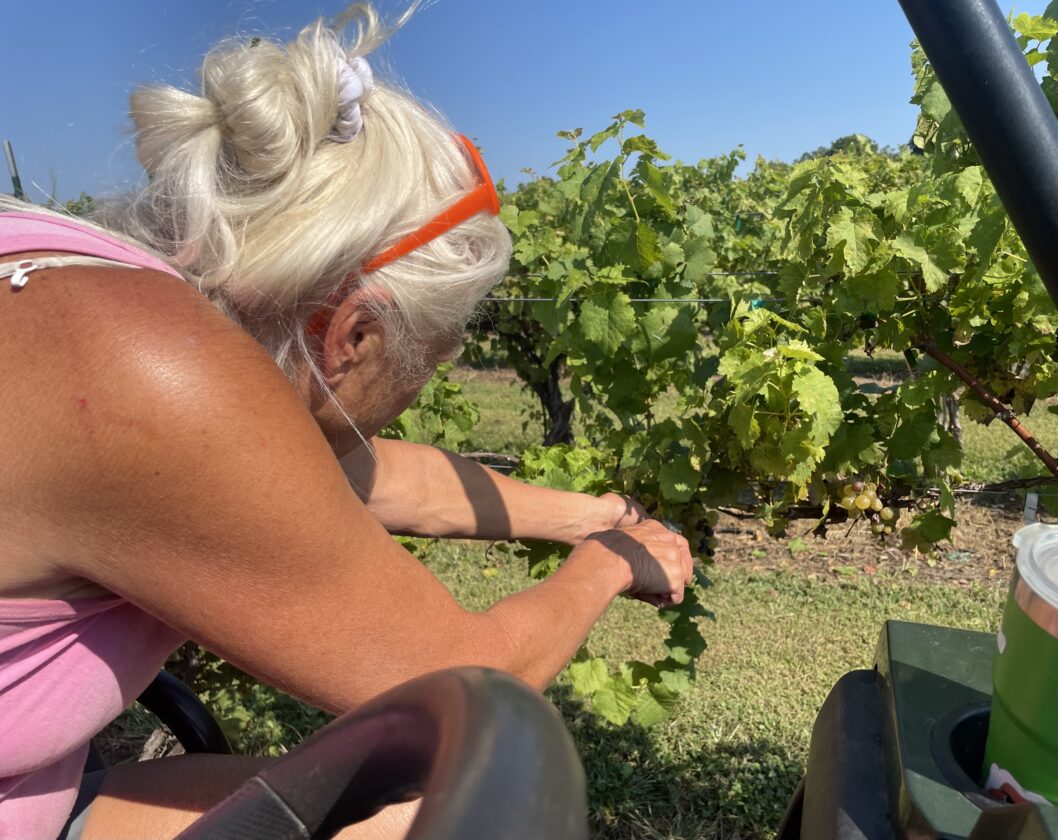
photo by: Sylas May/Journal-World
Michelle Meyer of Holy-Field Vineyard and Winery cuts off some Valvin Muscat grapes on Friday, Aug. 28, 2026.
Why not Kansas?
When winemakers Bryan and Gina Zesiger first got into the industry, a question occurred to them: Why is Missouri thought of as wine country, but Kansas isn’t?
The Zesigers, founders of Z&M Twisted Vines, said they would always see TV commercials about Hermann, Missouri, a town of roughly 2,000 people halfway between Columbia and St. Louis. “That’s kind of where it started for Bryan and I,” Gina said. “Why are we, when we see a commercial even on, like, Kansas City news, and it’s sending people to Hermann, Missouri?”
“We were newbies in the industry,” she said, “so we’d come on pretty strong, with passion and just who we are as people. And I was like, ‘Listen, we don’t need to send people to Hermann! We’ve got some stuff going on here in Kansas.'”
The answer to why Hermann was getting so much attention was that Hermann was an AVA.
In fact, Hermann is one of five AVAs in the state of Missouri. There’s an AVA northwest of Kansas City called the Loess Hills District, two in the Ozarks, and one in the eastern Missouri town of Augusta that was actually the first AVA in the entire country.
Having an AVA is about more than just some extra words on your wine’s label, the Zesigers said. Bryan cited the classic example of an AVA: the Napa Valley region of California. California has the most AVAs of any state in the country – according to the TTB, 154 of the 280 AVAs in the U.S. are located there – and the branding of regions like Napa and Sonoma County is associated with wine worldwide.
“The financial impact of Napa and Sonoma, and there’s several there in California, the economic driver on that is enormous,” Bryan said.
That brand can bring in tourists who patronize other agritourism businesses, not just wineries. And in some cases, Kohl said, it can drive the economy of a whole region.
“You’ve heard of Napa Valley; they’ve got a lot of grapes and wine, but that maybe was the hook or the anchor that started out the tourism that happens there now,” he said. “Same with the Finger Lakes up in New York; of course, there’s a lot of grapes, but there’s other fruit and there’s other things happening there, and it’s a tourism hub. Hill Country in Texas is an AVA.”
And the Zesigers thought they were in a position to help make an AVA happen. For years, Gina was president of the KVFWA, and on a trip to Washington, D.C., she spoke with federal agriculture officials and learned more about what the process involved.
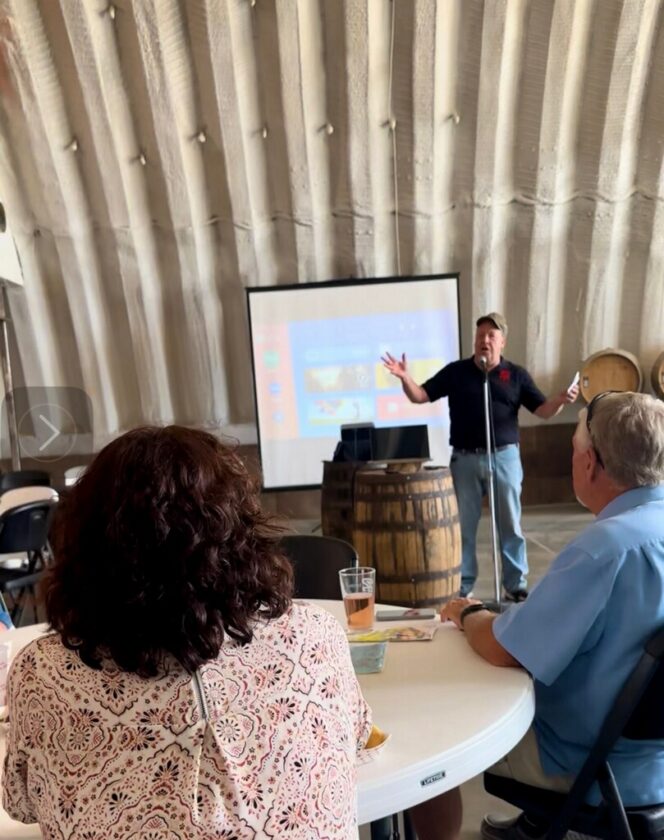
photo by: Courtesy of Z&M Twisted Vines
Tom Holland speaks at a 2024 summit on viticulture organized by Z&M Twisted Vines.
A lengthy process
Applying for an AVA is quite an involved process. Kohl said that other Kansas communities had learned that lesson pretty quickly.
He heard about an effort in the early 2000s in Salina, when some people were exploring whether an AVA would work in the Smoky Hill River Valley. This was before you could send your application to the feds electronically, he said, so they would have had to mail their application in.
“When you go to get a box of papers for, like, copier paper,” Kohl said, “it’s, you know, like a big, giant brick of paper. They expected a whole box of that to be the petition. I couldn’t imagine creating that much paperwork to do it.”
Apparently, neither could the Smoky Hill folks. They never mailed anything in at all.
“The task was too tall of an order, and the folks that were considering it, they didn’t have the resources to put all that together,” Kohl said. “They talked about it, said, ‘Yeah, that’d be cool,’ and that’s about it.”
So, from the beginning, the champions of the Kaw Valley AVA knew they would need help. And they found some allies in state government who could get things moving.
Tom Holland was a state senator from the Baldwin City area at the time, and has his own winery in the Kaw Valley region, Haven Pointe. He said he knew that some Kansas wineries had tried to set up AVAs on their own, but they “never really got anything accomplished with the federal government, the TTB specifically.”
So, he approached Mike Beam, who was Kansas’ agriculture secretary, and asked him, “Help us figure out how to skin the cat.”
“That got the ball rolling,” Holland said.
The AVFWA brought in Kohl at this point and asked him to write a state grant to pay for someone to do the petition to the TTB. It was a “specialty crop block grant,” he said, and it allowed them to hire a specialist in AVAs: geologist Kevin Pogue of Walla Walla, Washington, who is one of the world’s leading experts in terroir.
Pogue had written petitions for AVAs around the country, and he set to work doing the same thing in Kansas.
“He started digging through all these different things that have to do with the geography of Kansas and the climate in Kansas,” Kohl said. What he was trying to do was “find a region of Kansas that’s different from all the area around it.”
The Kansas River’s watershed, Pogue found, overlaps with part of the state that was once covered in glaciers. When the glaciers were in Kansas, they deposited minerals. When they melted and the river cut valleys into the landscape, those minerals stayed in the soil, and according to the TTB’s site, they changed the chemical makeup of it in a way that “can affect grapevine physiology and the chemistry of the wines produced from those grapes.”
“The topsoil consists of a lot of that glacial till, and in his opinion, that made this area unique from all the area around us,” Kohl said.
The application took all kinds of data into account, said Margit Kaltenekker, an agriculture agent with K-State Research and Extension. “It involved the mapping of the geology, soil morphology, and climate, and layering all these maps into their whole kind of data analysis,” she said, and the boundaries were drawn based on all of this soil, climate and water data.
“It really is amazing the way they can kind of figure this out,” Kaltenekker said.
The end result is a map that covers 5,493 square miles across 15 counties: Atchison, Brown, Douglas, Jackson, Jefferson, Johnson, Leavenworth, Marshall, Nemaha, Pottawatomi, Riley, Shawnee, Wabaunsee, Washington and Wyandotte. The TTB’s site says there are 33 wineries in that area, but Gina Zesiger said that more had certainly opened since the study concluded.
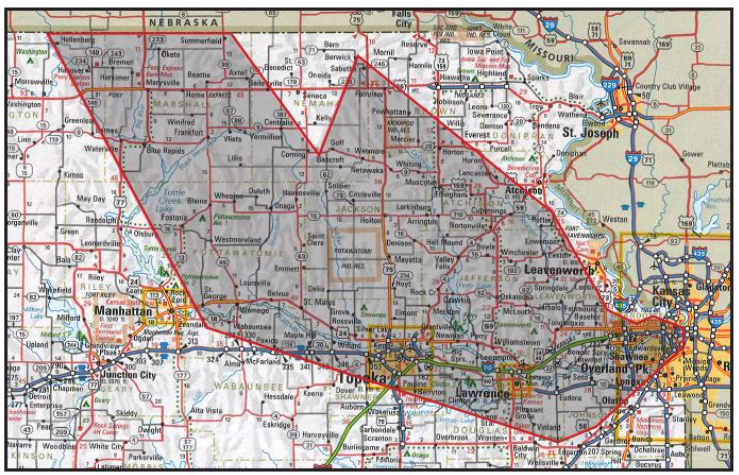
photo by: Contributed Image
A map of the proposed Kaw Valley American Viticultural Area.
Pogue submitted the petition to the feds in November 2022. Kohl said that “they sent it back and forth three or four times making sure that every little detail, all the i’s are dotted and the T’s are crossed, and whatever hoops the TTB wants to happen, happen.”
“And then we got put in the waiting list,” he said.
And there they stayed for years.
“Between the end of COVID and strange things happening in Washington, D.C., there was just kind of a pause in AVAs being approved by the feds,” Kohl said. “Between 2023 and 2025, there were very few; I’m thinking less than five AVAs were approved during those years.”
The preparations still went on, though. The Zesigers put together a summit in 2024 to network with other specialty crop growers in the region and build support for the AVA idea.
“We invited legislators, we invited news and media, we had the colleges there, we had grape growers and winemakers there,” Gina said. The message was: “We want you to know what might be coming so everybody can start making their plans.”
Then, earlier this year, as the Journal-World reported, a Kaw Valley AVA “passport” program was announced, with special coupons for participating wineries in the region.
And, finally, about a week ago, the wait was over.
The Kaw Valley AVA was up on the TTB’s site for public comments. (You can share yours at federalregister.gov/documents/2026/08/14/2026-16668/proposed-establishment-of-the-kaw-valley-viticultural-area.) Once the commenting window closes in October, “TTB does what they do, and they either say yes or no,” Kohl said.
“And we’re hoping they say yes.”
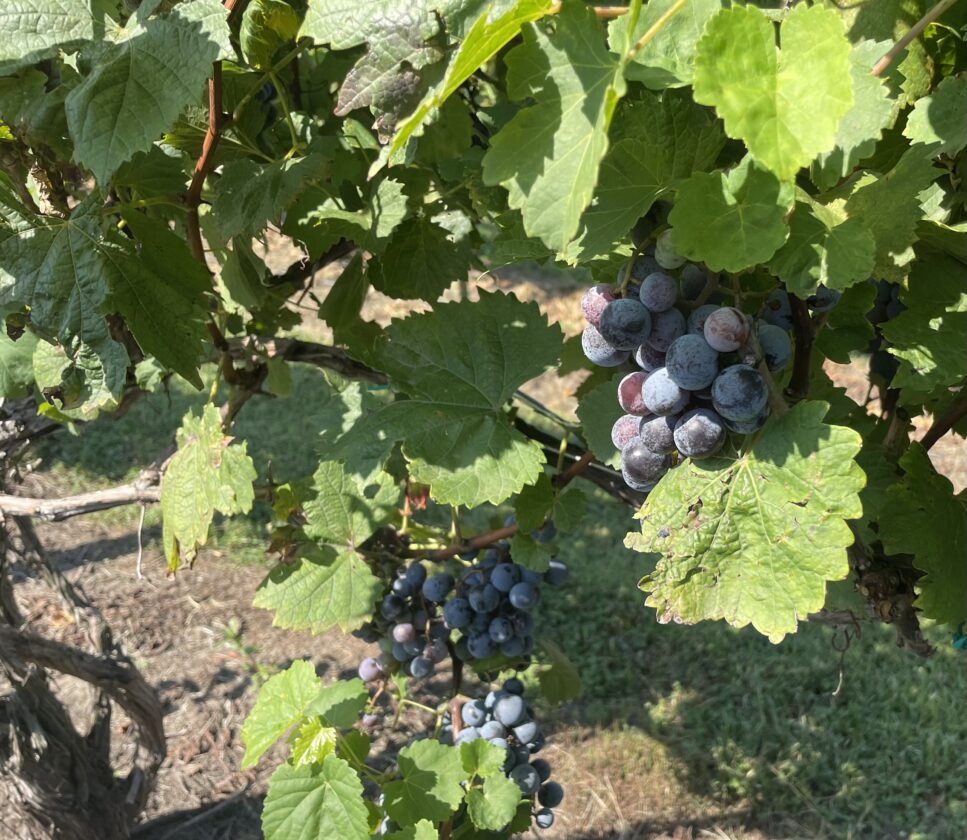
photo by: Sylas May/Journal-World
Grapes hang from the vine at Holy-Field Vineyard and Winery on Friday, Aug. 28, 2026.
‘The good ol’ days’
If it is approved, which the Zesigers said was highly likely, the Kaw Valley AVA will restore some of Kansas’ cachet as a place for wine.
“We would love to get back to the good ol’ days,” Gina said.
The good ol’ days? Oh, right – many people don’t know that more than a century ago, Kansas was well known for its wine and grapes. “If you look back at the history,” Kaltenekker said, “Kansas originally was one of the largest grape-growing regions of the country before Prohibition, which is hard to believe.”
When German immigrants came to the Midwest, they brought their winemaking traditions with them. That’s certainly the case in Hermann, which is part of the “Missouri Rhineland” – a reference to the region of west-central Germany known for Rieslings and other white wines. And many of those Germans settled in Kansas, too.
But, when Prohibition was enacted, it disrupted these wine traditions, and especially so in Kansas. Kansas became a dry state in the 1880s, decades before the 18th Amendment banned alcoholic beverages nationwide, and it didn’t vote to allow any alcohol stronger than 3.2% ABV until the late 1940s.
Even after that, Kansas farmers still weren’t allowed to turn their grapes into wine for commercial purposes. It was just over 40 years ago, in 1985, that the state Legislature passed the Farm Winery Act, which finally permitted farmers to make wines with the grapes they grew.
“So, getting back into the industry, so to speak, took quite a bit of time,” Meyer said.
Meyer and her father, Les, started their vineyard in 1986, and opened the winery a few years later. Holy-Field was the fifth farm winery to be approved in the state, and it’s the oldest one still operating today.
Winemaking in Kansas looks different from winemaking in more famous regions, though, and it starts with the grape varieties used.
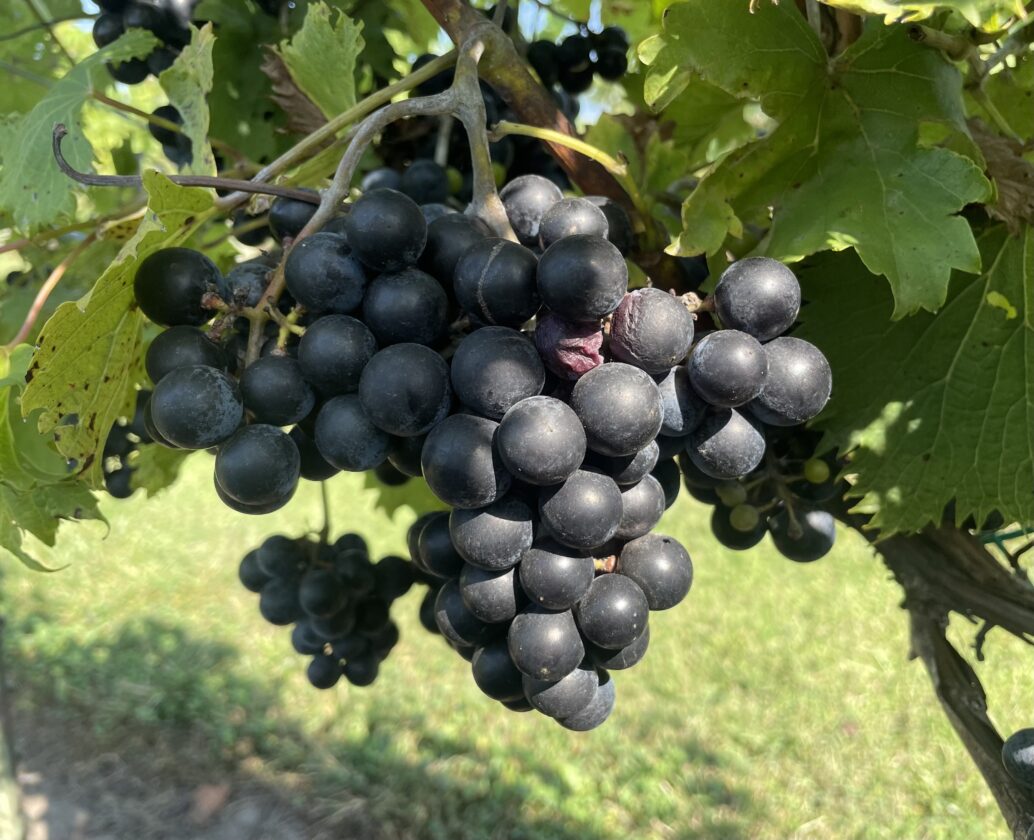
photo by: Sylas May/Journal-World
One of Kansas’ two state grapes, Chambourcin, is pictured at Holy-Field Vineyard and Winery on Friday, Aug. 28, 2026.
At Holy-Field, Meyer has the floral Valvin Muscat, but also rows and rows of Kansas’ official state grapes. That’s right, Kansas has not one, but two state grapes – a red called Chambourcin and a white called Vignoles. It was Holland who proposed that the Legislature designate them, Meyer said.
Both of these grapes are “French hybrids” – crosses between European varieties and native North American vines that are better suited for the Midwestern climate, Kohl said. The European vines, which are adapted to the mild Mediterranean weather, aren’t hardy enough for Kansas’ seasonal changes and temperature swings.
“A lot of those crosses are a cross of a cross of a cross of a cross, trying to create new wines that grow well in this region of the United States, in the Midwest, but they also taste good,” he said.
Through the industry’s evolution, the Legislature has had to step in several times, and not just to name some special grapes.
As the Journal-World reported, Holy-Field had to advocate for changes to the law to make and sell its Port-style wine, which is fortified with spirits. And the Zesigers worked to change a “systemic” problem they saw in state agritourism laws, where farms were being taxed and assessed as commercial operations.
“Other farm wineries, because we don’t have an AVA and they don’t understand Sonoma or Hermann, they look at it as, ‘well, that’s commercial,'” Bryan Zesiger said. “And they were labeling us commercial and taxing us and assessing us as commercial for our tasting rooms and our building.”
That legislation took a couple of tries, but Bryan said that, in his experience, lawmakers are pretty understanding and helpful when they realize that viticulture is just another kind of agriculture.
“What I found, and this goes as far back as the winemaking or the grape-growing, is Kansas is an agriculture state, through and through,” he said. “Once you understand that, the legislators were all on board. They are very protective of agriculture, and agriculture is changing.”
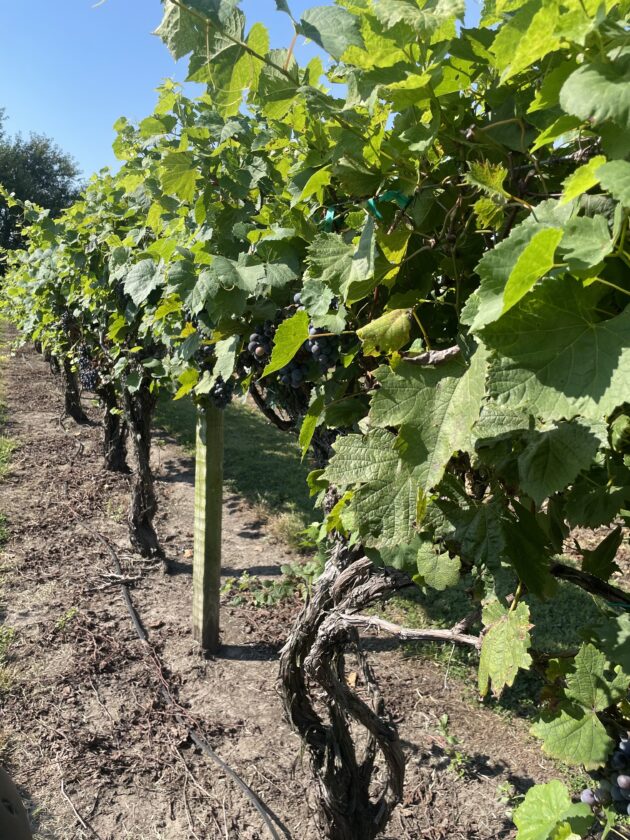
photo by: Sylas May/Journal-World
A row of grapevines is pictured at Holy-Field Vineyard and Winery on Friday, Aug. 28, 2026.
Groups, grapes and gripes
But the Kansas wine industry hasn’t been free of drama. For years, it was stained by some messy internal politics.
Kohl said that after the Farm Winery Act passed, the first vineyard owners who were getting ready to start wineries formed an association. He doesn’t remember when – it was before he got involved in the industry – but sometime in the late 1990s or early 2000s, that group fractured.
“There was a dispute by some of the members,” he said. “And the dispute was serious enough that some of the group decided to get out and start their own group. And that’s how we ended up with two groups.”
One of them is the KVFWA, the one that pushed for the AVA designation. The other is called the Kansas Grape Growers and Winemakers Association, or KGGWA. And Kohl said the dispute between them had to do with where the fruit in the wine must be grown.
At the time of the farm winery law’s passage, at least 60% of the fruit content of wine from a farm winery had to be from grapes grown in Kansas. Some winemakers wanted more stringent requirements; others wanted to be able to use grapes that were grown elsewhere. Kohl didn’t want to wade into that debate; “I want to be careful about who was for it and who was against it,” he told the Journal-World.
Other people are more confident in their idea of which side was which. Kaltenekker, who described the two groups’ past animosity as a “pissing match,” said it was the KGGWA that had wanted the looser restrictions.
“Those are the folks that want to be able to make wine from any grape juice around the world,” she said. “Well, OK, but it’s not a Kansas wine, and so let’s not call it that. But they have it in their name – Kansas Grape Growers.
“Well, are they, or aren’t they? I don’t know. That’s the whole argument that becomes the weird internal thing.”
There are different stories, too, about how the fruit question was settled.
Kohl remembers it was resolved at the U.S. Supreme Court – not in a case involving Kansas, but in 2005’s Granholm v. Heald, which was about state laws in Michigan and New York that allowed in-state winemakers to ship their products directly to consumers while preventing out-of-state winemakers from doing the same. The court ruled both laws were unconstitutional, and the New York law had defined what constituted a New York wine in part by fruit content.
Kohl said that in doing so, the court also nullified Kansas’ requirement.
“Creating an in-state fruit requirement to be able to say this wine is from Kansas, they decided that that is unconstitutional,” he said. “And requiring wineries to use in-state fruits is unconstitutional.”
Or, the resolution could have had to do with federal labeling regulations. The TTB has special rules for what’s called “appellation of origin”; basically, whether you can label your wine as being from a specific state or region. For a wine to be labeled with a state’s appellation, the rules state, “Not less than 75% of the volume of the wine” must come from grapes grown there.
In 2012, the Legislature was considering whether to amend the winery law. The bills being discussed would either drop or drastically lower the fruit content requirement for wineries’ products, but would require them to follow federal rules when labeling those products.
KGGWA, in its written testimony, supported this idea. It said winemakers needed the flexibility to buy grapes in emergency situations when their crops had failed, that the federal labeling requirements were sufficient, “and that the free market between wineries and their customers should control.”
Holy-Field’s Les Meyer, on the other side, argued that reducing the fruit requirement “benefits no one.” “Farm winery consumers expect it to be grown here, too; it is just plain deceptive to offer Kansas wine that wasn’t Kansas grown,” he wrote.
The conflict between different producers about how much Kansas fruit should be required was obvious to Doug Jorgensen, the state’s director of alcoholic beverage control at the time. He wrote to lawmakers, saying that the wineries were “split on the issue of requiring any percentage of Kansas products.”
“Previous attempts to amend this statute to address the Kansas product requirement have failed because the industry cannot or will not agree on a solution,” he wrote.
Today, however, that fight over Kansas fruit is a distant memory for the two groups, Kohl said.
“This happened maybe up to 30 years ago, and a lot of those winery owners and vineyard owners from back then have either retired, or they’ve died, or personally they’ve reconciled, or whatever,” he said. Now, KVFWA and KGGWA are in talks about reuniting, and he thinks that’s not far away.
“The majority of the membership of both groups wants to get back together,” he said.
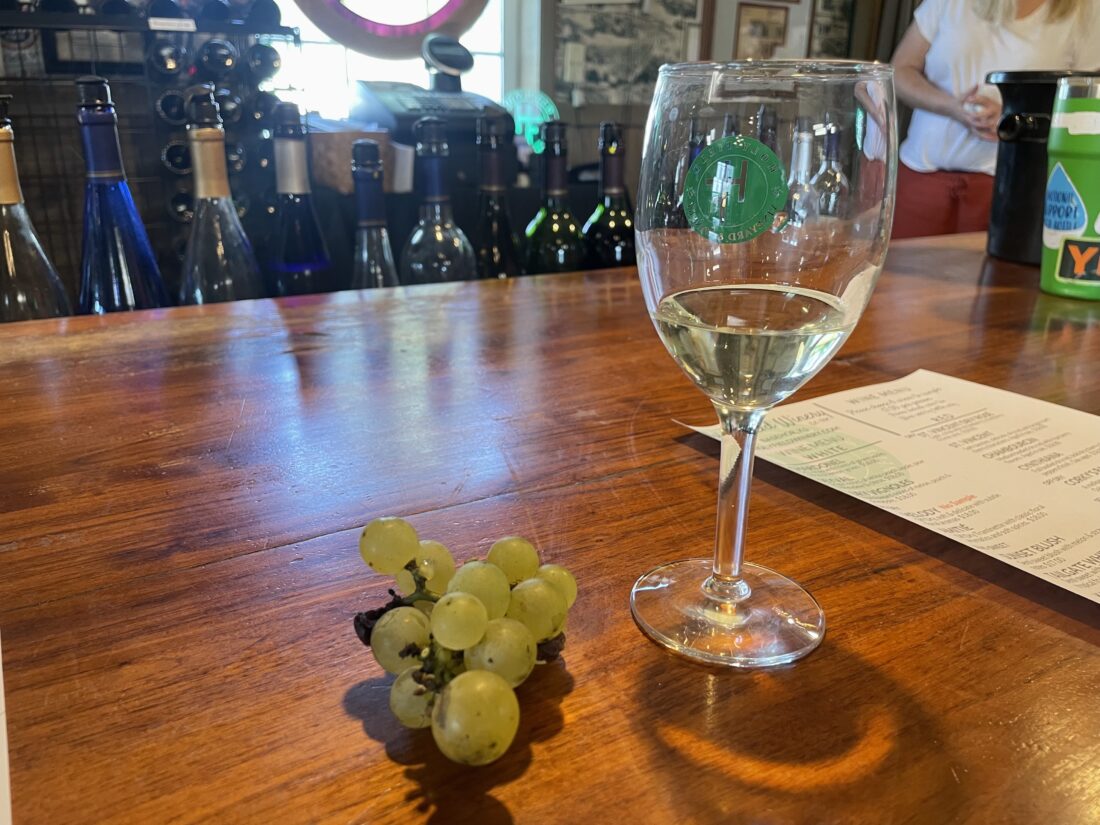
photo by: Sylas May/Journal-World
Valvin Muscat grapes and a wine made with them are pictured on Friday, Aug. 28, 2026, at Holy-Field Vineyard and Winery.
‘Just like it is’
If the Kaw Valley AVA is a success, it will be available for any farmer making wines with at least 85% Kaw Valley grapes to use. Kaltenekker, who has a background in organic certification and inspection, said that there would have to be some sort of verification procedure developed for those who want to put the designation on their labels.
“It’s got to be ready, in place,” she said. If the designation comes in October, “the new wine that’s being made this year, people could start slapping a label on it.”
“That’d be great, right?” Kaltenekker said. “But there’s got to be a process.”
The Zesigers, for their part, want to get that label on their products as soon as possible. “It’s a rush to the press,” Bryan said. “Can or will we have one of the first labels with the Kaw Valley AVA?”
But beyond that initial rush, the Zesigers said, it will be important for everyone in the industry to continue working together, and to work with other agricultural and tourism businesses, as well.
Tourism is really what keeps these wineries going, the winemakers said, not just sales in retail stores. And it’s something that they’re passionate about. They love to show people how it’s all made.
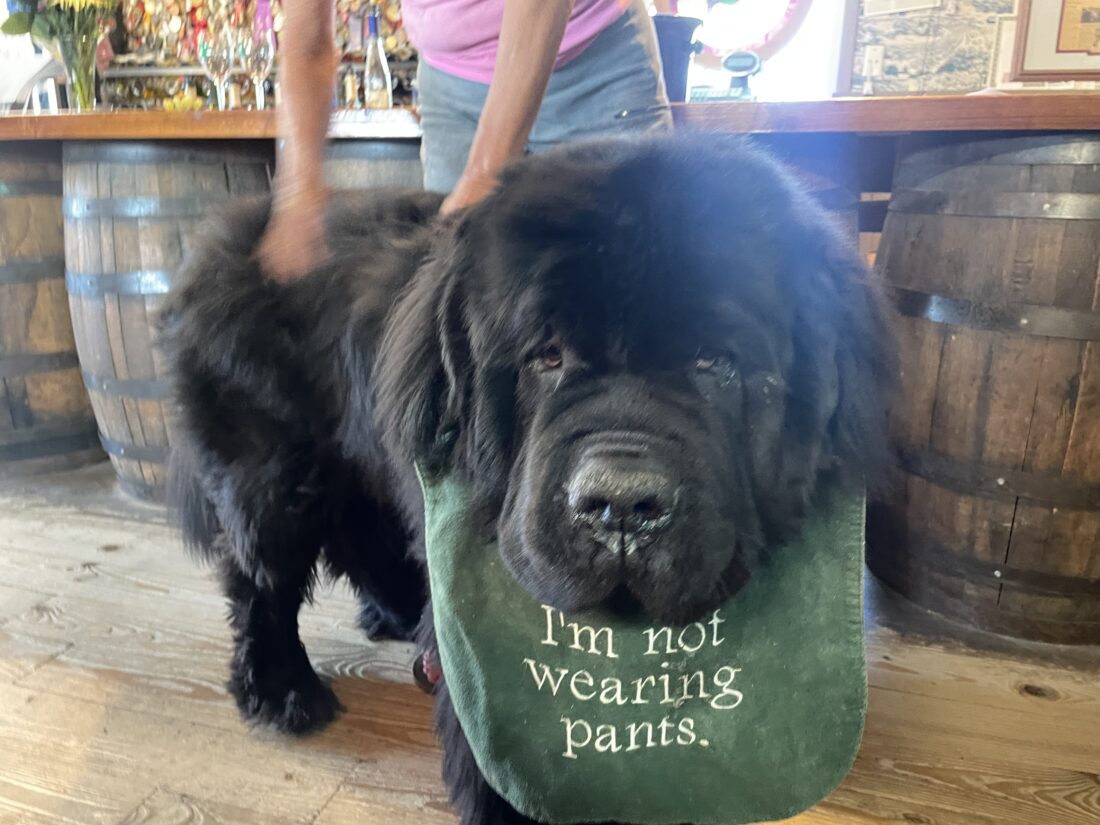
photo by: Sylas May/Journal-World
Michelle Meyer of Holy-Field Vineyard and Winery pets Porto the Newfoundland on Friday, Aug. 28, 2026.
At Holy-Field, Meyer says, visitors can experience every part of the process. Sure, they can just taste wine at the bar if they want (and meet Holy-Field’s laid-back Newfoundland dog, Porto), but they can also go out with Meyer during harvest season and help pick the fruit – and then go to the cellar and taste the fresh juice from that day’s harvest.
“I mean, that is pretty damn cool if you ask me,” she said.
Last weekend, she said, a mother and her young daughter were at the winery tasting the juice. She said the mom told her, “My daughter doesn’t want to taste it.” The girl didn’t like the color of the juice, the mom said.
“The color? This is as fresh as they get,” Meyer said. “When you pick something in nature and you press it, it doesn’t come out sparkly clear and pretty. That’s just not how nature works.”
But eventually, the girl did taste it – and she loved it, and asked for more.
“I said, ‘Did you like it?’ And she said, ‘Yeah, it was really good.’ I said, ‘See, you helped me pick that, and now you get to taste it, just like it is!'”
“All that leads back to the AVA,” Meyer said. ‘I went and I had this experience,’ or ‘Oh, yeah, the Kaw Valley AVA is really cool, they grow these kinds of grapes, and it’s special, it’s from a regional area with glacial soils,’ etc., etc., etc.”
She has a saying about Kansas grape growers: “We’re friendly farmers with friendly wine.”
“And we would like more people to experience that.”
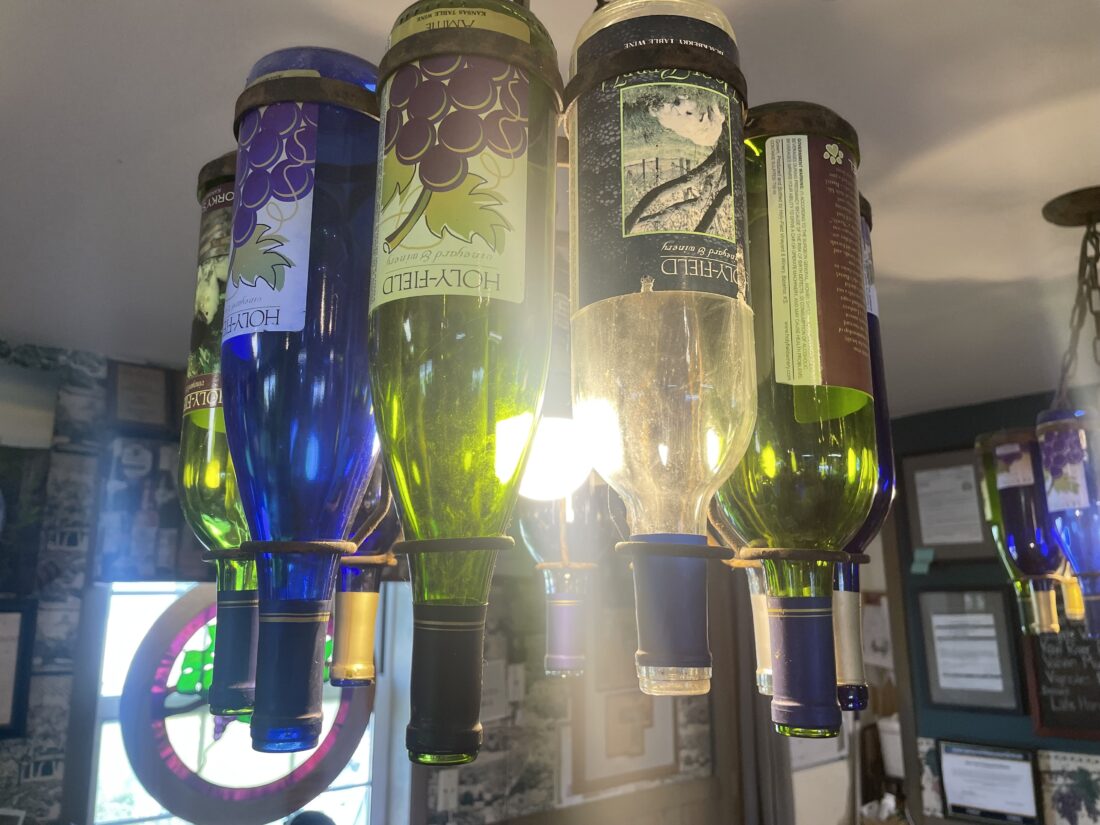
photo by: Sylas May/Journal-World
A wine-bottle lamp hangs above the bar at Holy-Field Vineyard and Winery on Friday, Aug. 28, 2026.
Arts and Entertainment

Go, See, Do: Library book sale, candidate forum and more

From a German pulpit to an indoor pool, old church building brings new visitors to downtown Eudora
Growing up with famed Kansas fossil hunter, daughter returns with new book that goes beyond the digs

Duncan Sheik, Tony- and Grammy-winning ‘Spring Awakening’ composer and pop star, dies at 56

For this local artist and many others, Lawrence’s Art in the Park is the biggest event of the year