Organizers cancel next week’s Old-Fashioned Christmas parade in downtown Lawrence due to horse virus
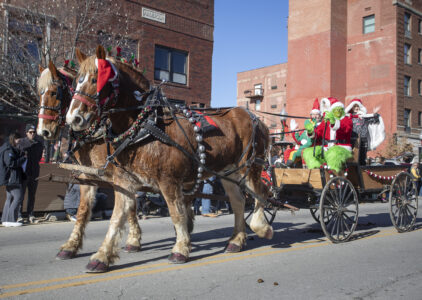
photo by: Mike Yoder/Journal-World
The Grinch drives wagon and team of horses in the 2024 Old-Fashioned Christmas Parade on Saturday, Dec. 7, 2024, in downtown Lawrence.
UPDATED 11:20 A.M. NOV. 25
A horse virus is knocking out one of Lawrence’s grandest — and most heavily visited — Christmas traditions.
Next week’s Old-Fashioned Christmas Parade in downtown Lawrence has been canceled due to a highly contagious virus that is infecting horses in the U.S.
Marty Kennedy, president of the Old-Fashioned Christmas Parade, told the Journal-World on Tuesday morning that the parade can’t happen this year due to an outbreak of the equine herpesvirus, also known as EHV.
“It was devastating for us to say, no, we can’t have it this year,” Kennedy said.
The event — which has been an annual attraction for more than 30 years — often draws more than 10,000 spectators to downtown Lawrence on the first Saturday of December. The parade is a modern-day rarity because all entrants are horse-powered. Entrants feature everything from covered wagons to horse-drawn funeral hearses to highly-decorated and expensive carriages.
Kennedy said organizers of the parade had little choice but to cancel the parade because a large number of key volunteers who oversee the safety of the parade had notified him that they could not risk bringing their horses to this year’s event. Those volunteers — known as outriders — travel on horseback along the edge of the parade procession and are in place to help control pulling horses if they become skittish or disruptive during the parade.
Kennedy said the parade normally has 40 outriders in place, but about 30 had indicated that they were not comfortable attending this year’s event due to the virus.
“We had contacted all of our outriders and asked them whether they were going to be able to make it,” Kennedy said. “When it got down to where there were only nine, or less, we were like, we can’t do this.”
The outriders also play a key role in getting the horses in line and organized at the parade’s start, which occurs at the Douglas County Fairgrounds.
That organizing process includes large numbers of horses bunched closely together at the fairgrounds, which is an environment that would be ripe for the spread of EHV, Kennedy said. Given that, Kennedy said he can’t blame the outriders for wanting to avoid that risk.
“These horses you see in the parade are generally used on their ranches,” Kennedy said of the outriders. “These are their actual working horses that they use everyday for their jobs. They can’t afford to lose these horses.”
EHV — which creates no risk for humans — can do varying levels of damage to a horse, Karen Hunter, a spokeswoman for the Kansas Department of Agriculture’s division of animal health, told the Journal-World. One version of EHV is similar to a head cold for humans.
However, another version of EHV — sometimes known as Equine Herpes Myeloencephalopathy — is more severe and creates neurological problems for horses that are infected.
“That is much harder for them to recover from,” she said.
That more severe version has been detected in the most recent U.S. outbreak. The outbreak appears to have started at a large equine event in Waco, Texas earlier this month, and then was detected again at a barrel racing event in Guthrie, Okla., according to a release from the Missouri Department of Agriculture, among others.
Hunter said Kansas has not yet registered a confirmed case of the more serious EHV strain during this outbreak. She said the Kansas agriculture department did not order organizers of Lawrence’s parade to cancel the event. She said the parade, and other equine events like it, would be well-advised to take extra precautions if it were to try to operate during the outbreak. That would include careful monitoring of horses, and special care to ensure that horses weren’t sharing any equipment, feed buckets or other such items.
Kennedy said the parade — which was scheduled for Dec. 6 — was slated to have horses from multiple states, including Oklahoma.
“This is the type of event that kind of could become a spreader,” Kennedy said.
However, organizers are optimistic that won’t forever be the case. There are treatments and vaccines for EHV, and Kennedy said the assumption is that the outbreak will be contained. There’s no reason to believe that it will create a problem for next year’s parade.
“Canceling this year’s parade was an extremely difficult decision,” Kennedy said in a press release. “We are grateful to the participants, volunteers, sponsors, and spectators who bring this parade to life each year, and we are committed to coming back next year bigger and better than ever.”
This is the second time the parade has had to be canceled — and both times were the result of a virus. Organizers canceled the 2020 version of the parade due to the COVID pandemic.
Other News

Events: St. Pat’s celebrations, Eagle Day, theater, dance, music and more
Douglas County commissioners approve one-year extension on permit for North Lawrence solar farm

Kansas lawmakers ask Bureau of Indian Affairs to provide update on search for permanent president for Haskell Indian Nations University

LMH Foundation celebrates Lawrence residents with awards for philanthropic support, service
The latest legal notice filings in Douglas County
State law requires residents of a county to be notified of a lot of different legal matters that are underway at ...