Longtime deejay with extremely rare disease has found joy, healing through music
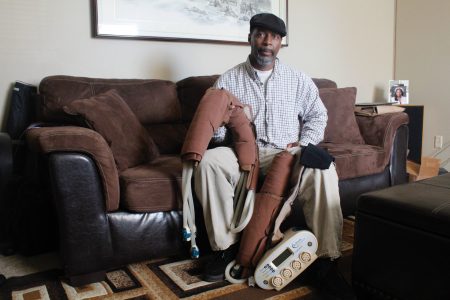
photo by: Lauren Fox
Michael Freeland Jr., who has a rare form of primary lymphedema called Milroy's disease, is pictured with his pneumatic compression pump on Oct. 30.
Wearing shorts in front of a crowd was a big victory for the Topeka teenager with the rare disease.
Michael Freeland Jr. had always covered his enlarged left leg with oversized pants, but on that day in eighth grade he wore track shorts. It was a huge moment for him, Freeland, now 49, remembered.
The meet was special because it was at Highland Park High School, the school Freeland would attend the next year, and it was the last race of the middle school track season. Freeland had tried and failed at other sports, but he had stuck with track — despite the fact that he had been denied an opportunity to race all season.
So as the events of the day went by and Freeland cheered his teammates on from the stands, he was surprised to hear his name called for the 400 meter toward the end of the meet.
“So I get excited,” Freeland recalled as he retold the story in October. “It’s my only race and I’m determined to run. And who’s in the audience that decided to come and watch me run? My mother. And my mom was waiting for that moment — for me to run that race.”
Freeland got into his box. He got set. And at the blast of the gun, he shot off.
For the first 200 meters, Freeland kept up with his competitors. But by the second half of the race, Freeland’s swollen leg was slowing him down. By the time he reached the last 100 meters, the other racers were crossing the finish line. And as he ran alone, he heard people from the stands laughing at him and talking about his leg.
It wasn’t the words themselves that upset Freeland. It was knowing his mother, sitting in the middle of the crowd, also had to hear them.
“That was one of the worst moments of what I had been through,” Freeland said this fall outside his Lawrence home near Dad Perry Park. “I never tried out for another sport again in high school.”
But what that young teenager didn’t know that day on the track was that the swollen leg that had been the source of his physical and emotional pain — the one doctors almost cut off years before — would also be the leg on which he would find joy dancing to Marvin Gaye, Sam Cooke and Earth, Wind & Fire. It would be the leg he would stand on in 2019 in Kampala, Uganda, speaking to a university about what it means to be different.
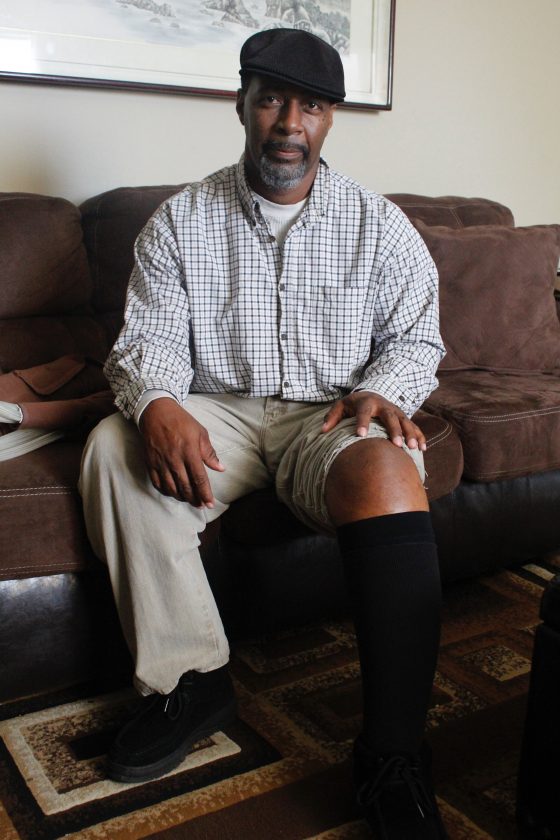
photo by: Lauren Fox
Michael Freeland Jr. was diagnosed with Milroy’s disease, a form of primary lymphedema, at age 5. It affects his left leg.
Milroy’s disease
Most people don’t have clear memories from when they were 5. Freeland does. He remembers the day his mother saw his leg and screamed.
His family was living in Arizona at the time — Freeland’s father was in the Air Force — and Freeland was in the bath getting washed before an event.
“I recall my mother cleaning me up and I was sitting in the tub and she lifted up my right leg and she washed me. And then she lifted my left leg and I heard her scream,” Freeland said.
His mother, Brenda Redmon, said in a phone call with the Journal-World that Freeland’s left leg was twice the size of his right leg. She remembers screaming too.
Freeland’s parents took him to a local hospital, but when they couldn’t figure out what was wrong, Freeland was flown by military craft to Boston Children’s Hospital. There, the diagnosis came. He had Milroy’s disease, a primary lymphedema that is typically inherited and congenital. It’s also extremely rare.
So rare, in fact, that since it was discovered in 1892 by W.F. Milroy, only about 200 cases have been reported in medical literature.
Lymphedema is swelling that results from failure of lymphatic drainage. It is inflammatory and can cause hardening of the skin (fibrosis) and susceptibility to skin infection (cellulitis).
Most people with lymphedema have secondary lymphedema, which is caused by another health problem, such as breast cancer. Only one out of about every 10,000 people have a form of primary lymphedema, according to Dr. Joseph Feldman, a lymphedema expert based in Evanston, Ill. People with Milroy’s disease represent a microscopic fraction of that group.
Feldman, who is the medical director of the lymphedema treatment program at NorthShore University HealthSystem, said the awareness of lymphedema and its treatment has increased a lot in the last 15 years. But when Freeland was growing up, he felt he was going through it alone.
No answers
After his diagnosis, about every three months as he was growing up Freeland would experience “excruciating pain throughout the body,” he said, in the form of nausea, extreme fever, cold chills and red skin that burned to the touch.
According to Feldman, those are symptoms of cellulitis, a common side effect of lymphedema. But at the time, Freeland’s doctors didn’t know how to relieve his pain. Freeland remembers being placed in ice baths to try to get his temperature down. Once, when he had a fever of 107 degrees around the age of 8, he said doctors were considering cutting off his leg.
“They told my dad if they couldn’t break my fever, they were going to have to amputate my leg,” Freeland said. “I remember begging my dad, in tears, to please don’t let them take my leg. I begged him.”
Eventually, Freeland’s fever went down on its own.
As a child, Freeland said, he didn’t know how to separate the physical and mental pain that came with his disease.
“I had to learn first about the physical, because I didn’t understand at that age what it meant to have the mental anguish that went along with that,” Freeland said. “When I hurt outside, I hurt inside.”
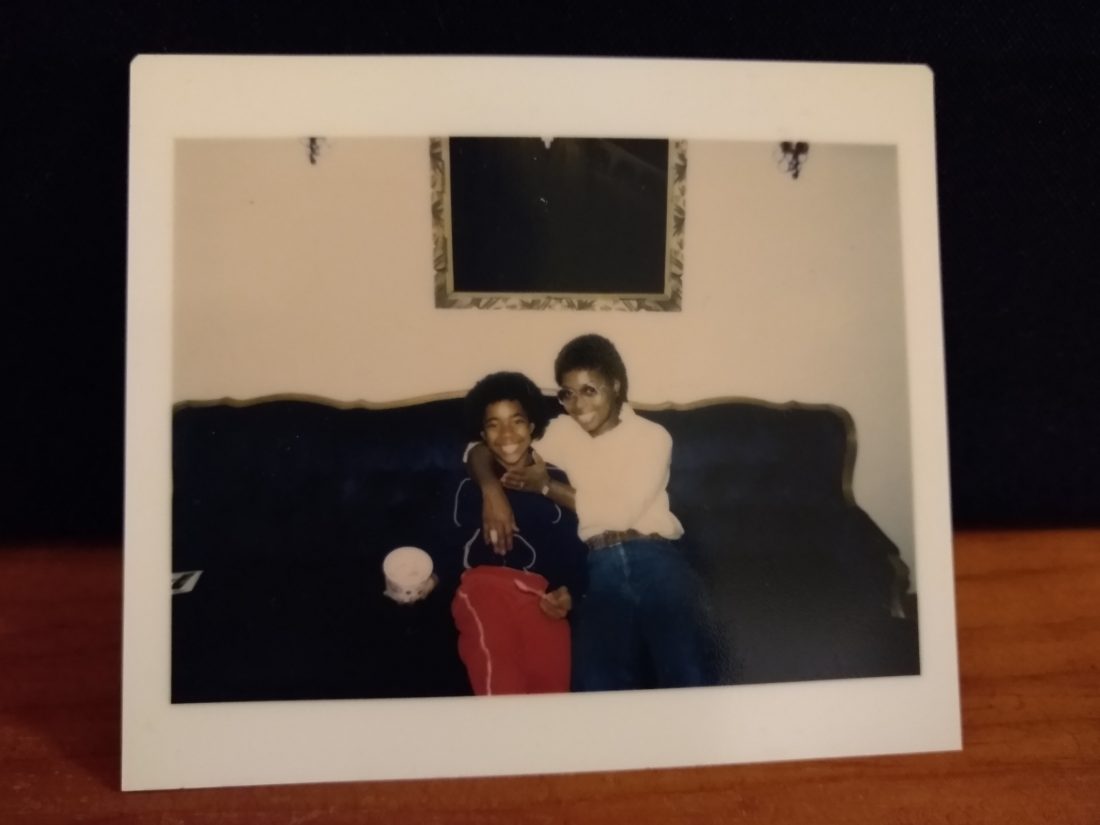
photo by: Contributed Photo
Michael Freeland Jr. is pictured at age 12 with his mother, Brenda Redmon.
As Freeland grew up, the episodes became less frequent, but they still happen to this day, and when they do, they are just as excruciating, he said. He still struggles with the fact that he doesn’t know how he got the disease; there’s no known history of it in his family. Freeland now has a family of his own, and none of his children has Milroy’s disease, he said.
Freeland always wears compression garments on his left leg that go up to his hip. And every day he uses a pneumatic compression pump that helps circulate the fluid in his body.
Dea Burmingham, a physical therapist at LMH Health, said people with lymphedema commonly use pneumatic compression pumps.
“It simulates a massage that’s intended to move the fluid out of the legs and up into the abdominal area and through (the) kidneys and eventually out,” she said.
Freeland uses his pump daily, typically for an hour but sometimes for two or three, he said. His job in the Kansas Department of Transportation is good for him because it requires him to be active. Feldman, the lymphedema expert, said exercise and weight control are important, because obesity can increase the severity of lymphedema.
Lymphedema has no cure.
‘Music became my healing’
As a teenager, Freeland found messages of hope, inspiration, triumph and survival in music. And to this day — in two faded duffel bags — he keeps cassette tapes of the music that helped heal him.
In his freshman year of high school, Freeland isolated himself from friends and spent a lot of time watching music videos on BET and MTV. It was Kid n’ Play’s “Gittin’ Funky” that inspired him to learn to dance, and after that he learned every dance he could.
“I would stand up in my living room by myself, and when the music videos come on, I would make it my business to know every dance move of that video,” he said. Eventually Freeland became skilled at dancing, and during his sophomore year he decided he would participate in the school talent show.
He asked three trusty friends to join his crew, and his mom made them all outfits. They danced to “Gittin’ Funky.”
“When I got to the music, and when I did my dance, it was as if nothing else around me existed,” Freeland said. And when their dance ended, “people celebrated me, instead of making fun of me, and that was the best feeling in the world.”
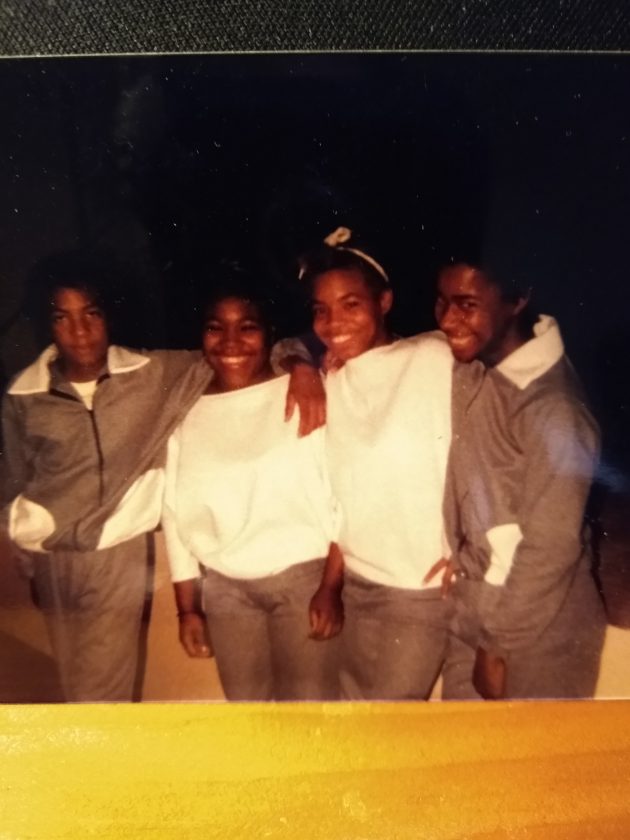
photo by: Contributed Photo
Michael Freeland Jr., at right, is pictured with his high school dance group.
But for Freeland, music was about more than dancing.
“See, the reason that I love music is because it creates the healing,” Freeland said. “People wrote songs back then about what they were going through … sometimes the best way of understanding what you’re going through is to hear that somebody else has been through it.”
Take Gaye’s “Got To Give It Up,” for instance.
“If you listen to the words of that song — remarkable,” Freeland said.
He began to recite them:
I used to go out to parties
And stand around
‘Cause I was too nervous
To really get down
“That was me,” Freeland interjected.
But my body yearned to be free
I got up on the floor and found
Someone to choose me
“That was me,” Freeland repeated.
No more standin’ along the side walls
Now I’ve got myself together, baby
And I’m havin’ a ball.
“Music spoke to me because I learned how to listen through music,” Freeland said. “Music always spoke to something that I was going through … That was my therapy: to use the music.”
For the past 29 years, Freeland has passed on the inspiration he has found in music to others through deejaying. He goes by the name DJ Mike J, and his motto is “It’s not about the music, it’s about the experience.”
“All of this started because I love music,” Freeland said. “All of this started because music became my healing.”
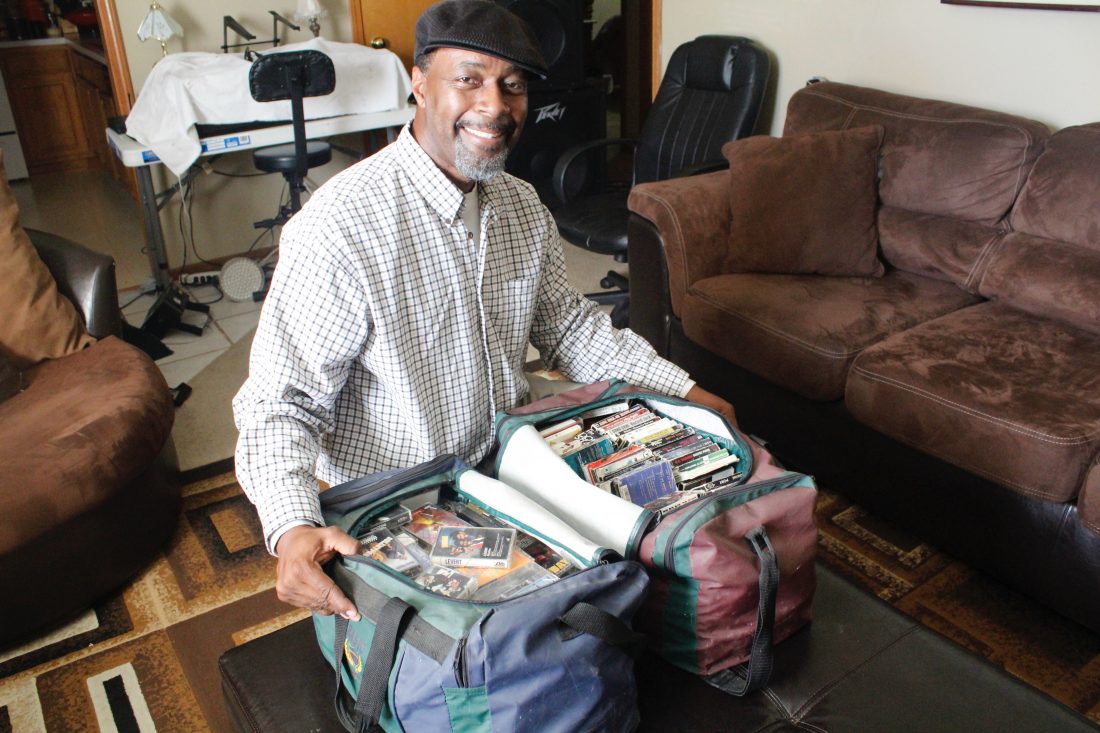
photo by: Lauren Fox
Michael Freeland Jr., pictured in his Lawrence home on Oct. 30, has two duffel bags full of old cassette tapes from when he was younger.
Sharing his story
Freeland takes away people’s apprehensions on the dance floor.
That’s what Ruben West noticed when he saw Freeland deejay his parents’ wedding anniversary three years ago. West, a corporate trainer and keynote speaker who grew up in Topeka but now lives in Illinois, saw a special mentality and potential in Freeland. After the event, West hired Freeland to deejay at a training event, and they’ve been friends since.
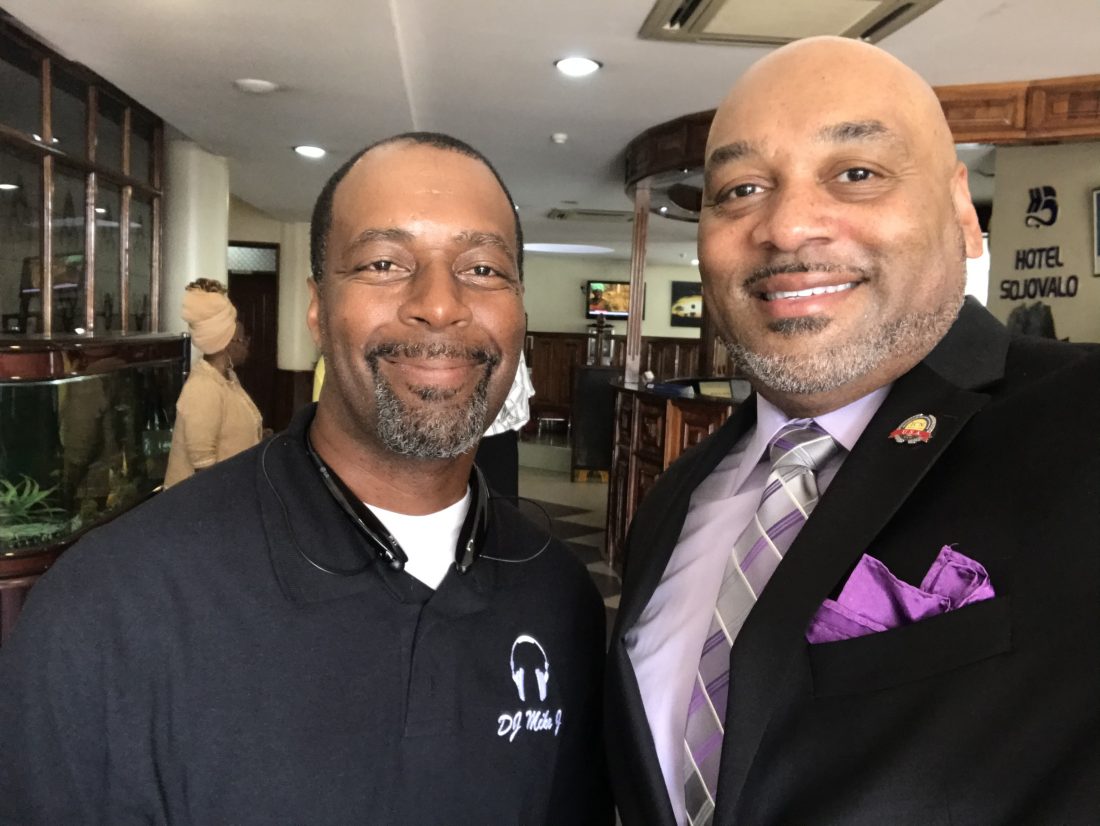
photo by: Contributed Photo
Michael Freeland Jr., left, is pictured with Ruben West in Kampala, Uganda, in Sept. 2019.
West liked how Freeland got people of all ages on the dance floor and taught line dances so even the shyest could participate. When West heard about Freeland’s leg condition and how music transformed his life, he knew that in addition to sharing music, Freeland had his own message to share.
“I was reluctant at first to tell my story because, you know, dealing with my leg condition was always a point of embarrassment for me,” Freeland said. But he knew that his story might help others.
Freeland’s first speaking engagement was in September 2019 at Kayiwa International University in Kampala, Uganda. He spoke about being different. And though he didn’t have any deejaying equipment with him, he still had the audience up and dancing — “which means the music is coming from the inside,” West said.
“It was fantastic to watch, to see the people react to him in that manner,” West said. “He didn’t have his speakers and he didn’t have his turntables and he didn’t have his records. But he still had the music.”
Michael Freeland Jr. in Kampala, Uganda
Freeland said he’s learned that everything he’s gone through hasn’t been for nothing. His journey to understanding who he is has also taught him how to give back to other people.
“The days that I live and the days that I survive are also days that somebody else has to fight their way through,” he said.
Prior to the pandemic, Freeland continued to do speaking events alongside West and even hosted a solo event in Kansas City called “Your Reason to Live” in November 2019.
He was granted an honorary doctorate from United Graduate College and Seminary International in 2020.
This spring, he self-published a book titled “Free Your Land: Developing Your Mental Real-Of-State.” The book details Freeland’s life and also states how the right mindset can help people develop themselves and others.
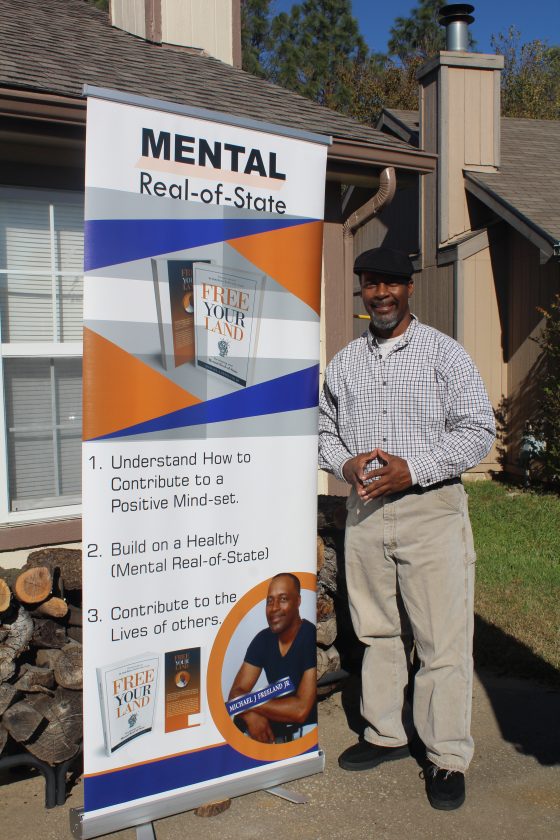
photo by: Lauren Fox
Michael Freeland Jr. is pictured outside his Lawrence home with a promotional poster for his book, “Free Your Land: Developing Your Mental Real-Of-State.”
West said the book has “simple, immediately implementable strategies that can help people change the way they see life.” Freeland’s mother, Redmon, said, “I didn’t know how much he suffered until I read that book. It really opened my eyes to some things that I didn’t know took place.”
Freeland will be hosting a book signing event on Jan. 24, 2021, from 2 to 5:30 p.m. at Vivid Events KC in Grandview, Mo.
Freeland said the message he tries to get across during his speaking events and in his book is that circumstances don’t define a person and that developing oneself starts with an understanding of one’s mentality.
For Freeland, that understanding came when he realized Milroy’s disease was his condition but not his situation.
“I finally had to break the mold to say that’s what I deal with, but that’s not who I am,” he said.
Other News
Clinton State Park and other state parks will increase overnight camping, vehicle permit fees starting next month
‘No day is like the other here’: Students from Lawrence’s German sister city discover football, new foods and new friends on exchange
GCSAA celebrates 100 years with new plaza and statue honoring its founder and first president

Go, See, Do: Library book sale, candidate forum and more

Gas station at Lawrence’s new Costco will be open starting next Wednesday