An incumbent Douglas County commissioner and another Democrat will face off for the county’s District 1 seat
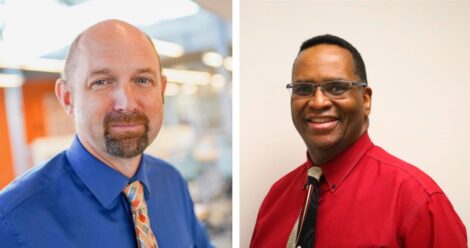
photo by: Contributed
Patrick Kelly and Milton Scott
An incumbent Douglas County commissioner will face a first-time candidate for the county’s District 1 seat in the Democratic primary.
County Commissioner Patrick Kelly – currently representing District 1 – is running against Milton Scott, both are Democrats. Whichever one wins will be running unopposed in the general election in Douglas County District 1, which includes parts of northern, northwestern, and central Lawrence.
PATRICK KELLY
Kelly has lived in Douglas County since 1989 when he came to attend the University of Kansas. He worked at Lawrence Public Schools for 31 years as a teacher and building and district administrator before retiring in 2024. Before serving on the Douglas County Commission, he served on the Lawrence Cultural Arts Commission and the Lawrence Douglas County Planning Commission.
Kelly said property taxes have placed a pressure on many Douglas County families, especially seniors living on fixed incomes. He said that’s someone county commissioners keep in mind everytime as they made budget decisions.
“I believe we can reduce the tax burden and maintain the services and infrastructure that our community depends on,” Kelly said. ” … I’ll continue making thoughtful financial decisions that balance taxpayers’ ability to pay with our responsibility to provide excellent public services. That includes finding efficiencies, supporting responsible commercial and industrial growth that broadens the tax base, and planning for the long term.”
Douglas County has had multiple funds with fund balances in excess of what the fund balance policy allows, as the Journal-World reported. Kelly said he’s heard the community’s concerns that some fund balances are higher than necessary.
“The proposed 2027 budget reflects that we listened,” Kelly said. “It brings our major operating fund balances back within our policy targets. That’s the balance I support: maintaining enough reserves to protect the County’s long-term financial health without collecting more from taxpayers than is necessary.”
Regarding the Wakarusa River Valley, Kelly said it is one of Douglas County’s most important natural, cultural and agricultural assets, and that’s why the county launched the Wakarusa River Valley Vision and Area Plan.
“My commitment to the Valley is clear,” Kelly said. “The Douglas County Commission adopted the county’s first Open Space Plan, identifying the Wakarusa River corridor as a county conservation priority. We’ve invested in protecting environmentally sensitive lands, restoring habitat, expanding public access, and supporting efforts that recognize the Valley’s ecological, agricultural, historical, and Indigenous significance.”
When it comes to large-scale developments, such as data centers and other similar developments, Kelly said the community should decide what belongs in Douglas County and work together to identify what matters most to the county.
“Based on what we know today, I believe large-scale data centers and similar industrial developments should meet an exceptionally high standard before they are considered appropriate in unincorporated Douglas County,” Kelly said. ” … Our responsibility is to determine whether a project is compatible with our community, our land use plans, our infrastructure and our long-term goals. If it cannot meet those standards, then Douglas County is simply not the right place for that type of development.”
In addressing homelessness, Kelly said preventing homelessness whenever possible is just as important as responding after someone loses housing.
“We are making meaningful progress,” Kelly said. “By combining one-time County investments with federal, state and philanthropic funding, projects are now underway that will achieve about 60% of the community’s supportive housing goal identified in (the) ‘A Place for Everyone’ (plan.)”
Kelly said a stronger Douglas County is one where people come together to solve difficult problems, recognizing that our community is strongest when we listen to one another, weigh competing priorities, and make thoughtful decisions that serve the common good.
“That’s the kind of Douglas County I want future generations to inherit, and the kind of community I’ve worked to help build,” Kelly said.
MILTON SCOTT
Scott previously ran for Lawrence City Commission in 2021. He currently serves as an adult service officer and coordinator for the Community Service Work Program with Douglas County Criminal Justice Services. He also has experience as a juvenile correctional officer. Scott previously served as director of programs and property management with the Lawrence-Douglas County Housing Authority for over 20 years and as executive director of the Kansas City, Kansas, Housing Authority.
Scott said the county’s taxpayers deserve a fiscal strategy that delivers intentional, meaningful and sustainable tax relief. And it can be accomplished without compromising essential public services.
“To prevent property taxes from escalating, the county must look inward and commit to rigorous operational efficiency including right-sized Douglas County government,” Scott said. “The county should meticulously evaluate supplemental budget requests, prioritize internal efficiencies, and work to manage the mill levy to off-set rising property valuations.”
In reference to the county’s fund balance policy, Scott said the county hoard’s millions of dollars while local families and small businesses struggle with rising property valuations.
“It means the county has routinely taken more out of our pockets than it actually needs to run our local government,” Scott said. ” … We must establish a reasonable reserve target such as 20% to 25% of operating expenditure. If the county ends the fiscal year with a significant surplus, those funds should automatically trigger property tax relief or a meaningful mill levy reduction in the next budget cycle.”
Scott said the Wakarusa River Valley is one of the most sensitive ecological regions in the county, as it functions as a sanctuary for wildlife, native plants and migratory species. The wetlands also provide many ecological benefits.
“The land surrounding the Wetlands carries deep cultural meaning, particularly for Haskell Indian Nations University and tribal communities across the country,” Scott said. “It is a matter of cultural preservation, historical respect, and honoring the lived experiences of Indigenous students and families.”
Scott said when it comes to large-scale and industrial developments, he strongly opposes data centers, cryptocurrency mines and lithium ion battery energy storage systems. He added that he’s even seeking a permanent moratorium on BESS facilities, as he’s concerned with fire and explosion risks.
“Data centers (place) significant strains on local resources, requiring very large amounts of water and electricity to operate,” Scott said. “Cryptocurrency mining operations often generate substantial noise and (consume) exceptionally high levels of energy, while offering relatively limited economic benefit to the surrounding community. I would oppose the development of industrial data centers anywhere in Douglas County.”
On the topic of homelessness, Scott said it’s the county’s role to strengthen and coordinate the entire system and not just fund pieces of it.
“Homelessness is rarely the result of a single factor. Mental health challenges, substance use, addiction, and trauma are deeply intertwined with housing instability,” Scott said. “The County’s role is to align countywide mental health services so that people can access care before they reach a crisis point … I have spent time walking alongside individuals and families facing some of the hardest moments of their lives. I learned what truly changes lives. Stabilized housing is the foundation of recovery, health, and hope.”
If elected, Scott said in addition to tackling rising property taxes, he hopes to champion clean energy solutions while respecting the local communities and protecting agricultural land.
Scott also wants to align county-wide mental health services so that people can access care before they reach a crisis point.
Other News
Clinton State Park and other state parks will increase overnight camping, vehicle permit fees starting next month
‘No day is like the other here’: Students from Lawrence’s German sister city discover football, new foods and new friends on exchange
GCSAA celebrates 100 years with new plaza and statue honoring its founder and first president

Go, See, Do: Library book sale, candidate forum and more
Gas station at Lawrence’s new Costco will be open starting next Wednesday