Douglas County commissioners approve contract for health care plan administrative services from UnitedHealthcare
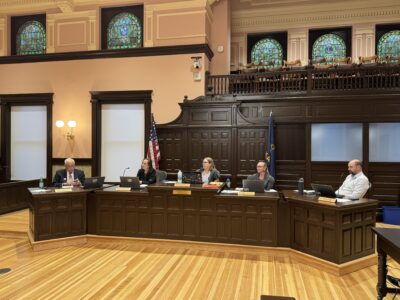
photo by: Josie Heimsoth/Journal-World
Douglas County commissioners met on Wednesday, Feb. 18, 2026.
Douglas County commissioners approved a contract for a new county employee health care plan on Wednesday.
The contract is with UnitedHealthcare to provide administrative services for the county’s self-funded employee health care plan, and it would become effective June 1, 2026. The vote was 3-2, with commissioners Erica Anderson and Gene Dorsey opposed.
As the Journal-World reported, commissioners deferred the vote on this item at their Feb. 11 meeting and requested additional information, including a network disruption analysis for all respondents and a summary of the proposed caveats.
Douglas County uses a self-funded health plan, paying medical claims directly while contracting with outside vendors for plan administration and stop-loss coverage. With this structure, the county can either use a third-party administrator or contact directly with an insurance company to manage claims and provider networks.
Since about 2001, the county has used Luminare as its third-party administrator. After a 2025 market review by consulting firm Willis Towers Watson, UnitedHealthcare’s direct contract proposal was identified as the best value, offering stronger network discounts and an estimated $434,000 in savings, along with plans to eventually shift oral surgery benefits to Delta Dental to expand local provider access.
Douglas County currently utilizes the Cigna network of healthcare providers. As the Journal-World reported, Bert Nash Community Mental Health Center ended its contract with Cigna in August 2025, resulting in county employees no longer having insurance-covered access to mental health services through that organization.
According to a memo to commissioners, UnitedHealthcare’s Choice Plus network was proposed due to its broad national scope and because analysis of prior-year claims showed it would match or exceed current provider access, minimizing disruption and maintaining continuity of care.
Dorsey said his concern was that if the county changes networks and reimbursement schedules, it may reduce the amount paid to local providers like LMH Health. “So while we’re saving money, the local economy is affected by the amount of money we save, Dorsey said.
Commissioner Shannon Reid said the change would result in more choices and offers more options of support for the county’s employees, and if it doesn’t work like staff plans, the commissioners can revisit the health care plan in the future.
“Being able to increase the spectrum of options for people is a net positive, to be able to choose to receive their health care outside this community, for whatever reason that might be,” Reid said. “So I’m personally in favor of this change … We have the ability to have this conversation again next year and make a change back as things are not as we expected them.”
IN OTHER BUSINESS, COMMISSIONERS:
• Heard a presentation from county staff on the findings of a report centered on the experiences of single-female-headed households living at or below the ALICE threshold, which stands for Asset Limited, Income Constrained, Employed. These households often are categorized as falling through the cracks of the system as they earn more than the federal poverty level but less than the basic cost of living.
The county along with its community agency partners leading the five-year Community Health Improvement Plan, or CHIP, collaborated with the University of Kansas Center for Public Partnerships and Research to conduct the initiative, dubbed “Douglas County Thrives.” Providing more opportunities to serve low-income women with children is a specific focus area outlined in the anti-poverty work within the CHIP.
As the Journal-World reported, the group developed a survey and collected 94 survey responses and later held a community sensemaking session in December 2025 to discuss the findings and gather feedback.
Most respondents were low-income single parents, primarily women between ages 35 and 44. Two-thirds reported annual household incomes below $30,000, with many earning less than $20,000. Respondents frequently identified intersecting challenges, including unemployment, food insecurity, mental health strain, housing instability, transportation barriers, debt, disability, and domestic violence.
• Approved a license for non-emergency transportation services with American Medical Response for a term of five years. City of Lawrence and Douglas County codes were modified in 2025 to allow for outside entities to perform non-emergency transfers. Two other licenses were approved with EMS Unlimited and TECHS EMS during commissioners’ Jan. 7 meeting.
Other News

Five poets win annual contest to feature poems on Lawrence Transit’s electric buses
Douglas County commissioners approve contract for health care plan administrative services from UnitedHealthcare

Lawrence-Douglas County Public Health accepting nominations for residents and organizations advancing health in the county
The latest legal notice filings in Douglas County
State law requires residents of a county to be notified of a lot of different legal matters that are underway at ...

PHOTOS: 2026 Lawrence Mardi Gras Parade