

Douglas County report highlights financial and housing struggles of single-parent families, calls for increased support
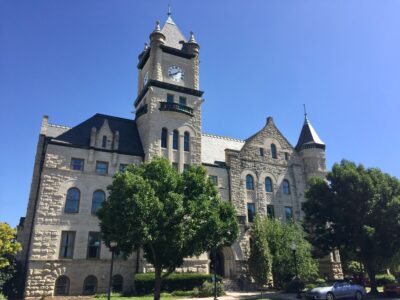
photo by: Journal-World
The west side of the Douglas County Courthouse, 1100 Massachusetts St.
A new report shows that families with a single parent in Douglas County – especially female-headed households – just above the poverty line face financial, housing and mental health struggles.
On Wednesday, county commissioners will hear about the findings of the report during a work session centered on the experience of single-female-headed households living at or below the ALICE threshold, which stands for Asset Limited, Income Constrained, Employed. These households often are categorized as falling through the cracks of the system as they earn more than the federal poverty level but less than the basic cost of living.
The county along with its community agency partners leading the five-year Community Health Improvement Plan, or CHIP, collaborated with the University of Kansas Center for Public Partnerships and Research to conduct the report. Providing more opportunities to serve low-income women with children is a specific focus area outlined in the anti-poverty work within the CHIP.
A guaranteed income pilot program is currently being explored to boost financial stability for these families, as the Journal-World reported. County commissioners approved a subgrant agreement with the International City/County Management Association for Douglas County to join the 2025 Economic Mobility Opportunity Cohort, one of 15 communities focused on advancing economic mobility.
The agreement also came with $25,000 to complete the report that will be presented on Wednesday as well as exploring the idea of a guaranteed income pilot program and a child care scholarship fund. County staff previously told the Journal-World that the county did not foresee using taxpayer dollars to fund a guaranteed income pilot program and said this grant wouldn’t be used to implement an actual guaranteed income program.
CHIP partners and the Center for Public Partnerships and Research developed a survey and data collection strategy to identify emerging themes and patterns for the report that will be presented on Wednesday. The initiative, titled “Douglas County Thrives,” was launched on Oct. 2, 2025, and remained open through Nov. 21, 2025. With support from local partners including DCCCA, Heartland Community Health Center, Just Food, and LiveWell, the project collected 94 survey responses.
Most respondents were low-income single parents, primarily women between ages 35 and 44. Two-thirds reported annual household incomes below $30,000, with many earning less than $20,000. Respondents frequently identified intersecting challenges, including unemployment, food insecurity, mental health strain, housing instability, transportation barriers, debt, disability, and domestic violence.
The findings were also discussed at a community workshop in December 2025, and following these discussions, the Center for Public Partnerships and Research prepared the report outlining strategic initiatives that elevate community voices and call for expanded economic mobility, health, and well-being.
Attendees of the December event reinforced a clear theme also seen in responses to the survey: families are navigating structural, ongoing pressures with little margin for error.
Financial strain sits at the center of a lot of these families’ hardships. Many families do have full-time jobs, but they often fail to keep pace with rising costs for housing, food, child care and health care. Families described the “benefits cliff” phenomenon — earning slightly more income can result in the sudden loss of public assistance, leaving them worse off.
Families also said existing services in Douglas County can be difficult to navigate. While there are lots of community resources available, participants said services often operate independently rather than as a coordinated network centered on stability for the whole family. Eligibility rules, documentation requirements and siloed agencies create confusion and delays.
In addition, participants said there is an emotional toll to chronic instability. Participants connected mental health strain not to individual weakness but to constant financial pressure, system navigation, and lack of rest. Families emphasized that improving mental health requires stabilizing basic needs first.
The report’s recommendations focus on helping families achieve economic stability and long-term well-being. Key actions include increasing income support through programs like guaranteed basic income pilots, financial education, expanded housing vouchers and resources to offset household costs, all aligned with the real cost of living.
Housing stability and affordability remain central concerns, with recommendations to expand affordable options, provide short-term stabilization support and design housing policies that account for fluctuating incomes. Strengthening coordination across agencies and investing in whole-family service models were also emphasized, ensuring programs work together to reduce strain on families and prioritize stability rather than rigid eligibility rules.
IN OTHER BUSINESS, COMMISSIONERS WILL:
• Consider a contract with UnitedHealthcare to provide administrative services for Douglas County’s self-funded employee health care plan, which would become effective June 1, 2026. As the Journal-World reported, commissioners deferred the vote on this item at their Feb. 11 meeting requesting additional information including a network disruption analysis for all respondents and a summary of any proposal caveats.
Douglas County uses a self-funded health plan, paying medical claims directly while contracting with outside vendors for plan administration and stop-loss coverage. Under this structure, the county can either use a third-party administrator or contract directly with an insurance company to manage claims and provider networks.
Since about 2001, the county has used Luminare as its third-party administrator. After a 2025 market review by consulting firm Willis Towers Watson, UnitedHealthcare’s direct contract proposal was identified as the best value, offering stronger network discounts and an estimated $434,000 in savings, along with plans to shift oral surgery benefits to Delta Dental to expand local provider access.
• Consider approving a license for non-emergency transportation services with American Medical Response for a term of five years. City of Lawrence and Douglas County codes were modified in 2025 to allow for outside entities to perform non-emergency transfers. Two other licenses were approved with EMS Unlimited and TECHS EMS during commissioners’ Jan. 7 meeting.
The County Commission’s work session will begin at 4 p.m. Wednesday in the Douglas County Commission meeting room at 1100 Massachusetts St. The business meeting will follow at 5:30 p.m. The meeting will also be available via Zoom.
County Government
Douglas County report highlights financial and housing struggles of single-parent families, calls for increased support

Douglas County Emergency Management to hold two upcoming workshops for heat readiness and severe weather training
Douglas County highlights housing and shelter gains as homelessness plan nears two years

Douglas County to provide a progress update on the joint city-county plan to end chronic homelessness
Douglas County commissioners explore new food system priorities as nearly decade-old plan nears milestone
