Douglas County commissioners take no action on changes to fund balance policy; larger finance policy rewrite to start in 2026
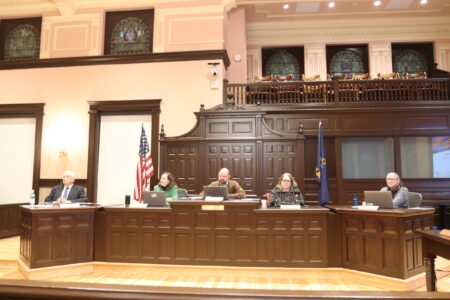
photo by: Josie Heimsoth/Journal-World
Douglas County commissioners met on Wednesday, Dec. 3, 2025.
After hearing some citizen concerns and some commissioner questions, Douglas County does not yet have a new policy spelling out how much money should be kept in rainy-day reserve accounts.
Instead, a split Douglas County commission on Wednesday decided to wait to tackle the issue again, perhaps with new information. But when that may happen was left unclear. Two of five commissioners sought for a review in February when the county is tackling other year-end financial matters, but the idea failed to gain a needed third vote.
Commissioners at their Wednesday meeting were considering adopting a new fund balance policy for the county. The new policy would remove a provision that says unused monetary balances in key county funds should not exceed 25% of the fund’s total revenue. The new policy would set minimum levels that should be kept in the accounts but would not set any maximum levels.
That didn’t sit well with some members of the public who attended Wednesday’s meeting.
“The county’s high current fund balances indicate that the county seems to be collecting excessive revenues,” Douglas County resident John Ims said. “Reducing property tax rates and or refunding excess money in fund balances could better align the county’s tax revenue with your expenditures and provide property relief to the Douglas County residents.”
Ultimately, a majority of county commissioners — on a 3-2 vote — decided to not take action on the policy for more discussion. County commissioners Patrick Kelly, Gene Dorsey and Erica Anderson all said they didn’t want to approve the proposed policy currently.
The changes commissioners considered on Wednesday come after the county has violated the former policy for the last two years by leaving millions of dollars in excess funds in county accounts. The former policy – approved in January 2023 – limited the amount of money that was held in a type of account called a “fund balance,” which operates like a savings account and covers unexpected expenses or rainy day events. The policy said the accounts can’t have fund balances that are more than 25% of their revenues.
The proposed policy set minimum targets for fund balances, ranging from 20% to 25% of total operating expenses, and it doesn’t set a cap on those funds. The changes also didn’t include any language about what to do in the event that a fund significantly exceeds or falls below the 20% to 25% level.
In the past, the Government Finance Officers Association has said a fund balance policy should include such language. GFOA also has said a policy should spell out what the government will do if a fund falls below its target level. The county’s proposed policy has no language about that scenario either.
The absence of a cap drew concern from some meeting attendees. Brent Boeve, a county resident and retired financial professional, said the commissioners should establish a cap for the fund balances and make the policy more restrictive.
“Don’t wait for another year to do that, and possibly defer the decision until a cap can be established,” Boeve said. ” … citizens of Lawrence and Douglas County are tired of escalating property taxes, sick of inflated budgets, sick of out of control spending (and) angry about rising debt levels. The days of ignoring valid concerns of citizens and taxpayers needs to be over.”
Dorsey initially moved to postpone the vote on the new policy — with no suggested changes — until the second week of February, when the commissioners are expected to review end-of-year balance transfers. Commissioner Anderson seconded the motion.
When Dorsey made the motion, Commissioner Shannon Reid had said she would not be opposed to deferring the item, but later she said it didn’t make sense for her to delay the decision if there were no recommended changes on the table.
“Because staff can bring anything different back to us, and I’m struggling to understand what the end of year information will change about that,” Reid said. “So I didn’t support the motion because there’s no changes requested explicitly.”
However, that motion did not pass. In its place, Dorsey, Anderson, and Kelly voted to oppose approving the changes at this time. Kelly said he was not in support of deferring the vote until a later date with no changes, but he also wasn’t in favor of voting for the changes as it was on Wednesday.
County staff initially told commissioners at the start of the meeting that the changes to the fund balance policy were just the beginning of broader work in updating the county’s larger finance policy. County Administrator Sarah Plinsky said she hopes to have several more conversations with the County Commission during multiple work sessions in 2026, where staff will ask questions and use that feedback to develop a larger policy.
“It’s going to outline a lot of things, a lot of which we follow as a practice but we don’t have codified in policy,” Plinsky said.
She added that there will be language in the larger finance policy that outlines different scenarios – such as the county’s course of action if the fund balances fell below the 20% to 25% minimum targets. In addition, it would describe exactly what reserve funds could be used for.
“Our current practice of only using it for one-time needs would be codified into finance policy,” Plinsky said.
Plinsky said the work on the finance policy is going to take a lot of time for county staff, and if commissioners want a larger chunk of proposed changes to consider, she would need more time.
Kelly told commissioners he wanted to see additional proposed changes before considering any revisions.
“I think we heard from staff that they are going to be bringing us more and so I expect that we will have more and then we could vote on a policy then,” Kelly said.
Plinsky also said prior to commissioners taking the final vote that “we will be out of compliance with the fund balance policy for the majority of 2026” if commissioners decided to wait for more changes to the policy to be brought forward. A majority of commissioners nodded in response.
Kelly said that the county’s policy does not outline strict requirements, but rather benchmarks for decision-making. He used the proposed policy changes in front of commissioners as an example.
“There is nothing keeping us from not going below (the 20% to 25% minimum targets),” Kelly said. “Staff could come to us and say, ‘you’re below 25%’ and we could say, ‘okay,’ and we could still reduce it. These are guidelines for us. I understand that some think they’re like laws that we have to follow and there’s penalties if we don’t … but I think it’s a guideline for us.”
The proposed changes to the policy come after the county violated its current policy for the past two budget years. As the Journal-World reported in February, the County Commission approved year-end transfers that violated the county’s policy by about $6 million.
The county also had violations of the policy in 2023, just months after the policy was approved. As part of its process for crafting the 2024 budget, the county approved a budget that allowed the county’s employee benefits fund to exceed its 25% cap. By October of 2024, after multiple violations of the policy, county commissioners said they wanted to consider changes to the policy.
Other News

Have fun with the senior Vintage Players (and a dummy diva) at Theatre Lawrence’s ‘Vintage Vaudeville Revived!’

Lawrence school district appoints five leaders to new roles for 2026–2027, reshuffles roles without adding staff
County commissioners to consider $300K request as HeadQuarters Kansas faces potential 2026 shortfall

Douglas County commissioners to consider tenant eviction defense pilot program for renters facing landlord-tenant disputes
New classroom materials, graduation pathways and more are part of Lawrence school district’s plan to improve instruction