City leaders discuss how to strengthen existing public art funding program and make it more flexible
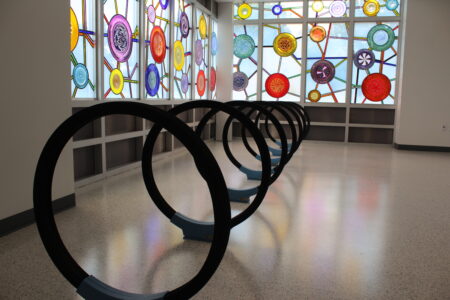
photo by: Austin Hornbostel/Journal-World
A bicycle storage area at Central Station, pictured on Tuesday, June 4, 2024, is perhaps the most interesting space in the building thanks to the art installed in its windows.
One of Mike Dever’s regrets from his earlier terms on the City Commission is that “I went eight years without spending money on art.”
Dever first served on the commission from 2007 to 2015, a time that included the Great Recession. Back then, he said at Tuesday’s Lawrence City Commission meeting, “we weren’t building, we weren’t spending, we weren’t constructing very many large projects, so the money wasn’t in there. And I’m kind of ashamed we didn’t have any art for eight years, 10 years.”
Soon, he and the rest of the City Commission could take extra steps to guarantee more funding for public art and make it more visible around town.
At its meeting Tuesday, the City Commission directed the Lawrence Cultural Arts Commission to review a proposed ordinance that would codify the city’s Percent for Art program, which sets aside money from some building projects to pay for public artwork.
As the Journal-World has reported, Percent for Art currently comes from a city resolution that says that the commission “may” set aside funds. But that means it can sometimes be overlooked when a project is being built. Porter Arneill, an assistant director with the Parks, Recreation and Culture Department, said that in most cities with programs like this, “if you don’t do it by ordinance, it happens sporadically at best.”
To that end, a team of consultants has developed a draft ordinance that would require the city to allocate 2% of the initial budget for certain projects in its Capital Improvement Plan to a public art fund.
“This would not create something new as much as it would strengthen and clarify what already exists,” Arneill told the commission.
The commission discussed on Tuesday what else Percent for Art should do, and how the city could think about public art in different ways.

photo by: Mike Yoder/Journal-World File Photo
“A Ribbon of Light,” by Dierk Van Keppel, hangs in the middle of the Lawrence Public Library, 707 Vermont St., as shown in this file photo from July 2014. It is one of the art pieces funded by a city of Lawrence program that sets aside up to 2 percent of a project’s budget for public art.
Historically, many of the Percent for Art projects have been designed as a decorative element of the building they’re associated with. That includes sculptures such as “A Ribbon of Light,” which hangs from the ceiling of the Lawrence Public Library, and “Making Connections,” the glass sculpture installation at Lawrence Transit’s Central Station.
But Arneill said it didn’t have to be that way. He said the artwork could be a completely separate project that wasn’t tied to the building project that helped fund it.
“It’s really up to the art commission recommending that back to the City Commission,” Arneill said.
Some buildings, he said, are less viable candidates for public art because the public doesn’t go there as often. He said that was the case for the police headquarters in western Lawrence. It has a $340,000 art piece funded through Percent for Art, the gazebo-like sculpture called “Through Other Eyes.” But instead of being right next to the headquarters, it’s southwest of it at the trailhead that leads into a nearby park.
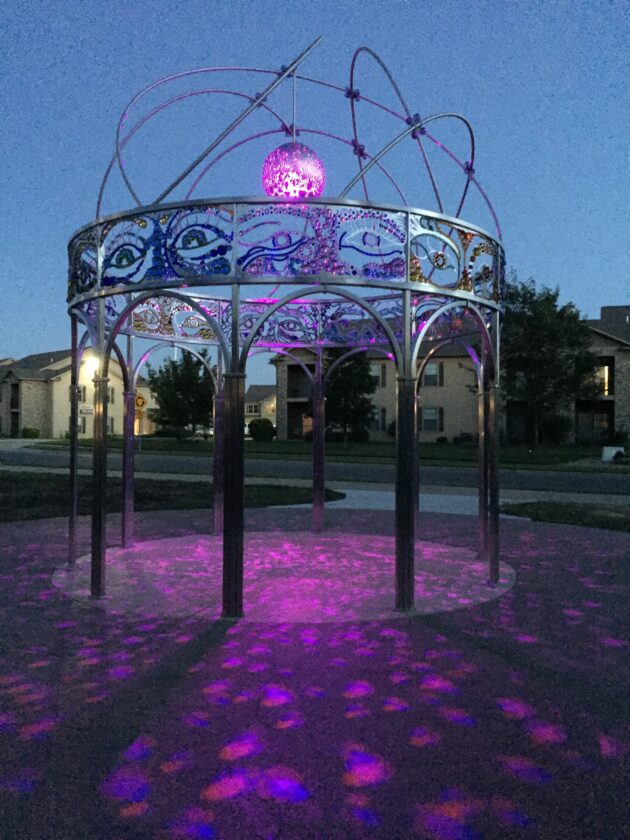
photo by: Rochelle Valverde/Journal-World
The art installation “Through Other Eyes” is pictured Wednesday, June 29, 2022, near Lawrence’s police headquarters, 5100 Overland Drive. The light sculpture at the center of the pavilion includes cut-out patterns that project images onto the ground.
Mayor Brad Finkeldei said the city’s $130 million Municipal Services and Operations campus, which is currently under construction, would be another example of a building where people have “some ability to go there” but wouldn’t normally have a reason to.
He wanted more flexibility, and so did other commissioners. Commissioner Amber Sellers, for instance, said it might be better in some cases to split up funding among multiple art projects.
“If we have $80,000 to spend, are we spending $80,000 on one, or could we do multiple installations?” she asked. “… If we had that for the MSO campus, it could be one piece or it could be multiple pieces.”
Former City Commissioner Courtney Shipley addressed the commission on Tuesday and said that was one of the biggest problems with how the city thought about public art.
“What (the Cultural Arts Commission has) interpreted it to mean is, we have this large pool of money and we have to do one thing,” Shipley said. “And they’ve never been told, even though they’ve asked, specifically, by this board or by this resolution, that they could do 10 things instead of one thing.”
Arneill said all of this discussion was “hitting on what every public art administrator struggles with, which is where’s the best place to do this and what’s the best benefit.”
He said that in his view, the most important thing is that the art is made with a specific place in mind.
“Public art is happier when it knows where it’s going to live,” he said. “What I mean by that is if you do public art in a random place, you have to have a really good reason to put it there.”
The draft ordinance will now go back for further review by the Cultural Arts Commission, and that body’s recommendations will come before the City Commission at a future meeting.
“Looking forward to this coming back in front of us,” Sellers said.
City Government

Rising Rates: A three-part investigative series examines why Lawrence water and sewer bills have been soaring
Some leaders are now stating a new reason for why Lawrence’s utility rates are soaring: The city didn’t grow enough

Lawrence City Commission could start the process of finding a construction manager for new fire station
Lawrence is charging water, sewer customers a special tax not required by state or city law

Lawrence housing market strains residents as development fails to keep up, city’s affordable housing study finds