After ‘angst’ and a tense vote, Lawrence City Commission takes step forward on nearly $184 million of debt
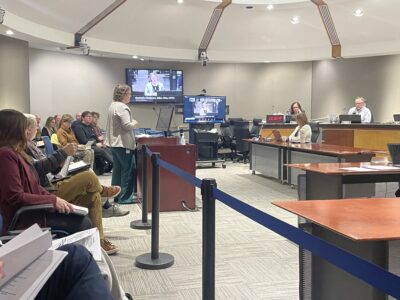
photo by: Sylas May/Journal-World Photo
Rachelle Mathews, the city's finance director, speaks at the Lawrence City Commission's meeting on Tuesday, March 3, 2026.
There was “angst,” talk of “dogwhistles” and “inflammatory language,” and a tense roll-call vote at the Lawrence City Commission’s meeting on Tuesday on something that normally passes without any discussion at all – resolutions to issue debt to pay for a slate of building projects.
On Tuesday night, the commission voted 3-2, with Vice Mayor Mike Courtney and Commissioner Kristine Polian opposed, to take a step forward on issuing $184 million in debt for a variety of projects in the city’s Capital Improvement Plan. It’s something the City Commission considers every year, but it’s usually on the consent agenda, where the commission can approve it along with several other items usually considered routine.
This year, however, it was pulled off for further discussion, and Polian forcefully criticized some of the city’s financial practices – even claiming that the city had failed multiple audits. Eventually, the commission was even asking staff what would happen if the debt resolution couldn’t pass – something that staff said would seriously hurt the city’s ability to borrow.
“If we’re going to talk about seriously not doing it, then we have to be prepared for the ramifications,” Commissioner Mike Dever said.
City finance director Rachelle Mathews told the Journal-World last week that the size of the debt the commission was considering was “unusual” – $158 million in general obligation bonds and $25.9 million in temporary notes.
But she also said this level of debt was not intended to be the norm going forward, and City Manager Craig Owens reiterated that on Tuesday night.
“We’ve been ramping up, and we’re going to ramp down,” he said.
Owens said the debt-funded projects – including major street and stormwater overhauls and the city’s new $130 million Municipal Services and Operations campus – were necessary because of “massive backlogs in almost every infrastructure and every system that we have.” He said that many of the city’s current projects had been on the backlog for a long time, and that when he came to Lawrence, one of the most urgent priorities was to fix neglected infrastructure throughout the city.
“This is a peak,” Owens told the commission. “This is absolutely the peak.”
Mayor Brad Finkeldei agreed with that assessment. He said that the debt was something the city knew about in advance and wasn’t a surprise.
“We’ve been planning for this bump, and we know there’s going to be less borrowing in the future,” Finkeldei said.
Questioning practices
But Polian had a number of concerns about the details of the financing plan, including how it used temporary notes to pay for things like the Jayhawk Watershed stormwater project. (That project has more than $15 million in temporary note funding in the city’s financing plan.)
Polian said she’d issued “a lot of debt” in her career in local government finance, and “I’ve never seen the temporary note process that we’ve done here.”
“When you’re doing long term financial planning, it’s very difficult to do that planning and get your actual plan tied to mills and utility rates while it’s in temporary financing, correct?” she said.
Polian also was concerned about the debt’s effect on residents and their tax burdens. She said that as opposed to the city’s legal debt limit, she was motivated by the idea of “level debt.”
“Is there any concern of outpricing our residents?” she asked. “… Do you let the projects dictate how much you’re going to issue in debt, or do you let the amount of debt you can handle, which is level debt, dictate what projects you’re going to do?”
Finkeldei said that the Capital Improvement Plan process was always based around those considerations, and Municipal Services and Operations assistant director Melinda Harger said that the city had many projects in the CIP that weren’t selected for funding – over $300 million worth currently.
“We’re funding about 60% to 70% of what the need is,” Harger said.
But Courtney wondered about what “the story to tell normal residents in town” would be. He said he’d heard from people who feel squeezed by property taxes.
“Everybody I’ve talked to just feels tapped out,” Courtney said.
‘No dogwhistles’
Polian also said some things that drew a response from other commissioners, including that she’d heard that the city had failed past audits.
Mathews told Polian that the city had received an “unmodified opinion, the highest opinion you can get,” on its audits for the past five years. But Polian said she didn’t care about that opinion, but rather about significant deficiencies and material weaknesses. She asked if Mathews knew of any of those in the city’s financials, and Mathews said she didn’t have that information on hand at the meeting.
“That is what dictates whether we’re going to have a massive financial failure,” Polian said.
After Polian made that claim, Dever told her, “I take very seriously these accusations you make.”
Sellers, meanwhile, took issue with Polian’s characterization of the City Commission as “a machine” that had “rubber-stamped” debt in the past.
Before the commission’s vote, Sellers told Polian that she too had experience looking at city finances and that she’d had discussions with staff when she had concerns, even if they didn’t take place in the City Commission’s meeting room. “Just because it’s not happening on YouTube in real time doesn’t mean it’s not happening,” she said.
And Sellers also had some ground rules that she expected from the commission’s discussions, she said.
“No inflammatory language,” Sellers said. “No dogwhistles.”
‘A lot of angst’
At one point, Sellers asked Baker Tilly financial adviser Ben Hart whether the city’s debt issuance practices were “out of character.” Hart said that based on Lawrence’s credit rating of Aa1, he wasn’t worried. If a city has a credit rating that high, he said, it generally means that it has financial policies “that aren’t just cookie-cutter; they’re financial policies you follow.”
“You’ve got the financial metrics that the bond market would consider safe,” he said.
But for Dever, the important question for Tuesday’s meeting was: What happens if the commission votes no?
As Harger noted, $145 million of the $158 million in proposed bonds were for projects that were already under contract. Mathews said that “any number of legal entanglements” could result; projects already in progress and outstanding contracts would be disrupted.
Looking farther out, if the city were to balk on the bond issue, there could be consequences for the city’s ability to find buyers for its bonds in the future. Mathews said a “no” vote could damage the city’s reputation among bond buyers and make it more difficult to issue debt.
“The closer we get to April 7, (the proposed sale date,) the more likely there is to be a negative reaction” on the bond market, Mathews said.
Dever said he thought there was “a lot of angst” about the debt. He said that in his previous stint on the commission, he “managed the city through a depression in 2008,” but that right now he was affected about the concerns he’d heard from other commissioners and the public.
The idea that “we aren’t fiscally conservative enough for the community,” he said, “gives me pause.”
While the resolutions were a step toward the eventual sale, the discussions about the city’s fiscal priorities are far from over.
Finkeldei, in fact, told the commissioners that they would continue next week. That’s when the commission will give initial input on the 2027 budget, and the process will continue throughout the summer months.
“We start next week!” he told his fellow commissioners.
And Sellers said that when that process begins, she expects the tough conversations will continue.
“This is not a 10-piece jigsaw puzzle,” she said. “There are complexities to municipal governance.”
In other business, the commission:
• Voted unanimously to receive an annexation request for 650 acres at the southwest corner of the intersection of Kansas Highway 10 and West Sixth Street. The request will next go to the Lawrence-Douglas County Planning Commission for consideration.
“This is just receiving it, so this is the first step of many steps,” Mayor Brad Finkeldei said.
City Government

Lawrence City Commission could start the process of finding a construction manager for new fire station

Lawrence is charging water, sewer customers a special tax not required by state or city law

Lawrence housing market strains residents as development fails to keep up, city’s affordable housing study finds
Property tax protest bill would let a few dozen voters block tax increases in some parts of Douglas County
Portion of 19th Street to close during much of April for stormwater structure replacement