Report: Electric cars are on the rise in Douglas County, but charging infrastructure has room for improvement
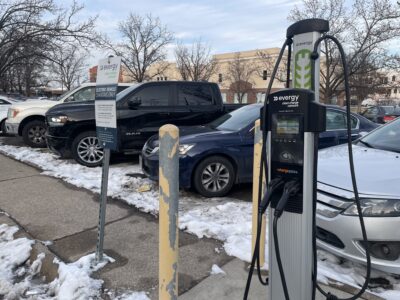
photo by: Sylas May/Journal-World
An electric vehicle charging station is pictured on Jan. 28, 2026, in a parking lot in downtown Lawrence.
While electric vehicles, or EVs, have been steadily rising in popularity in Douglas County, the area’s charging infrastructure has some growing to do, a new report from local planning officials suggests.
The report is called the Douglas County EV Readiness Report. It was produced by the Lawrence-Douglas County Metropolitan Planning Organization and the city and county sustainability departments, and its goal is to support future planning for EV infrastructure as more electric cars get on the road.
“This report does not establish new regulations or requirements,” the document reads. “Instead, it is intended as a first step in a longer-term process.”
One of its findings is that more EVs are being registered every year in the county. EV adoption has been rising steadily since 2017, the report says, and the most common type of EV here is the hybrid variety that can run on either electricity or gasoline.
The popularity of these over fully electric cars, the report says, “reinforces the importance of accessible and reliable charging infrastructure.” And here, the county seems to have some room for improvement. The report says that especially for people who live in multifamily housing, it’s hard to find places to charge up, and that may be a barrier to further EV adoption.
Next week, the report will be received by the Metropolitan Planning Organization’s Technical Advisory Committee; it meets at 2:30 p.m. Tuesday, Feb. 3, in Lawrence Public Library Meeting Room A. Below is a look at the state of charging infrastructure here and some of the report’s suggestions.
For single-family homeowners
Many EV owners use trickle chargers, or “Level 1” chargers, the slowest kind that plug into a normal 120-volt electrical outlet. These are the chargers that most EVs come with when purchased. Owners can connect them to the vehicle overnight, and the report says they’re usually good enough for low-mileage drivers.
But single-family homes can also support the next-highest level of charging, Level 2, if they have the necessary outlets: this type of charging uses a 240-volt outlet instead of the normal 120-volt one. It can provide enough charge in one hour for about 20 to 60 miles of driving, compared to 3 to 7 miles for Level 1 chargers.
The report suggests encouraging these outlets in newly constructed homes and supporting incentive programs or rebates to make them more affordable for homeowners. It also suggests educating people on how much impact chargers may have on their electricity use. Citing stats from the U.S. Department of Energy, it says that the power draw of a Level 1 charger is about the same as a space heater, and the power draw of a Level 2 charger is somewhere between that of a water heater and an electric furnace.
For multifamily
Charging at home is a problem for renters and other residents of multifamily housing, the report says. They often lack the parking or secure electrical outlets necessary to charge their vehicles overnight.
The report does provide some ideas for getting more charging infrastructure to these residents. But it says it’s more complex than doing it for single-family homes. The suggestions include encouraging EV-ready parking spots in new developments and giving property managers advice on how to run charging infrastructure, including how to bill users for the electricity.
Not having reliable charging at home can be one of the factors that prevents people from getting an EV, the report says, and for those who have one, a lack of charging at home contributes to “range anxiety,” or a fear of running out of charge. The only option for these drivers is to use public stations, which “may be insufficient or inconveniently located,” the report said.
In public
One solution for these drivers could be workplace charging. The report says local governments could encourage business owners to install Level 2 charging in employee parking lots.
But public charging infrastructure will be needed elsewhere, too, the report says: it’s “essential for supporting longer trips and addressing charging gaps.”
A map included with the report shows more than a dozen public charging stations in Lawrence right now. Most are located in the central part of town, around the Iowa Street corridor or in the downtown area. All but one of them are Level 2 chargers. One located outside Laird Noller Hyundai at 2829 Iowa St. is listed as a DC Fast Charge or Level 3 station, the type that can provide enough charge in one hour for 200 to 500 miles of driving.
The report says there’s room for more Level 2 and Level 3 chargers in the county, and they should target different areas.
The slower Level 2 chargers, it says, should be in places where people park for extended periods of time: downtown, at parks, at public buildings. The Level 3 fast chargers, meanwhile, should be near major roads and in high-traffic areas.
Beyond just helping those who can’t charge at home, more public chargers would benefit commuters who may be concerned about longer trips, the report says.
In particular, it highlights a gap in charging infrastructure between Topeka and Kansas City. A map shows some scattered chargers in Topeka and Lawrence; many more chargers in the KC metro area; and lots of space with no chargers between the three urban areas.
“Strategically placed public and workplace charging can help … support broader EV adoption among commuters,” the report reads.
Some of the only chargers between these communities are along the major highways. On I-70, both the Lawrence and Topeka service stations have chargers, and the only charging station outside of Lawrence in Douglas County is at 1435 Church St. in Eudora, just off of K-10.
Where the stations are
The report lists 15 “public charging stations” in Lawrence. But what it does not say is how much these stations cost or whether just anyone is allowed to charge there.
What it does say is whether these stations are “networked” or not. A non-networked station isn’t connected to any other devices and typically can’t monitor users’ electricity consumption or bill for it, the report says. These ones are often installed by “smaller businesses or individuals.”
Networked or “smart” stations, on the other hand, can communicate with smartphones and apps, are often operated by third-party companies, and often charge users for electricity.
To find out more about these sites, the Journal-World used PlugShare, an app that lists charging locations and provides user check-ins and reviews. Here’s the information we were able to glean about which ones are networked and whether they charge a fee.
Non-networked stations
Crown Toyota, 3400 Iowa St.
Bob Sight Chrysler Dodge Jeep Ram, 2300 W. 29th Terrace
Evergy Lawrence Service Center, 746 E. 27th St. PlugShare lists this one as “Employees only.”
Laird Noller Pre-Owned Vehicles, 1013 W. 23rd St.
The Oread, 1200 Oread Ave.
Lawrence Memorial Hospital, 325 Maine St.
The Merc Coop, 901 Iowa St.
University of Kansas Center for Design Research, 2544 Westbrooke Circle.
Networked stations
McCarthy Subaru, 2101 W. 29th Terrace. PlugShare says it charges 20 cents per kilowatt-hour.
Laird Noller Hyundai, 2829 Iowa St. PlugShare says it charges 30 cents per kilowatt-hour.
Downtown parking lot at 711 New Hampshire St. PlugShare says it charges 14 cents per kilowatt-hour.
Hy-Vee, 3504 Clinton Parkway. PlugShare says this one does not charge a fee.
StoneHill Lawrence, 6101 Rock Chalk Drive. PlugShare says this one is free but for hotel guests only.
Rock Chalk Park, 6100 Rock Chalk Drive. PlugShare says it charges 14 cents per kilowatt-hour.
The report also lists a networked station at 935 E. 23rd St. No such station is listed on Plugshare, but Laird Noller staff confirmed to the Journal-World that there is a station at 935 W. 23rd St., the Laird Noller Ford dealership. Laird Noller also confirmed that the Quick Lane location across 23rd Street from the Ford dealership was in the process of bringing a new Level 3 fast charging station online.
City Government
Report: Electric cars are on the rise in Douglas County, but charging infrastructure has room for improvement
Big decisions lie ahead about North Lawrence corridor study’s goals

City Commissioner Amber Sellers to represent Lawrence on the National League of Cities’ college towns council
City of Lawrence holding open house about effort to designate Watson Park as a local landmark

City staff to gather feedback from Commission on whether to repeal clean energy ordinance, citing ‘unrealistic’ goals and timeline