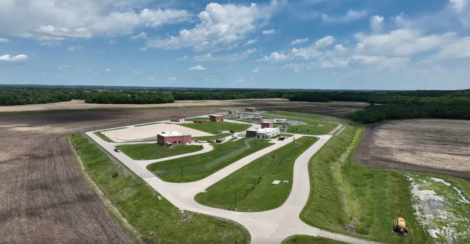
$74M in eco-friendly improvements to Kansas River wastewater treatment plant are nearly complete
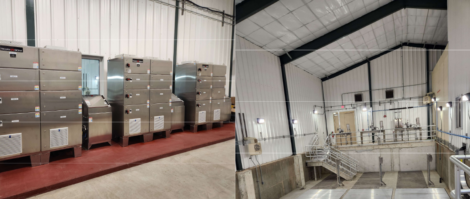
photo by: Screenshot/City of Lawrence
These images from the City of Lawrence show the new ultraviolet light building at the Kansas River wastewater plant.
More than $74 million in improvements to reduce the Kansas River wastewater treatment plant’s impact on the environment are almost complete, city staff said this week.
At the Connected City Advisory Board’s meeting on Monday, Trevor Flynn, assistant director of Municipal Services and Operations, said the project had reached its “date of significant completion” this week. From here, it’s a matter of “getting a few last things online,” he said.
“Final completion’s about 30-ish days,” Flynn said. “We should be pretty much there.”
The plant improvements have been in the works since 2023, as the Journal-World reported, and the budget for the project has been $74.4 million. It’s intended to improve the removal of nitrogen and phosphorus from the water being discharged into the river.
Flynn said the improvements might be difficult to notice at first glance, but that the changes were impactful.
“If you’re not going to the plant very frequently, you probably wouldn’t notice a whole lot other than a couple of new buildings, because the basins are all the same structure,” he said.
Those basins have in fact been converted from aeration basins to biological nutrient reduction basins. “It’s bugs,” as Flynn described it – bacteria that feed on phosphorus to get it out of the water.
Reducing nitrogen and phosphorus in the water that’s released into the Kansas River is important, because too much of these nutrients in bodies of water can harm the environment. According to the U.S. Environmental Protection Agency, excess nutrients can cause algae to grow faster than ecosystems can handle and decrease the levels of oxygen, which fish and other aquatic life need to survive.
“Nutrients are hard to get out,” Flynn said. “It takes a lot of money. Obviously it took us $74 million for this upgrade just to do it.”
There’s also a new treatment building that uses ultraviolet light for disinfection. Previously, there was a basin that used chlorine for disinfection, and Flynn said “we’ll save a lot of money and chemical there” by using the UV light instead.
In addition, the renovations have added a new building for the plant’s supervisory control, data and servers. It’s much safer than the old server room, Flynn said, which was in the basement and prone to flooding.
As the Journal-World previously reported, the Kansas River plant, at 1400 E. Eighth St., began operating in 1956 and has seen various updates and additions over the years. It handles 8 million gallons of water every day, equal to 80% of the city’s wastewater. The rest is handled by the Wakarusa Wastewater Treatment Plant, which was built for $74 million and opened in 2018. That plant already has biological nutrient removal processes in place – it was built for that, Flynn said.
Once the final few touches are done, Flynn said the process of breaking in the new plant will begin. It will take some time to get everything working smoothly, he said, noting that the biological processes “can be finicky.”
But he hopes it will be working well by December of this year. Under an agreement with the Kansas Department of Health and Environment, the plant must comply with certain phosphorus levels by Dec. 31, 2027, but Flynn said the target is an annual rolling average, so “we actually have to be kind of hitting our target for a full year.”
“We’re actually a little bit ahead of schedule here on completion,” Flynn said. “And we’re glad, because that gives us more time to kind of dial in the operation part.”
City Government

With new murals, Junior Girl Scouts and Jewish congregation hope to turn bland buildings ‘into something beautiful’

60 people from 23 states have applied for Lawrence’s city manager position, mayor says
City of Lawrence will soon start application process for a construction manager for Fire Station 6
Survey respondents think Lawrence is doing well on arts and culture, not so well on economy

Rising Rates: A three-part investigative series examines why Lawrence water and sewer bills have been soaring