

Survey respondents think Lawrence is doing well on arts and culture, not so well on economy
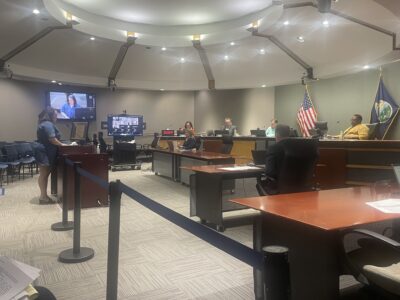
photo by: Sylas May/Journal-World
City spokeswoman Cori Wallace addresses the Lawrence City Commission on Tuesday, April 7, 2026.
As the City of Lawrence prepares to start its next strategic plan, a survey is showing that residents are feeling good about arts and culture, but not so good about the economy, city leaders heard on Tuesday.
At their weekly meeting, city commissioners heard the results of the National Community Survey, also known as the Community Satisfaction Survey, which was completed by polling firm Polco. The survey compares respondents’ opinions of Lawrence to opinion benchmarks gathered from cities around the U.S. about the economy, local arts and culture, tourism and more.
City spokeswoman Cori Wallace said the city hadn’t participated in a survey like this since 2022. She said it was important to have this kind of data to help the city plan for the future.
“The best decisions we make as a city are informed by the people that we serve,” Wallace told the commission.
Polco executive vice president of data and insights Sonya Wytinck said the survey was sent to 4,000 randomly selected households and received 405 total responses from them. In addition, in a link to an online survey that was open to all residents, she said 201 responses were received. The results were “statistically very sound,” she said, and designed to give a holistic picture of the community.
“If you think about survey polling, when it’s randomly sampled correctly, it does represent your community,” Wytinck said.
What the survey revealed was that Lawrence has “many strengths,” as well as “opportunities for improvement,” Wytinck said. In many ways, Lawrence is similar to other cities around the nation, but it exceeds the benchmarks for education and arts and culture, and is below the benchmarks for safety, parks and recreation and the economy.
In addition to asking residents to rate city services, the survey asks about how important residents think the issues are, and Wytinck said “there is a clear gap between the quality and importance of the economy, with quality outpacing importance.”
“These issues are not unique to Lawrence,” she said, but they are “top of mind” for many people.
Wytinck emphasized that “arts and culture shine in Lawrence,” and that visitor amenities and the vibrancy of downtown also ranked highly. And public transportation ratings “hit the mark quite well when compared to communities nationwide,” she said. Around 6 in 10 residents gave high marks for bus and transit services, which was higher than the national benchmarks, and 39% reported having used public transit instead of driving, higher than the national benchmarks.
In addition, she said the community’s volunteerism and activity in the community were strong. “One of the most encouraging findings is that Lawrence residents are highly engaged,” she said.
Other areas were weaker, though none was as weak as economic issues. Only one in 10 respondents were content with the availability of affordable housing, and only 22% were satisfied with cost of living, the results said.
Several questions about local government fell below the benchmarks. The government’s ratings for transparency, acting in the best interest of the community and overall competence all lagged the national stats.
And as for safety, 65% of respondents said they felt it was good or excellent in Lawrence. While 94% of respondents said they felt very or somewhat safe in their neighborhoods during the day, around three out of four said they felt very or somewhat safe from violent crime, property crime or while downtown.
Vice Mayor Mike Courtney asked why those perceptions of safety were the way they were. “The ‘why’ of an answer or response is always difficult to identify,” Wallace told him.
Commissioner Mike Dever said he thought the reasons were something the community needed to talk more about in the future.
“I do believe there is an overall problem with how people perceive public safety downtown,” Dever said.
Mayor Brad Finkeldei said he would be interested in looking at the results that were most dissatisfied. He noted that the survey drew a dividing line between “good or excellent” and “fair or poor” in reporting its results.
“Some people think fair is good,” he said. “… I’m always interested in looking at the poor side of it.”
As for how the data will be used, Wytinck said it could inform a variety of things, including the budget and the city’s strategic plan. The city will soon be developing its next strategic plan after it hires its next city manager to replace outgoing City Manager Craig Owens.
Polco is the company that facilitates the city’s “A Balancing Act” budget simulator tool, Wallace said, and the city chose to do this survey with Polco because it fit in with that tool. And going forward, Lawrence hopes to do surveys similar to this one every two years and compare the results over time, she said.
“This gives me a lot to think about,” Commissioner Amber Sellers said, as the city heads toward the strategic planning process.
City Government
Survey respondents think Lawrence is doing well on arts and culture, not so well on economy

Rising Rates: A three-part investigative series examines why Lawrence water and sewer bills have been soaring
Some leaders are now stating a new reason for why Lawrence’s utility rates are soaring: The city didn’t grow enough

Lawrence City Commission could start the process of finding a construction manager for new fire station

Lawrence is charging water, sewer customers a special tax not required by state or city law
