

Lawrence is charging water, sewer customers a special tax not required by state or city law
The tax isn't listed on the city's monthly bills, and city has no policy governing it

photo by: AdobeStock
Lawn sprinklers are shown in this AdobeStock image.
In the world of water and sewer utilities, what you can’t see often rules the day — miles and miles of pipes beneath the ground.
Those pipes, some more than a century old, are the most frequent exhibit city officials point to when residents question why water and sewer bills in Lawrence are increasing at rates far greater than inflation. To keep the system efficient and reliable, old pipes and other aged infrastructure must be replaced, with costs routinely running in the tens of millions of dollars per year.
A review of city financial records backs up the claims that the city is spending heavily on water and sewer infrastructure projects. The city’s audited financial statements show that the city-owned water and sewer utility spent $18.8 million in principal and interest payments for sewer projects in 2024, and has spent, on average, nearly $18 million per year since 2019.
But those same records, if you read them closely enough, report another cost that isn’t buried beneath the ground but is nonetheless not likely seen by most water and sewer customers: The city charges it water and sewer customers a tax that is not required by either state or city law.
A Journal-World investigation found that the city is charging water and sewer customers a de facto franchise fee without any city policy in place governing how much the tax should be nor how it should be charged or communicated to the public.
According to the city’s records, the de facto tax generated $6.8 million, or about about 10% of the entire revenue stream of the city’s water and sewer utility. However, no part of the monthly bills that the city sends to water and sewer customers mention that a portion of their payment is for the de facto tax.
The investigation also found that the city is charging the tax at a rate that is approximately twice as high as the rate that for-profit utilities — which are required by law to pay the tax — are charged.
The city disputes that finding, but in doing so is acknowledging that its audited financial statements for 2024 are in error. The 2024 financial statements include a straightforward statement that the city’s water and utility fund took $6.8 million of ratepayer funds and transferred them to the city’s general operating fund as a “payment in lieu of franchise fees.”
The $6.8 million total is 9.8% of the water and sewer department’s local revenues. Both state law and the agreements the city has with various for-profit utilities — Evergy and AT&T are examples — require that franchise fee payments be no greater than 5% of a utility’s local revenues.
When the Journal-World questioned why the city was charging its own utility a rate that is nearly twice that amount, city officials said they would have to research the issue. Days later, the city said it had determined the statement in the 2024 financial report was inaccurate.
The financial statements “should have provided clearer detail” about the $6.8 million transfer, Rachelle Mathews, the city’s director of finance, told the Journal-World via email. Upon review, the city determined that $4.224 million of the amount was a payment in lieu of franchise fee that went to the city’s general operating fund. The remaining $2.6 million, however, was a transfer to a capital improvement fund and should not be counted as a payment in-lieu of franchise fees, Mathews said.
When the Journal-World said it would need to hear directly from the city’s third-party auditing firm — RSM US, LLP — that the audited financial statements were in error, the Journal-World was told the auditors “are required to maintain client confidentiality,” and thus would not be able to discuss the matter with the Journal-World.
When the Journal-World questioned how that could be the case — the city is the auditor’s client and thus can waive any confidentiality requirements, and the city’s financial statements by law are public documents — the city modified its response. On Tuesday, it simply said the auditing firm would not speak to the Journal-World about the matter.
“RSM, consistent with their standard professional practices and policies as an independent audit firm, does not provide comments to the media regarding client matters,” City spokeswoman Cori Wallace said in an email to the Journal-World.
The questions about the de facto tax come during a period when local residents are experiencing some of the largest rate increases on record. From the beginning of 2022 through 2025, the city’s water and sewer rates increased by an average of 9% per year, with increases hitting 11% in 2025.
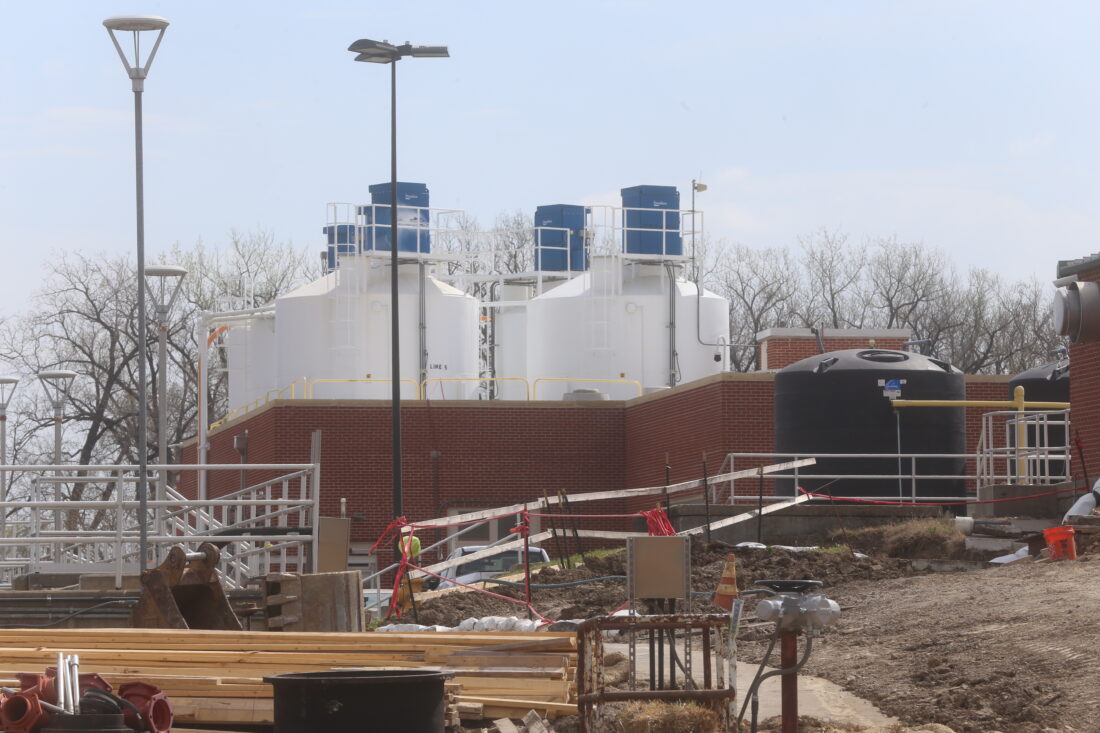
photo by: Chad Lawhorn/Journal-World
Construction work at Lawrence’s Kansas River Treatment plant is shown on March 31, 2026
A TAX TO USE CITY-OWNED LAND
Putting aside, temporarily, the question of how much has been collected, city officials said there are good reasons that the city should be charging its water and sewer customers the de facto tax. To understand why, likely requires a better understanding of what a franchise fee is designed to do.
A franchise fee basically is designed to compensate cities for when their publicly-owned rights of ways — think of the land beneath and along city streets, for example — are used to help for-profit utility companies make a profit.
Evergy, for example, uses miles and miles of city of rights of ways to house its electric lines, which are the core components of the company’s multibillion dollar business. The same is true for other utilities like natural gas providers, broadband internet providers and others that string wires or bury pipes on city-owned land.
The city’s water and sewer utility uses the city’s rights of ways in much the same fashion. Many city streets have water and sewer lines beneath them. But unlike Evergy or other utilities, the city’s water and sewer department doesn’t use the rights of ways to turn a profit for shareholders. The idea of a city department paying a tax also is unordinary. City governments generally are exempt from paying all sorts of taxes.
Lastly, by paying the de facto franchise fee, the city essentially is charging one of its own departments a fee for the right to use city-owned property that was bought or acquired by the city for the purposes of providing city services.
At least that is one way to look at the arrangement, but it is not the only way, Mayor Brad Finkeldei said. He told the Journal-World that a better way to view the matter is that the city isn’t making a city department pay the fee but rather is making water and sewer ratepayers pay the fee.
That’s an important distinction, Finkeldei said, because it gets at the heart of who should pay for what. The city’s general operations — police, fire, road repair and other such functions — largely are paid for by taxpayers. The city’s water and sewer service are paid for by ratepayers. Most ratepayers are also taxpayers, but not always.
The biggest example in Lawrence is its biggest employer — the University of Kansas. While it owns billions of dollars in buildings, relies on the city’s fire department, road system and other services, it basically pays no property or sales taxes to the city.
But it does pay for its city water and sewer service, and those services rely heavily on the use of the city’s rights of ways. In that regard, Finkeldei said the idea of charging the city-owned utility a de facto franchise fee makes good sense.
“To me the philosophy is that we should have our utilities be self-supporting and paid for by the users,” Finkeldei told the Journal-World. “That is particularly important in Lawrence where we have many users who don’t pay property taxes and don’t pay sales taxes.”
Finkeldei said he thinks many residents who are concerned about the amount of their property tax bills should be pleased to know that the city is implementing the de facto franchise fee because it is one way to tackle an issue that comes up frequently — why doesn’t KU have to pay taxes to support the services it receives from the city?
“I think for an individual citizen property taxpayer, I think most of them would be happy to hear that we are finding a way to have KU and other non-property taxpayers support the overall budget of the city,” Finkeldei said.
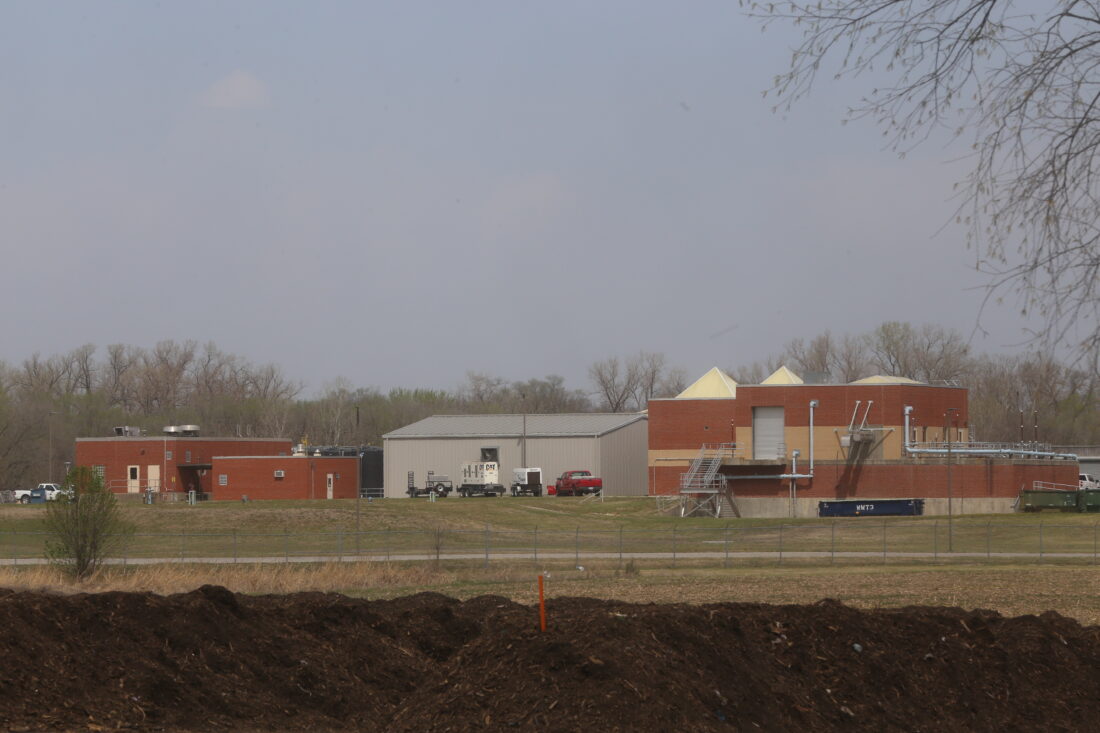
photo by: Chad Lawhorn/Journal-World
Lawrence’s sewage treatment plant in far eastern Lawrence is shown on March 31, 2026.
ABSENT FROM BILLS
In that regard, the franchise fee is a way to get monies from the university — or others who don’t pay taxes — that can easily be used to help pay for fire, road maintenance and other such services. But the franchise fee isn’t just paid by entities who don’t pay regular taxes. Ordinary residents who pay property and sales taxes are paying the franchise fee as well.
However, many of them may not know that.
Unlike other utilities, like Evergy and Black Hills Energy, the City of Lawrence does not list the franchise fee amount on the bills it sends to its customers. Unless you are a close follower of city finances, you likely wouldn’t know that a portion of your payment is being used to make a de facto tax payment to the city.
When asked about why the city doesn’t list that franchise fee on its bills when other utilities that operate in Lawrence do, Finkeldei said the city’s practices may need to change. He said it was an issue he had not previously considered, but said it would add a new level of transparency to the city’s practice.
“I think there could be some benefit in that it would actually show folks that some of this is supporting more general uses, and might remind them that users are paying that,” Finkeldei said.

photo by: Journal-World
Lawrence city manager Craig Owens is pictured on Tuesday, Nov. 5, 2019, outside City Hall.
A HIGHER RATE
How much city water and sewer customers are paying, however, is still a big question hanging over this debate.
What is clear, though, is that city water and sewer customers are paying more than the 5% rate that customers of Evergy, AT&T, Midco, Atmos and other such utilities are paying.
If you take the city’s 2024 financial statements at face value, city ratepayers are paying a rate nearly 100% higher than what customers of other utilities pay.
However, the city’s financial records do contain information that suggest the actual amount may be less than the full $6.8 million transfer. The records do show that a $2.6 million transfer was made to the Utilities Non-Bonded Construction fund in 2024.
It was the city’s disclosure of that $2.6 million transfer that caused the Journal-World to begin looking at the history of the Utilities Non-Bonded Construction fund. As reported earlier this week, the Journal-World found multiple questions about the financial history of the fund. While the investigation didn’t find evidence of fraud, questions about what happened to $1.8 million of funds that once resided in the fund remain unanswered.
Also unclear is whether the $2.6 million transfer might still need to be classified as a payment in lieu of franchise fees. The fact the money went to a construction fund doesn’t mean it wasn’t also a payment in lieu of franchise fees. Without being able to question the auditing firm, it isn’t known whether the classification of the transfer as a payment in lieu of franchise fees was intentional or an error.
But what is clear is that even if you agree with the city’s finding that only $4.224 million of the $6.8 million transfer should be classified as a payment in lieu of franchise fees, city ratepayers are paying a franchise fee that is greater than 5% of local revenues, which is the cap in state law.
The $4.224 million payment in lieu of franchise fees was equal to a little more than 6% of the water and sewer department’s revenues. In other words, that is a rate that is more than 20% higher — the difference between 5% and 6% — than what the state says cities can charge private utility companies.
But the state-imposed cap does not apply to the city since it is charging a de facto franchise fee to its own department. City Manager Craig Owens said he’s comfortable charging a higher rate because he believes the state imposed cap is too low.
“I don’t think it was done super scientifically, and I certainly don’t think it captures the full value of the public asset that private companies are able to take advantage of,” Owens said of the 5% state-imposed cap.
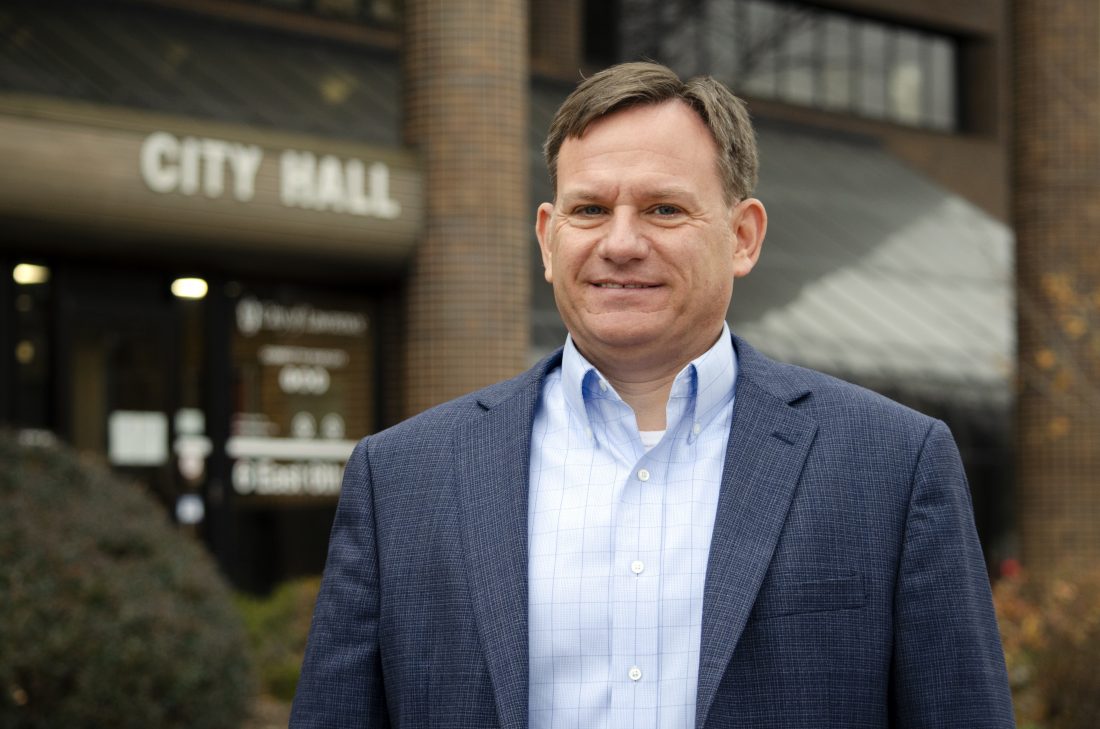
photo by: Ashley Golledge
Vice Mayor Brad Finkeldei is pictured Tuesday, Nov. 24, 2020 outside City Hall in downtown Lawrence.
NO POLICY
Whether city commissioners agree with that approach is unclear. Owens acknowledged that the issue of payment in lieu of franchise fees has not come up as a discussion point with the commission during the six-and-a-half years he has been the city manager. The city also confirmed that it does not have a written policy that states the rationale for the payment in lieu of franchise fees nor how the fee should be calculated.
That’s different than how the city deals with private utilities. Each franchise fee charged to a private utility is governed by formal, multi-page agreements. It also is different than how some other cities deal with the issue of charging a franchise fee to a city-owned utility.
The idea of a de facto franchise fee is not unique to Lawrence. In reviewing the financial statements of other cities, the Journal-World found multiple examples of Kansas cities transferring money out of their water and sewer funds into their cities’ general operating funds. Most did not label the transfer as a payment in lieu of franchise fees.
The City of Topeka, however, did label its $5.4 million transfer as a “payment in lieu of taxes.” That is a broader term that would allow the city to collect a de facto property tax payment from the utility, for example. Private utilities, after all, must pay property taxes on their plants and other real estate.
Topeka’s financial statements also made clear that Topeka has a policy on how any such payment in lieu of taxes should be calculated. The policy includes instructions on how to value and assess taxes on property used by the utility, and sets a 3% cap on the franchise fee portion of the payment.
There’s record of Lawrence city commissioners having one discussion of whether the city should have such a policy. That discussion took place in 2011, and resulted in no policy ever being created, according to city meeting minutes. That discussion came about after a city auditor recommended on multiple occasions that the city should have a written policy if the city was going to transfer millions of dollars in ratepayer funds to the city’s general operating fund.
The city for decades has indeed made such multimillion dollar transfers. But for most of that time the transfers were characterized as payments for specific city services. Common examples were the city’s legal services department does all the legal work for the utility department, and the city’s mechanic shop repairs all of the department’s equipment.
The city several years ago, though, stopped using general transfers to pay for those types of services. They now are handled through a separate internal service fund. The big multimillion dollar transfers, however, continued to happen. In 2018, the city’s audited financial statements began referring to the transfers as “payment in lieu of franchise fees.”
Owens — who is leaving his position as city manager in May — told the Journal-World that he thinks a policy could be appropriate but it is not problematic that one doesn’t exist because city commissioners are responsible to both taxpayers and ratepayers.
“No particular reason,” Owens said of why the city doesn’t have a policy, “other than the same governing body is the same governing body that does both.”
The City Commission indeed does have full control over what size of payment in lieu of franchise fee the utility department is required to make. Such decisions typically would be made during the City Commission’s budget hearings each summer. However, as Owens stated, he doesn’t recall the topic of payment in lieu of franchise fees ever being discussed with the commission during his tenure.
Budget documents provided to city commissioners for consideration do not label the transfer from the utility department to the general fund as a payment in lieu of franchise fees. Commissioners likely would only be aware of that distinction if they read a particular note deep in the city’s audited financial statements. The budget documents provided to commissioners for discussion simply list the dollar amount of the transfer with no details about is purpose. Historically, the transfer has drawn little discussion during the process.
But with little discussion about the transfer itself, and with no policy guiding the size or purpose of the transfer, both Owens and Finkeldei were asked what assurances ratepayers had that the city wasn’t crafting a transfer that simply used utility funds to fill gaps in the city’s general operating budget?
Owens said that question deserved more thought and consideration. Mayor Finkeldei said he understands why some may be concerned about that prospect.
“I mean, I think that’s fair,” Finkeldei said of the question. “And, yeah, I think that’s a fair point.”
City Government
Lawrence is charging water, sewer customers a special tax not required by state or city law

Lawrence housing market strains residents as development fails to keep up, city’s affordable housing study finds
Property tax protest bill would let a few dozen voters block tax increases in some parts of Douglas County
Portion of 19th Street to close during much of April for stormwater structure replacement

With water and sewer rates soaring, a city utility fund has had multiple financial discrepancies
