With water and sewer rates soaring, a city utility fund has had multiple financial discrepancies
City commissioner calling for forensic audit, saying she 'lacks confidence'

photo by: AdobeStock
City of Lawrence water and sewer rates have increased by more than 9% per year, on average, since the beginning of 2022.
As water and sewer rates are soaring in Lawrence, the whereabouts of $1.8 million of ratepayer funds at City Hall is unclear, a Journal-World investigation has found.
While reviewing years of audited financial statements and budget records in an attempt to learn more about why Lawrence utility bills have been increasing at rates far greater than inflation — last year rates increased by 11% — the Journal-World found a nearly $2 million discrepancy in a utility fund used for miscellaneous construction projects.
City Hall officials were presented questions about the discrepancy more than two weeks ago, and on Tuesday afternoon offered their first response. They acknowledge that the financial tallies in the Utilities Non Bonded Construction Fund changed significantly from past audited financial statements, but city officials now contend that the audited financial statements are not the best representation of the city’s actual finances. Instead, unaudited budget documents are a better representation, a city official said.
“The audited financial statements represent a snapshot at year-end, while budget documents may reflect updated or restated figures as more complete information becomes available,” an email from city spokeswoman Cori Wallace said.
That response brought disappointment and a call for a forensic audit of city finances from one city commissioner who already had been raising red flags about the city’s financial reporting practices.
“To be very clear, I do not believe there is anything nefarious or fraudulent going on with the city’s finances,” said City Commissioner Kristine Polian, who is a former chief financial officer for various public entities. “However, I lack confidence that everything is being tracked properly, mainly because we have such a convoluted finance structure, and I am very disappointed in the level of information being provided to city commissioners.
“There have been significant decisions made by the past city commissioners in the areas of of debt, CIP, personnel decisions, and general use of taxpayer dollars with very little information on which to base those decisions.”
While there is currently no evidence that the funds have been stolen or otherwise fallen victim to fraud, questions of where the funds are residing, whether they have been used to support the city’s utility system as designed or whether they have been used at all remain outstanding. The Journal-World has asked for a copy of the financial ledger tracking the funds, but had not received one as of midday Wednesday.
All of the activities surrounding the city’s utility department came during a period when local residents were experiencing some of the largest rate increases on record. From the beginning of 2022 through 2025, the city’s water and sewer rates increased by an average of 9% per year, with increases hitting 11% in 2025.
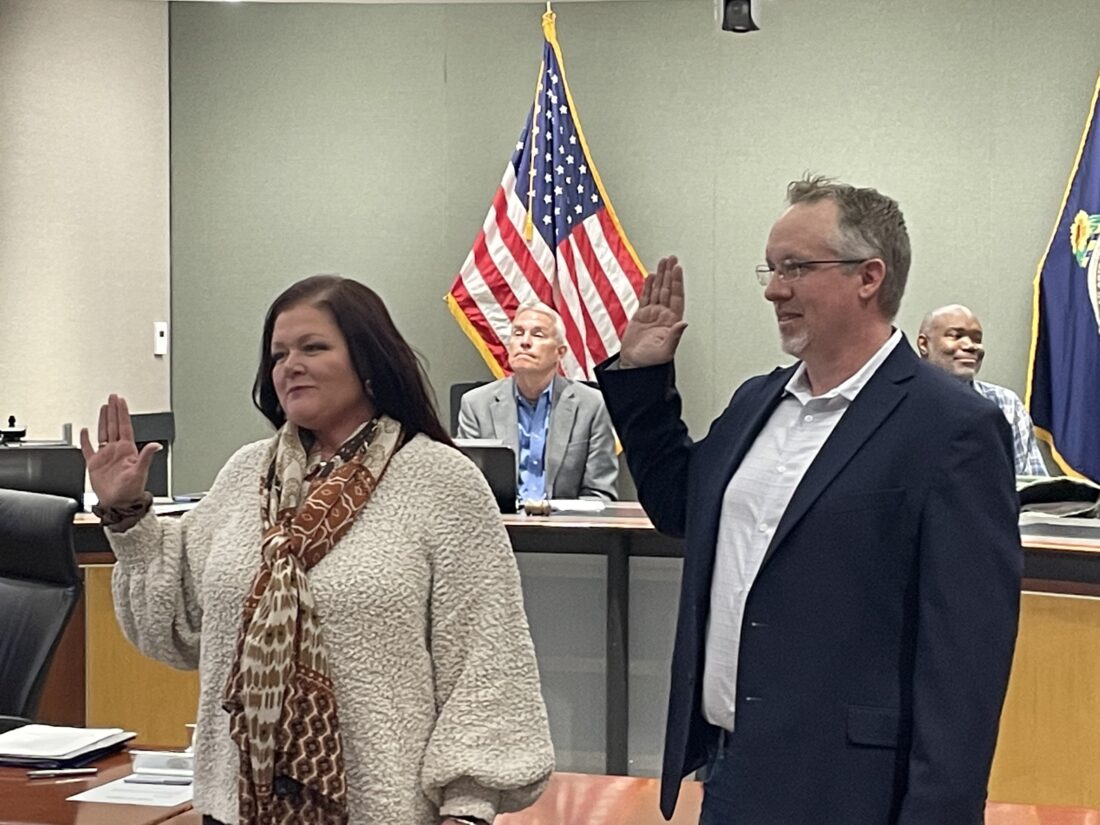
photo by: Sylas May/Journal-World
New city commissioners Kristine Polian, left, and Mike Courtney are sworn in on Tuesday, Dec. 2, 2025, at Lawrence City Hall.
Millions in past errors
City budget documents aren’t the most fascinating of reads, but they can create a tale of mystery, especially if you are willing to go through years of them.
City budget documents show that at the end of business on Dec. 31, 2022, a city fund known as the Utilities Non-Bonded Construction Fund had $9,862,184 in it. The next year’s budget documents show that the same fund started Jan. 1, 2023, with $8,045,348.
In other words, the calendar flipped, and approximately $1.8 million of public money disappeared from the fund. To this day, it is still not clear to the public where the money went.
The Journal-World began asking City Manager Craig Owens and Director of Finance Rachelle Mathews about the $1.8 million discrepancy on March 16. On Tuesday, 14 days later, the city provided a response about how such discrepancies can arise, but did not provide specific information about this particular discrepancy. Instead, the city said the discrepancy was related to “accounting and reporting adjustments rather than a single expenditure or transfer.”
“These can include year-end reconciliations, encumbrances (funds committed but not yet spent,) or reclassification of funds based on updated financial reporting standards,” Wallace said in an email to the Journal-World.
Such discrepancies also can be the result of errors. While the city’s statement to the Journal-World didn’t acknowledge that was the case in this instance, a deeper dive into the city’s 2023 audited financial statements raises questions about whether an error is behind the discrepancy.
A note in the 2023 audited financial statements discloses that in 2022 the city’s water and sewer fund had several errors related to when construction projects were being booked on the city’s financial sheets. Errors also were found to have been made in where the city was placing the proceeds of bond sales that the city conducted to raise money for various construction projects.
The errors, the auditors noted, required significant adjustments to the city’s 2022 financial statements after the fact. Adjustments in the city’s water and sewer fund meant that the city actually had $164.9 million available for water and sewer activities in 2022 instead of the $161.2 million that city officials believed was the case.
Those changes don’t necessarily explain the discrepancy with the Utilities Non-Bonded Construction Fund, though. That fund saw a loss of funds during 2022, ending the year with $1.8 million less than the city had thought it had.
City officials consider the Utilities Non-Bonded Construction Fund to be an audited fund because it is “subject to annual review by the independent auditors.” However, the city’s audited financial statements do not provide any specific information about the fund. While the financial statements provide specific totals for dozens of funds, the Utilities Non-Bonded Construction Fund is not one of them. Rather, the Utilities Non-Bonded Construction Fund is simply added into the general results of the city’s larger water and sewer fund, the city told the Journal-World via email.
Rate impacts
Knowing how much money the city has in a fund, of course, is important at all times. But it is particularly good to know during the months when city commissioners are setting budgets and utility rates for the coming year.
Documents from the city indicate that City Hall officials did not know how much money the utilities fund had in it when commissioners were setting the budget and rates for 2024. The city published its 2024 Budget Book in September 2023 — nine months after the city closed its financial books for 2022. The Budget Book still listed the Non-Bonded Utilities Construction Fund as having $9.8 million in it, not the $8 million that it was later determined to have. The Journal-World has asked the city when the fund had its balance reduced, but hadn’t received a response as of midday Wednesday.
A review of multiple years worth of documents for the Non-Bonded Utilities Construction Fund shows the fund has a history of big changes in dollar amounts and big misses when it comes to budget projections.
During budget-making and rate-setting season, city commissioners frequently were told the fund would have significantly fewer dollars in it than was actually the case, records show.
A prime example is 2024, when city commissioners ultimately approved water and sewer rate increases that totaled 10.25%. During the summer of 2023 — which is when commissioners were crafting the 2024 budget — city documents show commissioners were told the Utilities Non-Bonded Construction Fund was expected to have a balance of approximately $233,000 at the end of 2023.
That was a problem because city staff members were proposing that the fund pay for $2.6 million worth of construction projects in 2024. As a result, commissioners agreed to take $2.6 million of ratepayer funds out of the city’s water and sewer utility operating fund and transfer it to the Utilities Non-Bonded Construction Fund.
In retrospect, the transfer didn’t need to happen for two reasons. The first reason is the Utilities Non-Bonded Construction Fund ended up finishing 2023 with a balance more than the projected $233,000 — a lot more.
The fund ended 2023 with $7,080,759. In other words, the fund had plenty of money to undertake $2.6 million worth of construction projects. However, that didn’t end up mattering either. Ultimately the city did not use the fund to pay for $2.6 million worth of construction projects in 2024. Instead, it paid for $1 million worth of activity.
The multimillion-dollar misses had an impact on water and sewer customers. The $2.6 million that was transferred into the Utilities Non-Bonded Construction Fund came from the rates that water and sewer customers pay each month. Those rates increased by 10.25% in 2024 — which until the 2025 rate increase of 11% was the highest in recent memory.
In total, those 2024 rates generated $6.8 million in additional revenue for the city’s water and sewer utility. The $2.6 million transfer is equal to 37% of the new rate dollars. Had city commissioners known that the fund had $7 million in it, instead of just $233,000, they may well have recalculated what was needed for a rate increase. If the $2.6 million transfer didn’t need to be made, the city could have accomplished everything else in its water and sewer budget with a rate increase of approximately 6.5% instead of the approved 10.25% increase.
City Hall officials said the fact the fund had more money than thought wouldn’t necessarily have justified lower utility rates in 2024.
“A single year where revenues are higher than expenditures does not necessarily indicate that rates are too high,” the email from Wallace said. “Utility rates are set based on long-term financial planning, not just one year of results.”
The email further explained that the Utilities Non-Bonded Construction Fund originally was scheduled to spend $11.5 million to pay for water projects west of the South Lawrence Trafficway, which is an area the city is preparing to grow into. But as development there has occurred “more slowly than anticipated,” those funds were never spent, the city said via email.
Now, as development talk for the area has begun again, the city plans to use debt to pay for those west of the SLT projects. That means the money set aside in the Utilities Non-Bonded Construction Fund won’t be used for the west of the SLT projects, the city said via email.
What the money in the fund will be used for hasn’t been determined, but the city is not recommending that it be used for ratepayer relief.
“The city has chosen to maintain most of the balance to support future infrastructure needs and preserve financial flexibility,” the city said via email.
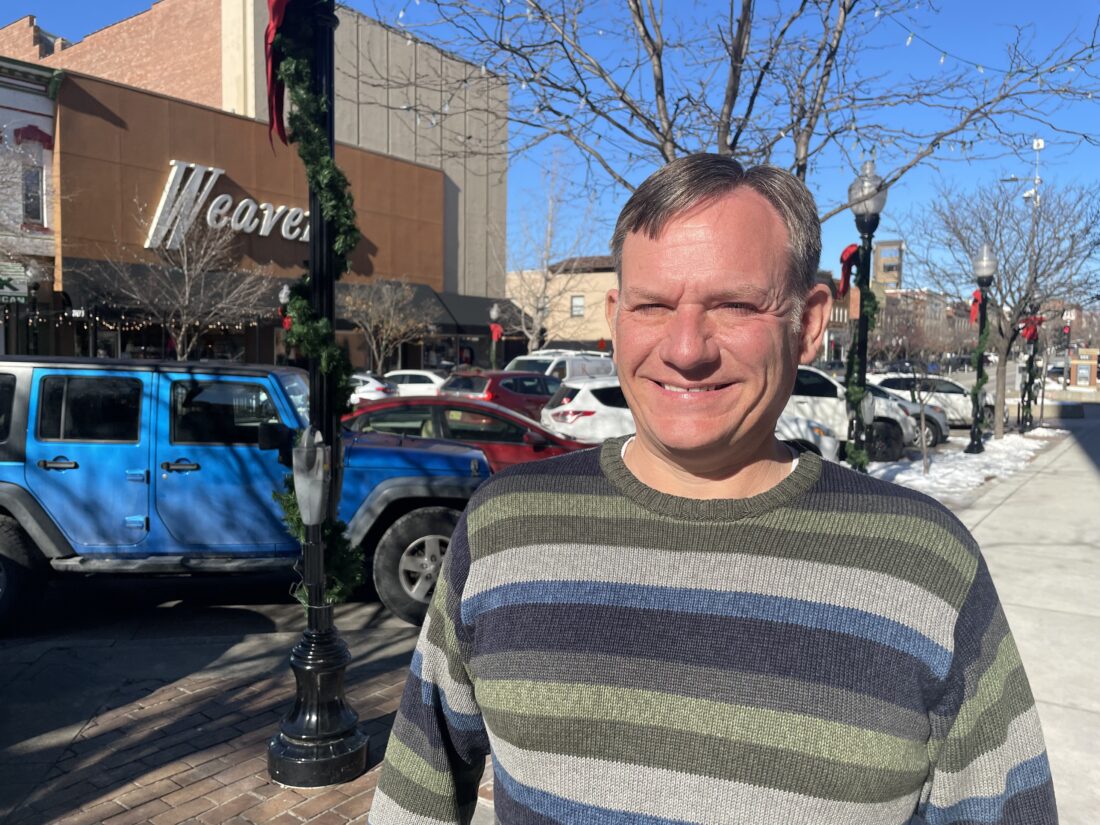
photo by: Sylas May/Journal-World
Mayor Brad Finkeldei is pictured Thursday, Dec. 4, 2025, on Massachusetts Street.
Forensic audit needed
Polian said the most recent findings reinforce her belief that the city needs to hire a third-party financial professional to conduct a “forensic audit” of all major capital improvement projects that have occurred during the past five years.
A forensic audit is different than the city’s year-end audit of its financial statements. A forensic audit would look at the financial activity of specific projects, rather than the city’s finances in general. A forensic audit also would examine whether projects are complying with various requirements from parties such as federal regulators, bondholders and others.
“I want to see a big picture of how our capital projects have been going because we have been throwing so much money at these capital projects in the last five years,” Polian told the Journal-World. “I lack confidence that the oversight has been there.”
Mayor Brad Finkeldei, who spoke to the Journal-World about the $1.8 million discrepancy prior to the city sending its statement to the Journal-World on Tuesday afternoon, said he hadn’t been aware of the discrepancy in the Utilities Non-Bonded Construction Fund.
He said there are good reasons that the fund may carry a large balance that doesn’t get immediately spent, even during times when residents are experiencing higher rates. He said the city will have many needed utility projects in future years, thus he expects the funds to get spent on those upcoming projects.
Polian said she thinks spending the funds right away before inflation takes its toll on the money may be a better option than letting them sit unused for multiple years.
But the debate over the appropriate amount of money the fund should have is secondary to the question of whether the city knows how much money the fund has in it at any given time. Finkeldei said accuracy of the financial statements must be a priority.
“Clearly you always want your financial statements to be accurate, and certainly when I joined the commission, we had the situation where we didn’t even pass our audits,” Finkeldei said of when he joined the commission in late 2019. “But we have corrected that, we’ve had some clean audits from here on out.”
He also said he has confidence in the staff and consultants who are creating the rate models used to fund the water and sewer department. He said those rates are carefully created to ensure that the city has enough ratepayer dollars coming in to keep the system working efficiently and reliably.
“I feel that we have several outside vendors always looking at that, and I feel good about that,” Finkeldei said. “But, if there are concerns, I’m also not opposed to making sure the information is accurate.”
Polian said she will continue to push for commissioners to approve the hiring of a forensic auditing firm to review the capital improvement projects because “we are issuing an immense amount of debt and I need comfort.”
“I’ve slowly been trying to say, ‘hey, this is a problem,'” Polian said. “But if you do that forensic accounting, I’ll be grateful if things are great. I’ll be so grateful, but I suspect they are not.”
City Government
With water and sewer rates soaring, a city utility fund has had multiple financial discrepancies

At city compost facility this weekend, staff will load vehicles with compost and wood chips

City of Lawrence rolls out new engagement platform for public feedback on 2027 budget; will host ‘drop-in’ engagements over next two weeks
In the complex ‘ecosystem’ of city government, Lawrence’s mayor asks sustainability advisers to look at the big picture
Some fire stations in Lawrence respond to fewer calls than others; a look at the data and whether it means anything for Station 6