

After illness, injury and weeks of training in the Himalayas, northeast Kansas man reaches the top of Mount Everest
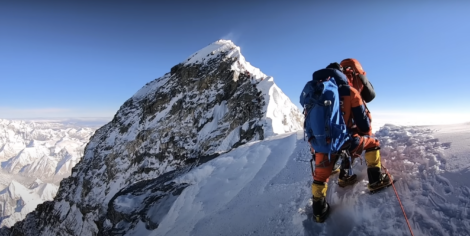
photo by: Contributed
Rhett Evans climbs Mount Everest in May of 2024.
For years, Olathe’s Rhett Evans had his sights set on climbing Mount Everest. But when he got to Nepal this spring — and got very sick with a parasite — it was possible he might not even make it to base camp.
Evans, 55, had eaten some bad meat near the beginning of his weekslong expedition. Before he even reached the staging area for the Everest climb, he was “extremely sick,” he said. His bout with the illness lasted just a few days, but it cost him a lot of weight and strength that he had built up for the lengthy ascent.
“I really thought that might take me out of the climb,” Evans said.
But Evans, who works in Lawrence as CEO of the Golf Course Superintendents Association of America, wasn’t about to quit. He’d climbed some of the world’s tallest peaks before — Kilimanjaro in Africa, Denali in Alaska. And he knew that unexpected challenges are part of the deal.
“Anytime you’re in the wilderness, there are a lot of things that can go wrong, and there can be challenges with your body,” he said.
And he persevered. He made it through a period of acclimatization and conditioning high in the Himalayas — injuring himself along the way and having to work around a bad arm — and ultimately reached the summit in May in a grueling five-day push upward.
This past week, Evans spoke with the Journal-World about how he overcame one of mountaineering’s biggest challenges, as well as the lessons from the climb that he says are just as useful in business and all other challenges of life.
• • •
It was in April that Evans began his lengthy trek. He and a climbing partner embarked from Kathmandu, the capital of Nepal, which is about 4,600 feet above sea level. Their goal, the top of Everest, is more than six times that elevation — just over 29,000 feet above sea level.
For the climbers, who were assisted by a mountaineering company called Pioneer Expeditions, the first step on the journey is getting to base camp, about 17,500 feet above sea level, and even that is no small feat. That phase of the trip — sickness and all — took 14 days and covered about 40 miles through the Himalayas, Evans said.
In some ways, making it to base camp is a reset, he said: “Once you’re at base camp, that’s where the climb really starts.”
But it’s also a signal that the work is about to get much harder.
While you’re preparing for the climb at base camp, you are living for an extended period of time at an altitude 3,000 feet higher than any mountain in the Colorado Rockies, Evans said. Including the climb to the summit and back, he said he spent more than a month in these conditions, at an altitude of around 17,500 feet or higher.
Everest itself is more than 10,000 feet higher than that base-camp level, and conditions at the top are much harsher. That’s why much of the time at base camp is spent on practice expeditions, going higher and higher each time to acclimatize.
Evans said climbers do a series of “rotations” on Everest itself and other nearby mountains, climbing partway up and then back down to base camp repeatedly and going a bit farther each time.
On one of these climbs, Evans said, his adventure nearly ended a second time.
It was while he was on a nearby mountain called Lobuche Peak. Lobuche is 20,075 feet high, and Evans said the idea was to spend a couple of nights camping on it in addition to base camp rotations.
He made it up the mountain fine, but on the way back down, misfortune struck: “I had a fall on the descent with a faulty rope and ended up hurting my shoulder, wrist, and leg.”
“I thought again that might be the end of my climb,” he said.
Again, it took a few days of rest before he was back in action. Now he had to use a modified climbing technique that favored his uninjured arm.
• • •
The five-day “summit push” to the top of Everest is, as expected, the hardest climbing of the trip. As you go higher and higher, the challenges start to compound, Evans said.
“There were many more challenges that hit you, whether it’s the lack of appetite at high altitude or low energy,” he said. “There’s only 33% of the oxygen than you would (have) at sea level. Your body is just deteriorating and really has to fight through a lot of adversity.”
When you’re tackling any high mountain, you have to be prepared for nightmarish conditions. When Evans was climbing Denali — “known to be one of the coldest mountains in the world based on its northern latitude and its crazy weather there in Alaska,” he said — his climbing party got caught in a bad storm and was stuck in camp partway through.
“We had quite an adventure there where we were locked in for nine days as we waited out a massive snowstorm with whiteout conditions and minus-40 degree temperatures,” Evans said. The climbing party on Denali was uncertain how long the storm would last and whether their food supplies would run out before they could move on.
The Everest climb didn’t have a lengthy delay like that, but the weather up there can still be wild, Evans said. It isn’t necessarily frigid all the time: “The weather is going to change constantly,” he said. Some parts of the mountain are extremely cold, while others can be comparatively hot.
That’s not the only cruel trick that Everest can play on you.
Before reaching the top, Evans and his climbing partner came to an area called the “Balcony” or the “south summit.” This is what’s called a false summit. Everest has more than one of them. It looks like you’ve made it to the top at first — but then you realize you still have a ways to go.
“A lot of climbers think they’re there, and once they get up there they realize, ‘Oh my goodness,'” Evans said. “They still have to go along that ridge and up the Hillary Step, which is a technical area” — an area that requires specialized equipment to traverse — “and then the summit ridge, which is the final summit.”
Evans and his climbing partner kept going, and on May 23, they finally reached the top.
“Only 40% of those that attempt it make it to the top of the summit,” Evans said, “and I was fortunate enough to be one of those individuals to make it and accomplish my dream.”
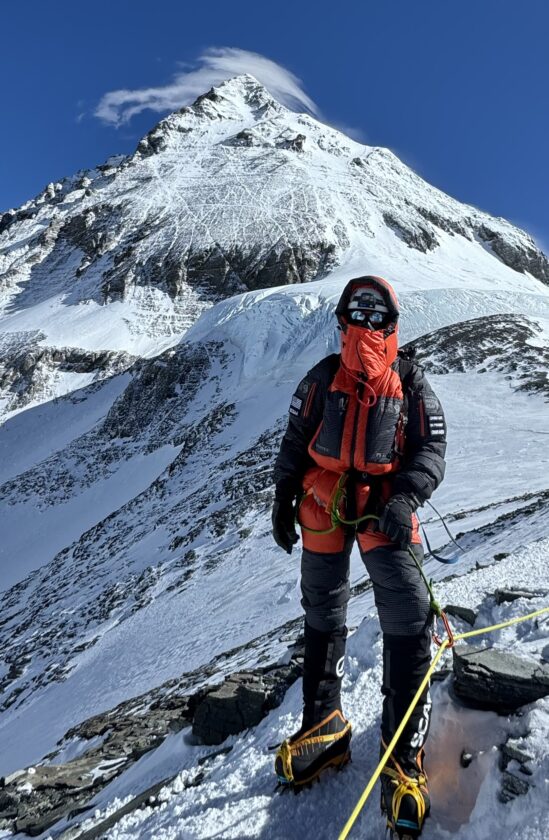
photo by: Contributed
Rhett Evans climbs Mount Everest in May of 2024.
• • •
Evans’ harrowing climbs may seem daunting to the average person, but he said that success in mountaineering — just like success in business and a whole host of other pursuits — is the result of good planning, perspective and perseverance.
“In business, and in life in general, we all have those mountains, those Everests to overcome,” he said. And they come in many shapes and sizes — “There may not be folks looking to climb Mount Everest, but there’s folks thinking about running a marathon or getting off the couch to run a 5K.”
“Whatever their Everest is, yes, you can,” he said. “It is doable. Yes, you can. The human spirit is capable of so much more than we really know. I think our minds are our most powerful tool we can harness for success in life.”
But how to go about it? Evans said what works for him is to go step by step. An Everest is only intimidating when you look at the whole challenge and try to overcome it all at once.
“When you look at mountaineering, it’s very methodical, it’s very thought-out,” he said. “You’ve trained, you’ve prepared and you take it one step at a time.”
Once Evans is rested up again, he plans to start that methodical process over again with a peak that’s just as extreme as Everest in some ways — the Vinson Massif in Antarctica. It may take him a while to get there, he said, but the approach is the same — one step at a time.
“We do have challenges, we do have obstacles, but yet when we stick to the basics and we just look at where we need to be next, pretty soon we look back and say, ‘Wow, we really came a long way and reached the summit, and we did it right,'” Evans said.
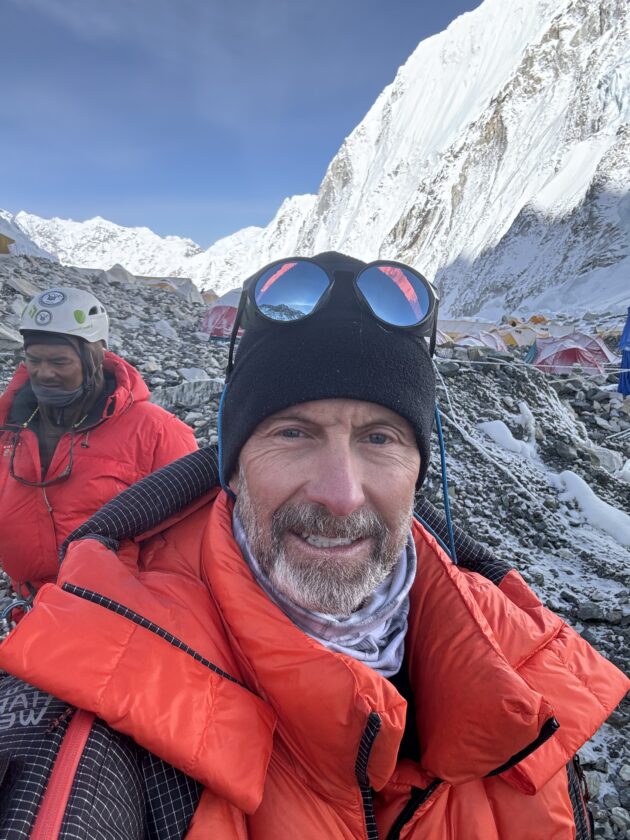
photo by: Contributed
Rhett Evans climbs Mount Everest in May of 2024.