‘How do we do this?’: Distribution of food through Harvesters’ weekend BackSnack program has dropped this year, affecting Lawrence schools
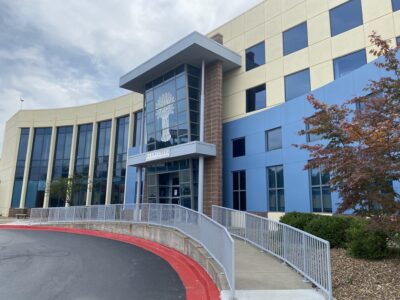
photo by: Austin Hornbostel/Journal-World
Harvesters Community Food Network's main facility in Kansas City, Missouri, is pictured Thursday, Sept. 15, 2022. The nonprofit is relocating its smaller distribution facility in Topeka to Lawrence.
When it comes to feeding kids in need, Harvesters Community Food Network’s BackSnack program is one of a number of services that Lawrence schools rely on — but this school year, it isn’t providing as much support as normal.
The program facilitated by Harvesters, the Kansas City-based regional Feeding America food bank, provides a weekly backpack filled with nutritious, child-friendly food for kids at elementary schools and some middle schools to take home over the weekend, usually in partnership with a school and a local corporate, civic or religious organization. But according to the program coordinator at one of Lawrence’s elementary schools, the number of kids getting one of those packs has dropped substantially districtwide this year.
“It has placed not just me (in a bind), but I’ve talked to a couple other counselors, too, and they’re like, ‘How do we do this?'” Julie Heatwole, the BackSnack coordinator at Sunflower Elementary School, told the Journal-World Wednesday. “How do we say, ‘You get the food and you don’t?’ Obviously, we’re trying to come up with a plan.”
Heatwole said her school has historically been able to count on receiving enough packs to serve about 70 kids per weekend, but the number of packs the school’s getting this year has been effectively cut in half. That’s true of the rest of Lawrence’s elementary schools that are involved with the program, Heatwole added, which have all been “seriously cut back.”
As part of the strategy to mitigate the issue at Sunflower, Heatwole said, the list of kids getting packs now doesn’t include new kindergarten students. She said other schools have taken different approaches, like dividing students into two groups and cycling between them for each distribution.
The drop in the number of packs being distributed is intentional, said Sarah Biles, a spokesperson for Harvesters. The agency is distributing fewer BackSnacks at most schools this year, not just those in Douglas County, as Harvesters shifts toward expanding its school pantry program.
“What we found after gathering feedback from schools and BackSnack parents and children is that it’s often the whole family that is experiencing food insecurity and many families need more food than what is provided through the BackSnack program,” Biles told the Journal-World last week. “Children are often taking the BackSnacks home and sharing the food with siblings or others in the household.”
In an attempt to meet that greater need, Biles said Harvesters began implementing school pantries a few years ago. She said schools are a “natural fit” for pantries in that they provide a convenient, comfortable location for families and students that they visit regularly, which helps break down barriers, such as a lack of transportation, that might otherwise prevent families from using a food pantry. The pantries can provide a wider variety of items than the BackSnack program, including fresh produce, refrigerated dairy or protein items and personal hygiene products like laundry detergent and soap.
Just Food is Harvesters’ local affiliate food bank, but only about half of Lawrence’s elementary schools have a Classroom Cupboard through the food bank, according to Just Food’s website. Biles said schools that don’t have a pantry can reach out to Just Food to get one set up, and each school’s BackSnack coordinator can also reach out to Harvesters directly if they want to talk about the number of BackSnacks that are currently being distributed there.
“The distributions just started in the last couple of weeks, so sometimes there does need to be some adjustment,” Biles said.
It’s not unusual for organizations like Harvesters to need time to adjust as families submit free and reduced-price meal applications and the number of qualifying families fluctuates, district spokesperson Julie Boyle told the Journal-World. And despite the decline in BackSnack distributions per school, Boyle said Harvesters has actually added four more Lawrence elementary schools as participants to the program this year; a total of nine of the district’s 11 elementary schools are participating.
Boyle said the district has seen an increase in its at-risk student population overall since the beginning of the COVID-19 pandemic. For example, during the 2021-2022 school year, 30% of district families — or 3,350 students — qualified for free or reduced-price school meals. By the next school year, that percentage had jumped to 40.5% of school families, or 4,418 students. Boyle said that increase in students considered at-risk followed two years during which the United States Department of Agriculture funded universal school meals, providing all students with school meals at no cost regardless of their economic status.
Another indicator of the prevalence of food insecurity throughout the district, Boyle said, is an “unprecedented” level of unpaid meal balances. Last school year’s unpaid meal debt totaled nearly $100,000, which Boyle said required a transfer between district budget fund balances to address. That’s a change from the norm — she said the district’s food services department typically operates on a self-sustaining basis.
The district’s seen a similar spike in unpaid student fees, Boyle added. That balance was $131,600 in 2021 and had spiked to $486,229 by the end of the following school year and $527,810 by the end of the 2022-2023 school year.
“These measures indicated growing financial hardships for school families that lead to food insecurity,” Boyle said. “Lawrence is not unique among public school districts in seeing these increased needs.”
The BackSnack program isn’t the only food distribution option at Sunflower, Heatwole said. The school does work with Just Food as one of the buildings with a Classroom Cupboard, but she said the school food pantry is usually a more critical resource for kids from families that need the food assistance more than just over the weekend.
Heatwole said many of Lawrence’s elementary schools would probably appreciate direct food donations from community members. She encouraged those who might be interested to reach out to their neighborhood school’s counselor, principal or assistant administrators to get an idea of how they might be able to help, as those needs may vary from one school to another.
“We need to share the responsibility for feeding all our kids in our community,” Heatwole said. “And I think (it’s important to get) out the word that the shelves at Just Food, they’re very bare, and Harvesters is trying to figure out ‘How can we still feed some kids something for the weekends?’ … We have families that are food insecure, and I always remind myself that I’m just a paycheck away from not being able to get food or pay my mortgage or pay bills.”
K-12 Education
Welcome center, preschool expansion, more college credit options among Lawrence school district’s plans for 2026 and 2027

Lawrence school board to consider $3.5 million in renovations to prepare for district’s new Choice Campus at Centennial

A Lawrence initiative is seeking instruments to refurbish for students in need
As Kansas’ anti-transgender bathroom law goes into effect, local governments are still trying to figure out how it works

Kansas Senate votes to subvert students’ First Amendment right to join public protests