‘House of mirrors’: New Studio 804 project uses reflection inside and out
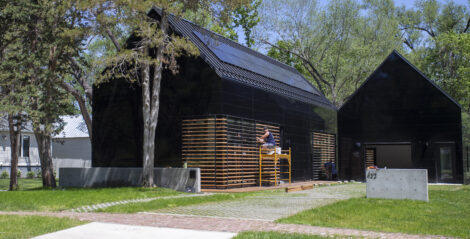
photo by: Mike Yoder
The latest Studio 804 project from students in the University of Kansas Department of Architecture is located at 432 Indiana St.
Though at first glance the simple black forms of Studio 804’s latest project offer a sharp contrast to the surrounding trees and nearby homes, an extra moment of observation will reveal that they actually — and quite literally — reflect them.
Whether standing on the permeable driveway of the property, located at 432 Indiana St., or on its front or back patios, the Japanese-made Nichiha fiber cement panels that cover much of its exterior reflect back the pine trees that crown the structures’ gabled roofline, the tree-lined creek that runs behind the property or the older home next door. University of Kansas distinguished professor Dan Rockhill, who has led the capstone Studio 804 class since its inception 28 years ago, said the finish was an aesthetic choice.
“We loved the patterns and the kind of texture that it gives, and the reflection of everything just makes it that much more interesting to us,” Rockhill said.
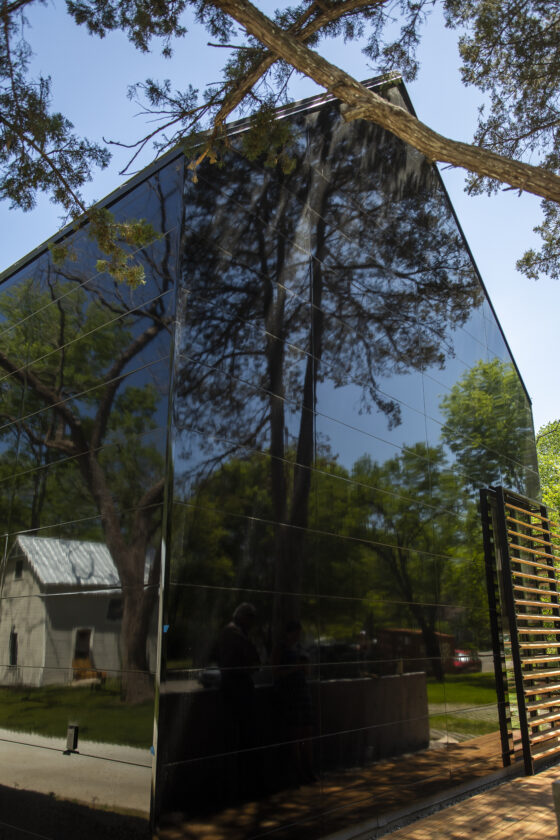
photo by: Mike Yoder
Nichiha fiber cement panels on the exterior of the home at 432 Indiana create a flat, smooth and highly reflective surface. This photo shows the west side of the home with a reflection of nearby trees and a building. Some of the fixed horizontal louvers on the southwest corner of the home are visible at lower right.
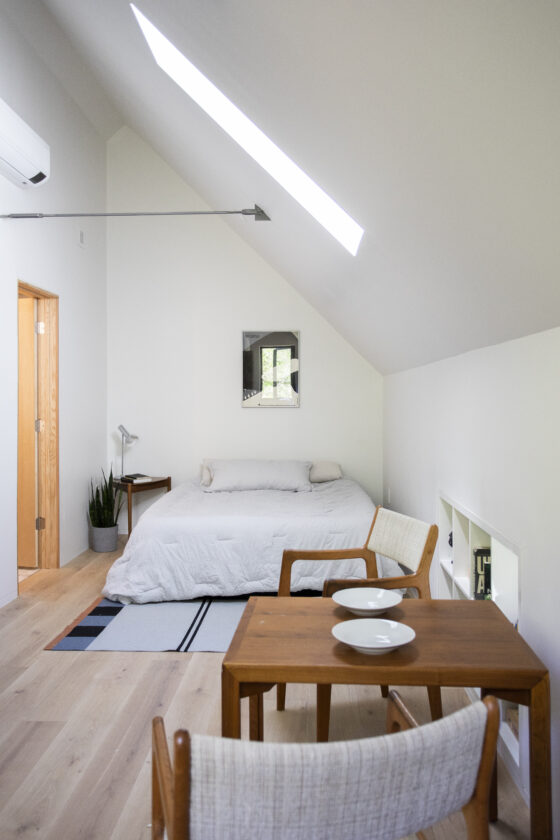
photo by: Mike Yoder
Above the garage at 432 Indiana is a 500-square-foot studio apartment space.
Students in Studio 804 continued to work this week to put the finishing touches on this year’s project ahead of a community open house Saturday. The project consists of an 1,800-square-foot, two-bedroom main house and an accessory dwelling unit with a single-car garage on the ground floor. The ADU, which Rockhill said was in keeping with the city’s goals for increased density, has a 500-square-foot studio apartment, and could be used as a rental or mother-in-law suite.
Inside the main house, the reflections continue, with a black accent wall in the kitchen covered in glass that reflects the living space and the yard and trees visible through the windows. The glass paneling also covers a wall in the adjoining living area, which faces the kitchen, extending upward to form a transparent barrier along the staircase that ascends to a loft office area and upstairs bedroom.
Graduate student Karina Sande said the glass on the interior brought the reflective, high-gloss finish from the outside of the house to the interior.
“It’s like a house of mirrors, almost,” Sande said. “It’s really lovely how the light plays, and throughout the day it changes.”
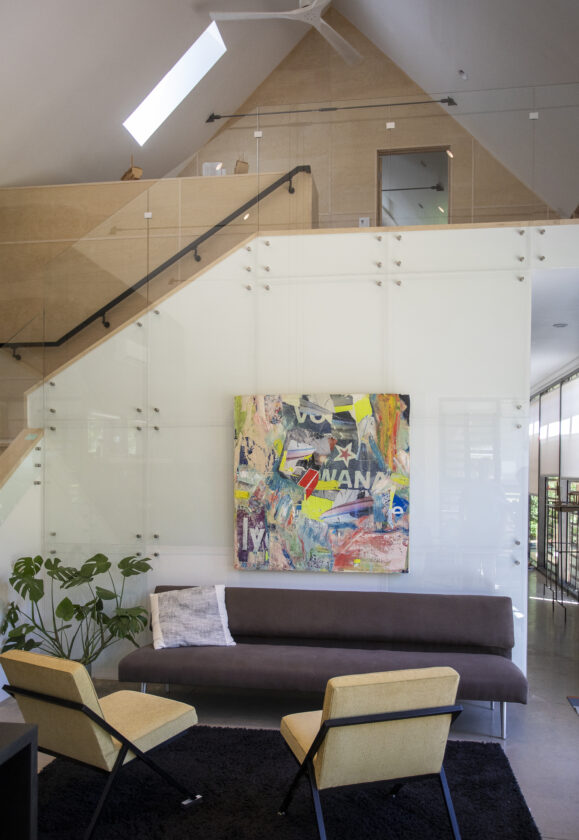
photo by: Mike Yoder
The living area at 432 Indiana is part of an open floor plan that includes the dining room and kitchen. Above the living area is an office/loft area.
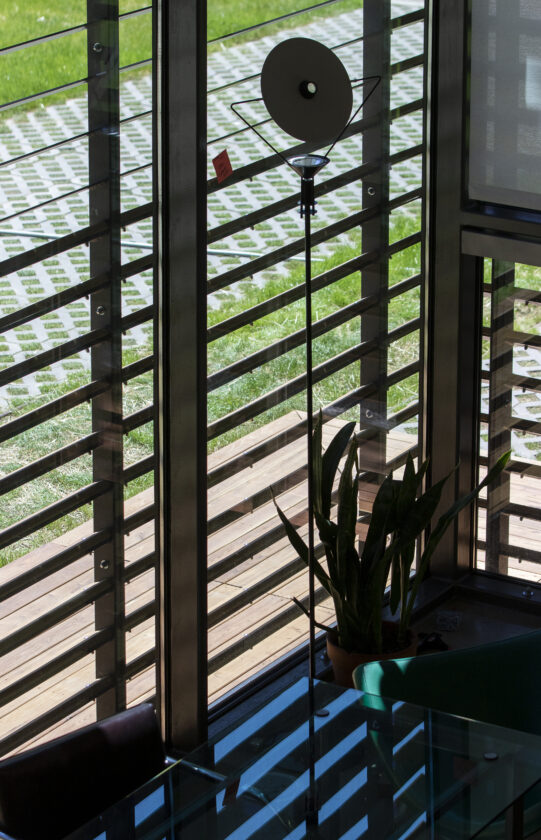
photo by: Mike Yoder
Large windows are a feature of the southwest corner of the house at 432 Indiana, allowing plenty of light. The fixed horizontal louvers provide some privacy and efficient shading.
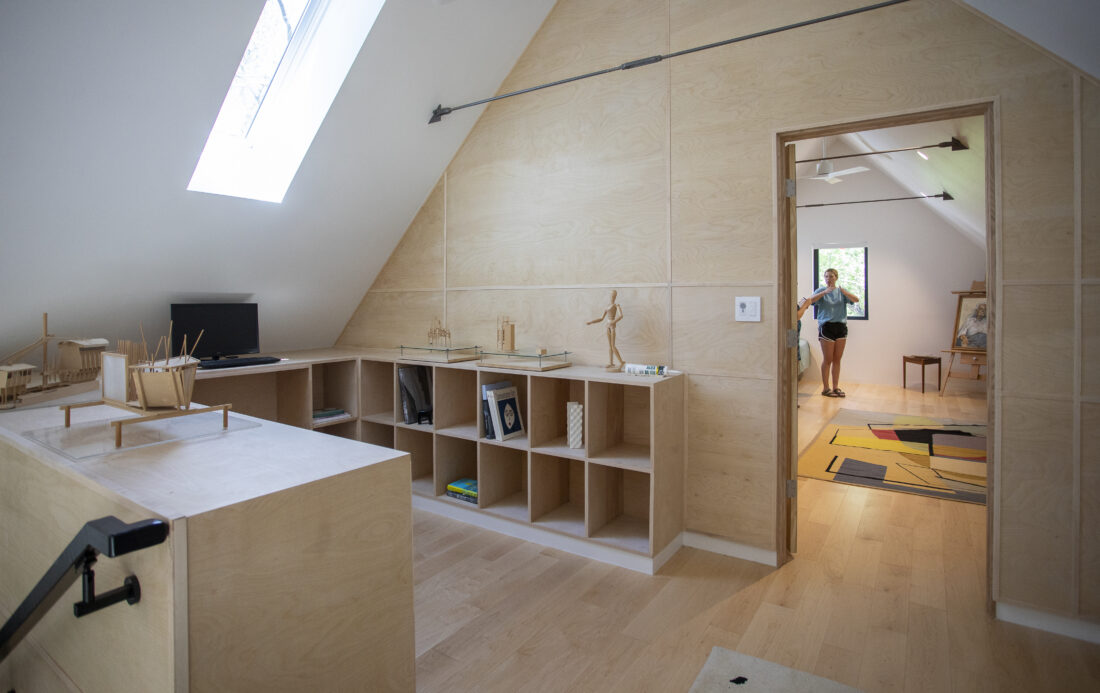
photo by: Mike Yoder
Wood floors, walls and cabinetry are used in the office/loft upstairs in the home at 432 Indiana. The main bedroom is visible in background at right.
The reflections are also meant to extend beyond the property line. The house is located in the historic Pinkney neighborhood, and Sande said though the house and ADU are modern in aesthetic, the gabled roof and the height of the house were designed to complement elements of the older home next door.
More than a dozen students were at work on different aspects of the house and ADU on Monday afternoon. Graduate student Austin Eikermann, who said he spent a lot of time working on the exterior, said the gutters and downspouts were even placed behind the siding, keeping the form simple.
“We did as much as we could to just make it as simple of a form, just that basic gable shape,” he said.
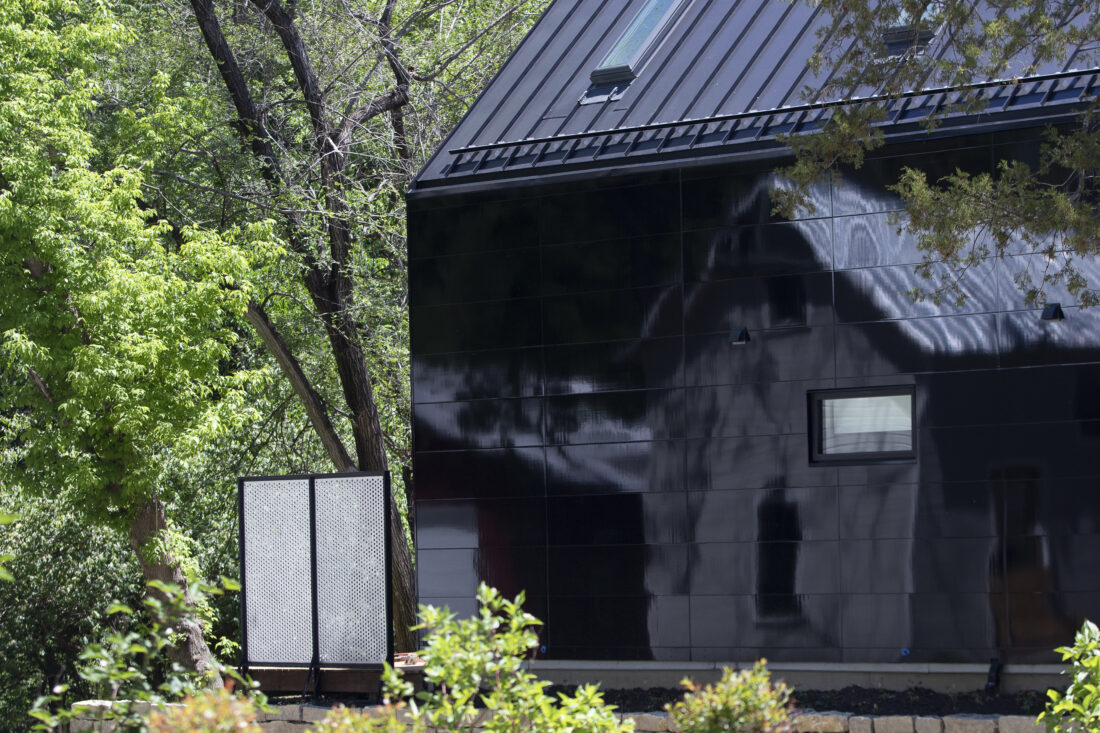
photo by: Mike Yoder
A privacy screen, at left, is part of the east side patio at 432 Indiana. The reflective surface of the home’s Nichiha fiber cement panels is seen at right.
Graduate student Maggie Roux was working alongside Eikermann on Monday, installing the last of the glass panels on the interior of the main house. Roux said at first she had worried that the project might clash with its surroundings, but she thought the repetition of the roof forms worked.
“It really has come together well, and I think that’s really bold to just do something that’s totally one color,” Roux said.
The environment, in a much larger sense, is also incorporated into the project. Like other Studio 804 homes, this year’s project has various environmentally sustainable elements and is built to the U.S. Green Building Council’s Leadership in Energy and Environmental Design (LEED) Platinum Standards. The roof has a 16-panel solar array estimated to offset about 85% of the property’s energy usage. In addition, Rockhill said the paneling, which is set over a rain screen that allows air to flow between the panels and the exterior walls of the house, also provides an added layer of insulation.
“That helps to mitigate the heat gain and heat loss,” Rockhill said. “That’s additional insulation — so our walls are super thick, and in this case the total assembly is almost a foot thick and the majority of that is insulation.”
The house’s large main-room windows are covered by what appear to be metal, exterior-mounted blinds — called louvers — that are angled to maximize sunlight in the winter and shade in the summer. The permeable driveway, where grass grows through the cutout patterns of the paving stones, and a rain garden planned for the area of the backyard bordering the creek help accommodate storm water drainage. Inside, the house has energy-efficient appliances and an Energy Recovery Ventilator (ERV) system with room-level heating and cooling.
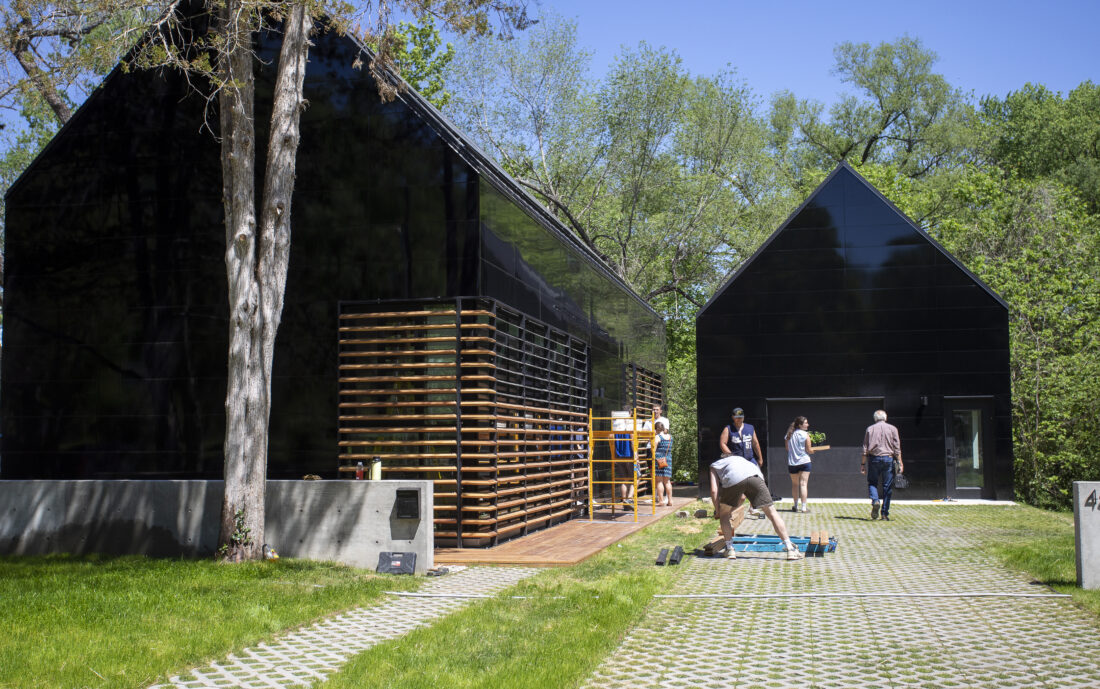
photo by: Mike Yoder
The latest Studio 804 project from students in the University of Kansas School of Architecture is located at 432 Indiana St.
For the students, the project also offers a year’s worth of hands-on experience. Rockhill said 26 graduate-level architecture students participated in the class this year. The students started the project in August, designing and building the house from the ground up over the course of the school year.
With the open house only days away, students worked in pairs or individually on different final elements of the project, hanging blinds, fastening wooden components to the louvers or finishing up aspects of the bathrooms. Working outdoors on one side of the house was Drake Johnson, who said the project forced him to problem solve and increased his work ethic, which he said were things he would take away for his future career.
“How can you problem solve and get out of that, figure it out without having to get the professor?” Johnson said.
Sande also spoke to the problem-solving required. She said she’d learned more in the past year than she had in the four years of undergrad, and that the project had taught her to work with her peers and take initiative to address problems as they arose.
“I think a lot of what people my age lack is the kind of initiative to say, ‘OK, I can work through something,'” Sande said.
The open house for Studio 804 will take place from 9 a.m. to 3 p.m. on Saturday at 432 Indiana St.
Other News
HeadQuarters Kansas has fully transitioned to 988, improving funding while keeping local response

Lawrence High School to host its annual formal wear drive to make prom accessible for students

Haskell Foundation announces creation of fellowship program that aims to advance clean energy development for tribal communities

Iranians in Lawrence area express relief, joy at ayatollah’s demise, hope intervention leads to democracy

‘Every kid can bring something to the table’ for Eudora’s Scholars Bowl team, which just won its 3rd straight state title