Lawsuit settlement affects parking at Penn Street Lofts, all future Warehouse Arts District projects
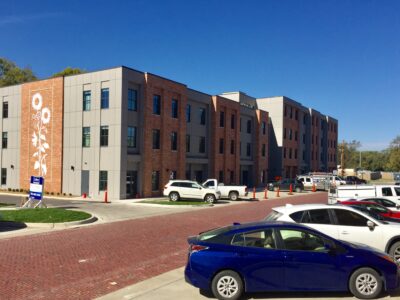
photo by: Rochelle Valverde
Public on-street parking along Pennsylvania Street and the Penn Street Lofts building, 801 Pennsylvania St., are pictured on Oct. 22, 2021.
Following a lawsuit from the Warehouse Arts District’s main developer, the City of Lawrence has revised its interpretation of the parking requirements for new developments in the district, allowing the addition of private parking for the first time.
Under the city’s initial interpretation of the district’s redevelopment guidelines, city planners concluded that the area was to have “districtwide shared parking,” allowing new developments to add less parking than they otherwise would under city code, but in turn requiring all parking to be openly shared. That changed under the settlement, causing residents of the adjacent East Lawrence neighborhood to worry that spillover parking into the neighborhood is going to become an issue.
“As the 801 (Pennsylvania St.) apartments start getting populated and as we come back from COVID and more people start going out, there is going to be spillover parking,” East Lawrence Neighborhood Association board member Phil Collison said.
Collison said if properties are able to reserve private spaces, it could mean that at busy times, there could be empty spots in private lots, but because the public parking spaces are occupied, patrons of restaurants and other businesses will have to park in the neighborhood.
Flint Hills Holdings Group LLC, which is managed by developer Tony Krsnich, appealed the city’s interpretation of the parking requirements for the district to the city’s Board of Zoning Appeals this summer. Krsnich has developed several projects in the district over the years, but the appeal and subsequent lawsuit was in reference to his latest building, Penn Street Lofts, 801 Pennsylvania St. After the board affirmed the city’s interpretation in July, Flint Hills Holdings further objected by filing the lawsuit in Douglas County District Court. Ultimately, the city and Flint Hills Holdings agreed on the settlement, which the City Commission recently approved, and the case was dismissed Oct. 18.
In addition to ELNA, other district property owners and the city have expressed concerns about parking in the district. Though opposed to the outright requirement in the city’s initial interpretation, Krsnich said he is in favor of shared parking in the district, and is working with other district property owners to come up with a parking agreement.
The guidelines
The city’s redevelopment guidelines for the district state in part that, “One of the virtues of a mixed-used development is that parking areas can be shared by different users at different times. For example, a residential parking space could be used by an office user while the home owner is away during working hours.” In the city’s initial interpretation, planners stated that allowing a new development to reserve parking for only its own private use was contrary to the guidelines and the spirit of the district.
“In summary, to allow a development to reserve parking on its own lot for its own use would be to permit a development to take advantage of the district-wide parking reductions, while at the same time excusing it from the burden of sharing its parking with others in the district,” the interpretation reads. “In other words, the development would be taking from but not contributing to the district.”
In the lawsuit, Flint Hills Holdings argued in part that the guidelines don’t specifically require shared parking and that requiring parking on private property to be shared would effectively make private property public property, resulting in an unlawful taking and exposing the owner to liability, costs and expenses.
As part of a settlement in the lawsuit, the city revised its interpretation of the district’s redevelopment guidelines. The new interpretation drops the idea of a districtwide shared parking requirement for new developments. Instead, it says that for private property, shared parking is strongly encouraged and recommended, but not required.
Deputy City Attorney Randy Larkin said the city changed its interpretation because the guidelines themselves never specifically required shared parking. He said that before the completion of Penn Street Lofts, nearly all parking in the district was public, shared parking on city property. He said that had been the basis for the original interpretation of the guidelines, but the Penn Street Lofts project brought private parking into the mix.
“It was the addition of private parking that caused the City to rethink that interpretation,” Larkin said in an email to the Journal-World.
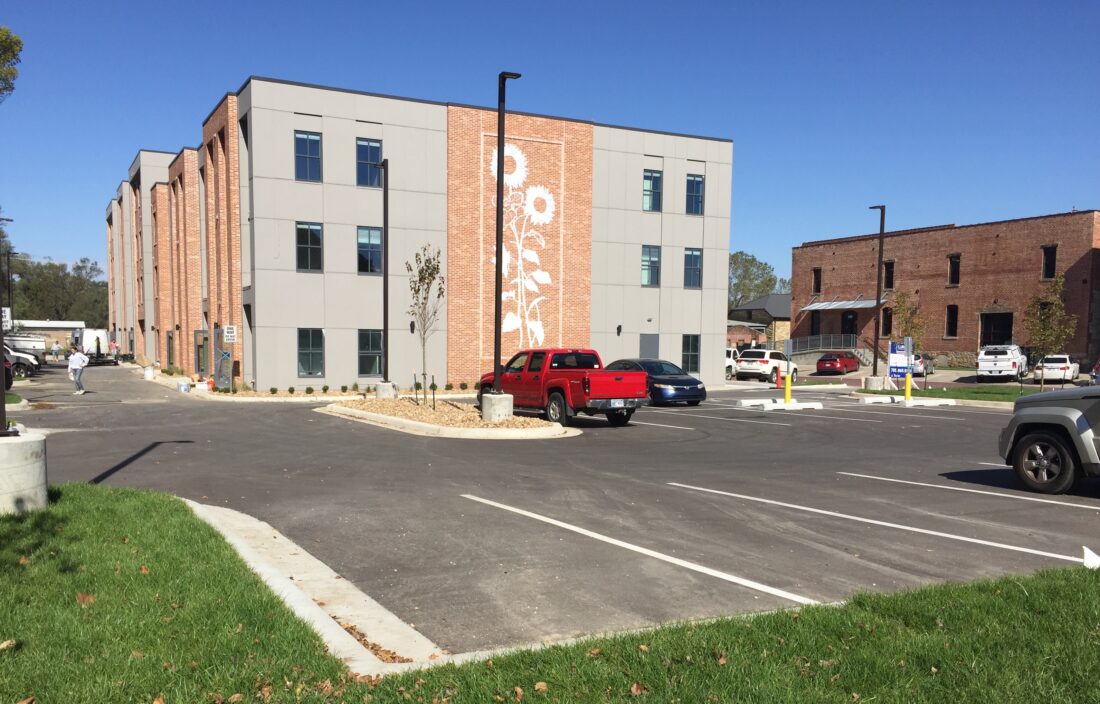
photo by: Rochelle Valverde
The private, off-street parking lot of the Penn Street Lofts building, 801 Pennsylvania St., is pictured on Oct. 22, 2021.
Larkin said in order to have shared parking on private property, city code requires a shared parking agreement. He also said there is some concern that requiring a private landowner to share its private parking with the public “might very well be tantamount to the taking of private property for public use.” He said for those reasons, the city altered its interpretation of the guidelines so that it is now recommended that private parking be shared, subject to a shared parking agreement, but shared parking on private property is not required.
For his part, Krsnich said that the city’s initial interpretation — that off-street parking on private lots should be available for public use — hindered development. Though he is not opposed to shared parking in the district and is working to create an agreement among property owners, he said that from a practical standpoint, the city’s initial interpretation was like having a stranger park in your driveway without permission.
“While this impacted a very limited number of parking spaces in the District, it dramatically disrupted the ability to develop future developments and manage existing buildings,” Krsnich said in an email to the Journal-World.
Krsnich said as soon as Flint Hills Holdings became aware of the interpretation earlier this year, it informed the city staff. He said Flint Hills Holdings is pleased to have settled on an agreeable interpretation of the shared parking policy that “preserves the ability to pursue the dynamic reuse of properties in the district.”
According to information provided by the city’s planning department, there are a total of 287 parking spaces in the district, 45 of which are on Penn Street Lofts’ private property. The building includes work/live units on the ground floor, and Larkin said that patrons of the work/live units may, at the discretion of the owner, park in the private parking lot. However, he said as members of the public, patrons would also have access to the public parking in the district.
Another parking lot in the district also came into play in the settlement of the lawsuit. As part of the settlement, Krsnich agreed to designate two of the 55 parking spaces in the parking lot adjacent to the Poehler Lofts building for public parking once that lot is converted from a city-owned public lot to a private lot in about five years. Under an existing agreement from 2011, Krsnich has an option to purchase the parking lot from the city for $1 on or after Jan. 1, 2027. As it stands now, once the Poehler parking spaces are converted to private spaces, about a third of the parking in the district would be private.
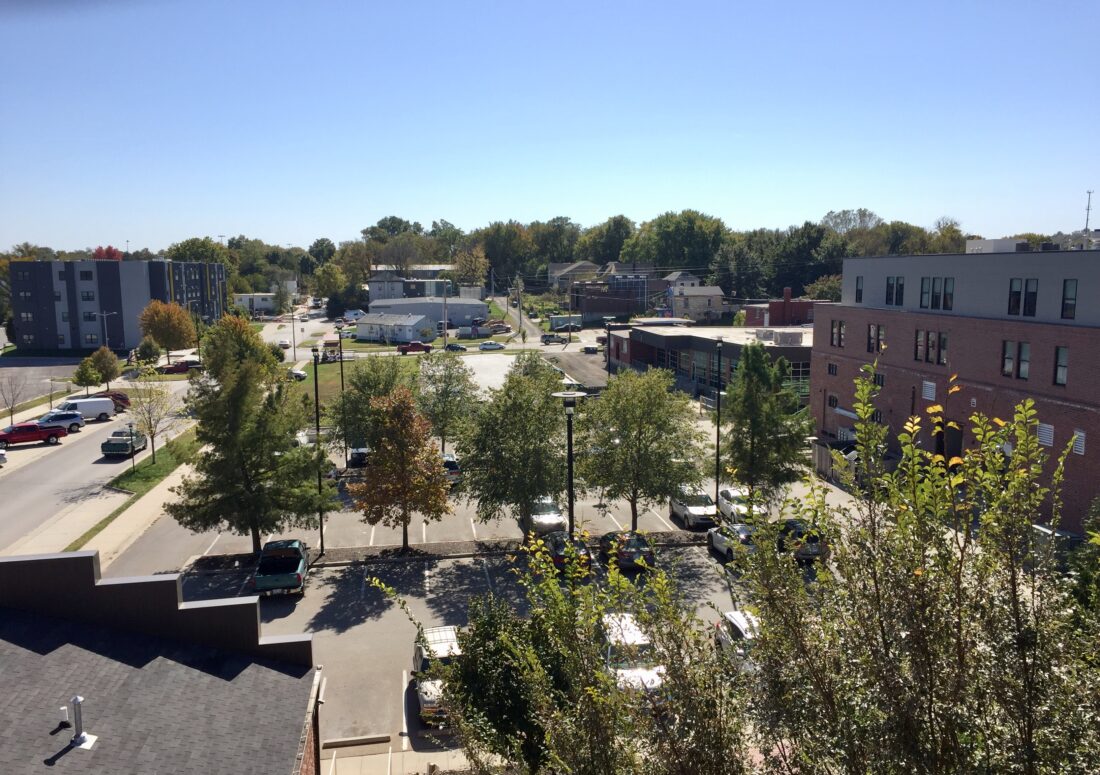
photo by: Rochelle Valverde
The currently public parking lot south of the Poehler Lofts building is pictured on Oct. 22, 2021. The neighborhood of East Lawrence is visible beyond the district.
In addition to the neighborhood association, three arts district property owners, representing seven properties or businesses in or bordering the district, objected to Flint Hills Holdings’ position when the Board of Zoning Appeals considered the matter. Though Larkin said the city believes the settlement was a fair resolution, when asked about the concerns of the neighborhood and other district businesses, he said the city also has concerns about parking and is working to address them.
“The City is concerned about parking in the district, has met and discussed possible options to alleviate concerns regarding parking in the district and intends to continue to meet and discuss the various solutions available to alleviate foreseeable parking problems in the district,” Larkin said.
The future of parking in the district
While all existing parking within the district that is on public property will remain shared parking, excepting the eventual turnover of the Poehler lot, the city’s new interpretation will affect not only the off-street parking lot of Penn Street Lofts but also the off-street parking of all future development projects in the district. That includes potential development of the relatively large parcel at the corner of Ninth and Delaware streets, which Krsnich has previously proposed as the site of a future project.
Regarding the concerns of the neighborhood and other district property owners, Krsnich said he’s actually in favor of public use of off-street parking in the district as a whole, but that there would need to be an agreement on liability, safety, cost-sharing, etc. He said an agreement between property owners in the district would be a reasonable and achievable solution to any potential parking issues in the district, and he is working to come to an agreement with his fellow property owners about shared parking.
“We have started that process and are working with other stakeholders in the District to reach an agreement,” Krsnich said. He added that a community improvement district could be a great way to structure and accomplish that.
The Journal-World reached out to the property owners who objected to Flint Hills Holdings’ appeal of the city’s initial interpretation in July. While some did not immediately respond or said they had no comment at this time, Codi Bates, who together with Simon Bates owns Bon Bon and The Cider Gallery, expressed optimism that a solution would be reached.
“We’ve always worked with our neighbors in the Warehouse Arts District in regards to parking and intend to continue doing so,” Bates said. “The businesses and tenants in our district all benefit when we work together to come up with solutions in regards to parking and we are optimistic that we’ll continue to do just that.”
City Government
‘We have to move forward’: On 3-2 vote, Lawrence City Commission approves budget with 1.4-mill hike

Manufacturer opens new production facility, adds 30 jobs in Lawrence industrial park
Lawrence City Commission set to take its final vote on budget next week; current proposal has a roughly 1-mill property tax rate increase
City manager says renovating Lawrence’s Fire Station 3 instead of relocating it could save millions of dollars
Incentive request for 341-unit apartment complex near KU Innovation Park wins City Commission approval