Four years after Lawrence father and scientist was nearly deported, family reflects on events, looks ahead to review of his case
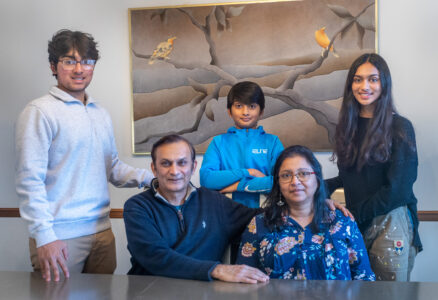
photo by: Mike Yoder
Gathered at their Lawrence home Wednesday, December 22, is Syed Jamal with his wife Angela Zaynub Chowdhury, seated center, and their children, from left, Taseen, 18, Fareed, 11 and Naheen, 16.
It has been nearly four years since Lawrence father and scientist Syed Jamal was detained by immigration agents and nearly deported, and as he prepares to stand before an immigration judge again, uncertainties remain.
Jamal, originally from Bangladesh, was arrested in the driveway of his Lawrence home in January 2018 while getting ready to take his kids to school. His case generated national and even international media attention as he passed weeks in detention and attorneys fought to prevent his deportation. But for the Jamal family, the feelings evoked by that day and the ensuing two months Jamal spent in detention did not go away with the spotlight.
“After I came home there were concerns about some of the trauma that the children went through,” Jamal said. “… I think it has affected them in some ways.”
Jamal was so close to being deported in 2018 that he was actually on a plane en route to Bangladesh when a midflight decision by an immigration judge allowed him to return to the U.S. to have his case reconsidered. He was finally freed from detention in March 2018, and the first hearing in his reopened immigration case occurred in November 2018. As the Journal-World reported at the time, Jamal’s attorneys were pursuing two ways for him to remain in the U.S., one via a cancellation of removal and the other through asylum. However, because of a backlog in immigration cases, the next hearing for Jamal’s case, which was combined with that of his wife, Angela Zaynub Chowdhury, was not scheduled until more than three years later, on April 27, 2022.

photo by: Nick Krug
Lawrence resident Syed Jamal hugs his children after he was released from the Platte County Jail, Tuesday, March 20, 2018, in Platte City, Mo.
Since then, Jamal said he’s been keeping himself busy and his family has been trying to work through what happened. He now works as a professor in the chemistry and biochemistry department of Benedictine College, where in addition to teaching he is working on research related to new breast cancer treatments. All three of his and Chowdhury’s children are U.S. citizens, and their eldest child, Taseen, 18, has graduated high school and is now studying chemical engineering with a focus in biomedicine at the University of Kansas. Their daughter, Naheen, 16, is in high school and their youngest son, Fareed, 11, is now in fifth grade.
Following his arrest, detention, and eventual return home, Jamal said his two older children spoke to therapists to help them through the trauma of what happened, and though the therapy helped, he thinks the matter remains in the back of everyone’s mind.
Gathering in the living room of their home in Lawrence, the Jamal family reflected on the past few years. The two older children, Taseen and Naheen Jamal, said they struggled in school after what happened, and both were diagnosed with stress-induced depression and anxiety related to the incident. Taseen Jamal said his grades dropped dramatically after what happened, and while he thinks he’s adjusted quite a bit over the years, it’s not something that’s easily resolved.
“I think I’ve gotten a lot better at dealing with some of the stuff I’ve been going through, but I doubt it will ever be the same,” he said.
Naheen Jamal said that after having an increasingly hard time focusing in school, things had also gotten better for her, but it was still something she struggled to deal with, especially as her dad’s next court date approaches.
“I’m starting to worry about it again,” she said. “It’s really hard to focus on staying present when I’m worried about what happens if my dad does get deported.”
Sitting nearby, Jamal spoke up, reassuring her that it should be OK. Fareed, the youngest son, said he just tried not to think about it, so that he would not start feeling depressed. After saying so, he got up from the chair he’d been sitting in to go hug his mother.
Jamal has been living in the U.S. for more than 30 years, and in that time he earned degrees in biology, biochemistry and pharmaceutical sciences. He has taught and conducted scientific research for several area colleges. Issues began after Jamal reportedly overstayed a temporary visa and did not follow a subsequent request to voluntarily depart the country, according to a timeline U.S. Immigration and Customs Enforcement previously provided the newspaper. An order for his deportation was initially issued in 2011, and then reissued in 2013 after Jamal unsuccessfully appealed the order. However, his arrest and near-deportation did not come until 2018, as the administration of then-president Donald Trump was deporting even longtime U.S. residents with no criminal history.
As far as where the case could be headed, Jamal’s attorney Rekha Sharma-Crawford said that while the hearing for April 27, 2022, still currently stands, the coronavirus pandemic has caused major backlogs with the immigration courts, and the date may change. Sharma-Crawford said a cancellation of removal and an asylum claim are both options for Jamal, and there are potentially other options as well.
If immigrants have already been living in the United States for 10 years with no disqualifying convictions, they can qualify for a form of deportation relief called a cancellation of removal. Asylum is a process that applies to refugees from a foreign country who can demonstrate they have been persecuted or fear they will be persecuted on account of various qualifying factors. Sharma-Crawford also noted that the recent U.S. Supreme Court decision in the case Niz-Chavez v. Garland, which ruled that the federal government must provide all required information to immigrants facing deportation in a single notice, could also affect Jamal’s case.
When it comes to what they want people to understand about the family’s situation, Taseen Jamal said a lot of people tend to forget the complexity of the immigration system, and that everybody’s case is different. He said some people’s pathways to permanent status are easier or harder than others, and that once you have family, friends, a career, and have established roots somewhere, it’s hard to want to leave. Among all that complexity, he posed a simple question.
“Why make us leave?” he said. “If we’re not hurting the community in any way, then I don’t think it should be in anyone’s heart really to make someone leave.”
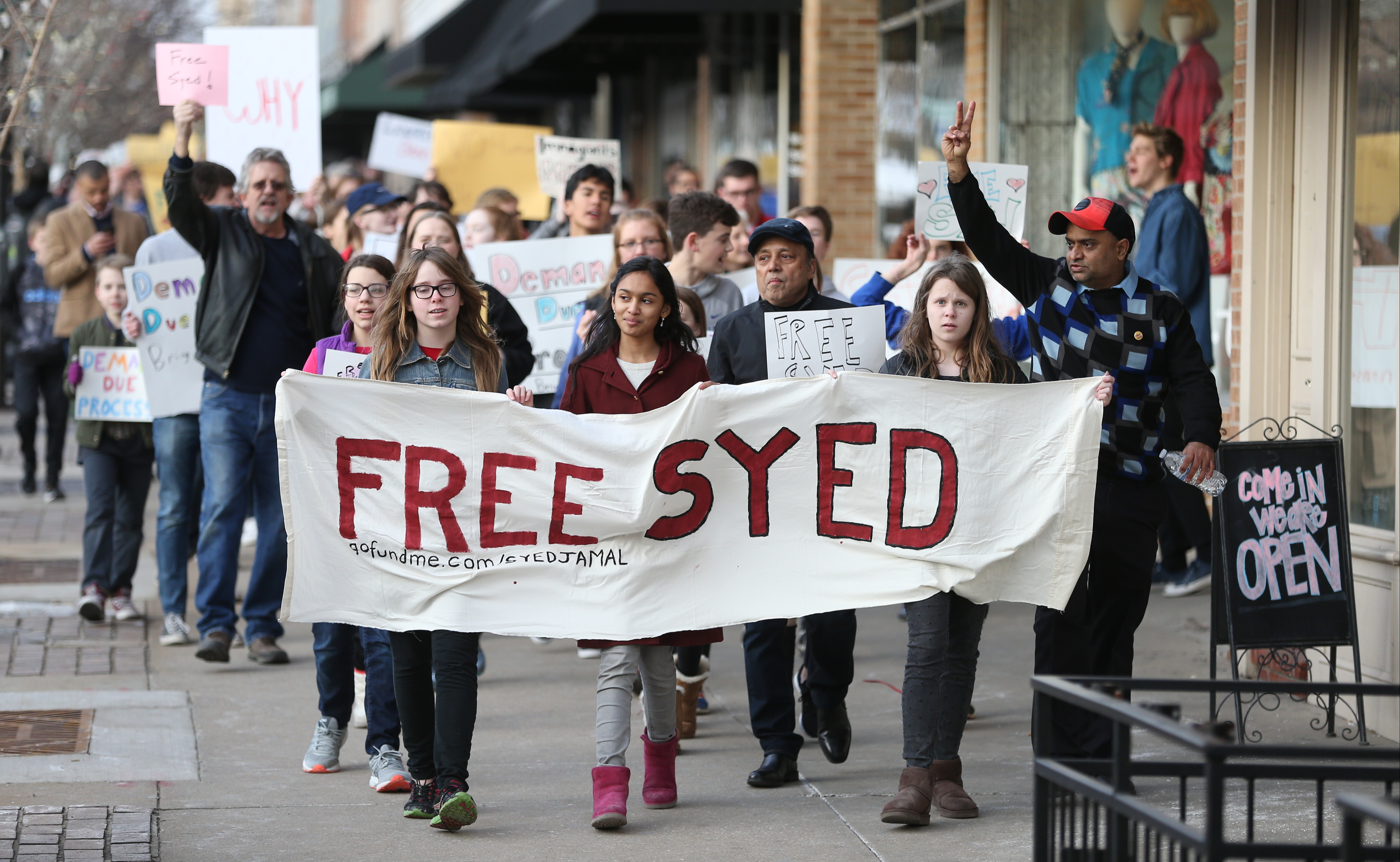
In this Journal-World file phone, Naheen Jamal, center, is flanked by her friends Elizabeth Anderson, left, and Anna Anderson as they lead a Free Syed Jamal march on Thursday, Feb. 8, 2018.
Through everything, the family said they feel fortunate to have had a lot of support from the community. As the Journal-World previously reported, community members signed petitions, organized letter-writing campaigns, and held a march through downtown Lawrence. Supporters and friends showed up at Jamal’s release from detention and his first hearing. Though the large-scale attention has fallen away, Naheen Jamal said friends continue to check in and offer support.
“Every single person who I’ve connected with in Lawrence has really made me feel loved and supported in so many different ways,” Naheen said. “I can’t even name it, but I have just felt so happy being here, and so supported and accepted.”
For his part, Jamal said while there are “lots of uncertainties” and he realizes the backlog in immigration cases could mean the April hearing is delayed, he is hoping that before too long, he and his family will get to see a favorable decision.
Other News

As development pressures grow, Douglas County lays out drafted vision for Wakarusa River Valley
‘Highly discriminatory’: Current and former trans lawmakers speak out ahead of Douglas County judge’s ruling on bathroom, driver’s license law
Peaslee Tech’s new homes made from garage doors arrive in North Lawrence
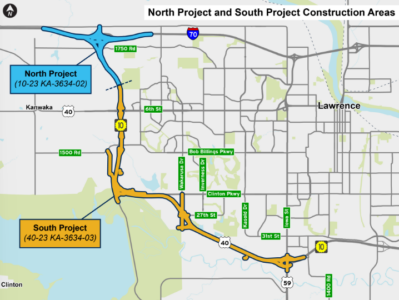
KDOT awards $104.7-million contract for north segment of South Lawrence Trafficway expansion
At 40, her first mammogram changed everything: LMH Health nurse urges others to get screened