

BuzzFeed sues Kris Kobach over denial of records requests
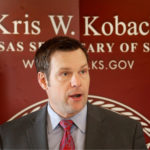
Kansas Secretary of State Kris Kobach speaks during a news conference Tuesday, Feb. 17, 2015, in Topeka.
Topeka — Owners of the internet news site BuzzFeed have filed a lawsuit against Kansas Secretary of State Kris Kobach seeking access to emails relating to his role as an informal adviser to President Donald Trump, and to his role as vice chairman of Trump’s Presidential Advisory Commission on Election Integrity.
According to a petition filed Friday in Shawnee County District Court, BuzzFeed Inc. is accusing Kobach of violating the Kansas Open Records Act, first by demanding what BuzzFeed called an unreasonable fee for access to the records and then by denying the news organization access altogether.
On June 19, BuzzFeed reporter Kendall Tagart filed the records request, seeking copies of “any emails sent by, received by, forwarded by, copied by, or blind copied by Secretary Kobach containing one or more of a list of 30 specific search terms,” according to the petition.
Those search terms included references to the Department of Homeland Security, Immigration and Customs Enforcement, Customs and Border Patrol, United States Citizenship and Immigration Services, Trump, the White House, former White House adviser Steve Bannon, Attorney General Jeff Sessions, the advisory commission, and key words such as Islam, Muslim, Mexican and Hispanic.
Kobach has spent years as a national crusader against illegal immigration, and he has drafted laws for numerous cities and states to crack down on illegal immigrants. Many of those laws have since been struck down by federal courts.
As secretary of state, he also championed two key voting laws in Kansas in 2011: one requiring voters to show proof of U.S. citizenship in order to register to vote and another requiring them to show photo identification at the polling place in order to vote. The proof-of-citizenship law is also under challenge in federal court.
Shortly after Trump was elected, Kobach was photographed going into a meeting with the president-elect holding a document described as a “strategic plan” for the Department of Homeland Security for the first 365 days of the Trump administration.
That document was later subpoenaed in the Kansas federal lawsuit, and it was shown to contain proposals to amend the National Voter Registration Act in order to make it easier for states to require proof of citizenship for voter registration.
The BuzzFeed request sought copies of emails from May 1, 2017, through the date of the request, June 19.
On May 11, Trump named Kobach to be vice chair of the advisory commission, serving under Vice President Mike Pence, who is chairman.
The Kansas Open Records Act allows public agencies to charge “reasonable fees” for retrieving public records. Those are usually limited to the cost of making photocopies.
However, agencies can also charge fees for the staff time required to sift through the requested documents and determine which ones are subject to the Open Records Act. Some emails could be exempt from the act, even if they met BuzzFeed’s search criteria, if they fell under any of the numerous exceptions to the act, such as confidential personnel records.
According to the petition, Kobach’s office initially sought $1,025 for 13 hours of staff time to compile the records. When BuzzFeed asked Kobach’s office to reconsider that fee, Sue Becker, a senior counselor in the office, wrote back denying the records request in its entirety, saying the emails were not subject to the Open Records Act.
Becker said most of the “topic-triggered emails” were exempt from the act because Kobach was not conducting official state business when he communicated regarding 24 of the 30 search terms.
Regarding the other six search terms, Becker said those emails were exempt under a provision of the act that exempts “notes, memoranda … recommendations or other records in which opinions are expressed or policies or actions are proposed.”
The act gives individuals the right to petition a court to order a public official to produce public records. It also authorizes courts to fine an agency up to $500 for each violation of the Open Records Act.
State Government

Property tax protest bill would let a few dozen voters block tax increases in some parts of Douglas County

Lawmakers pass bill to create sports authority to oversee new Chiefs stadium in Kansas
Kansas Legislature passes a bill that would give 10% of voters the power to stop some property tax increases
Kansas Senate, House pass budget bill that pegs raises at 1% for most state employees
U.S. Supreme Court Justice Sonia Sotomayor to visit KU next month; will speak to students, select guests
