

Garden Variety: Ginkgo trees show their full color in late fall
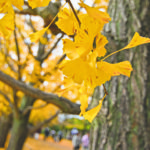
Gingko tree, aka maidenhair tree or Latin Ginkgo biloba
Ginkgo trees dot the landscape of downtown Lawrence, barely noticeable until this time of year when their late-clinging leaves turn yellow and their silvery bark stands out in contrast to the mix of tree species with which they are interspersed.
Ginkgo, also known as maidenhair tree or the Latin Ginkgo biloba, is remarkable because it is believed to be the oldest tree species still in existence today.
Chinese scientists have finally mapped the genome of this complicated species and have recently published a draft of the findings. They hope a better understanding of ginkgo’s gene sequences will provide a resource for how the species has survived for 270 million years, how it so effectively wards off insects and disease, and how it survived the atomic bombing (among other species) in Japan in World War II.
Besides its status as a living fossil, gingko is unique in the way it produces fruit and seed. Gingko is dioecious, meaning there are male and female trees. Male trees produce flowers and pollen; female trees produce flowers that collect the pollen and mature into seeds. This is where the uniqueness comes in: Unlike other broad-leaved trees, gingko seeds develop into a sort of half fruit, half seed that can best be described as resembling that of a pine tree. It is the unique seed that puts gingko in a scientific division all by itself.
The unique fruit also has a distinct, unpleasant smell. Horticulturists generally equate the odor of gingko seeds to that of dirty socks or terribly foul cheese — the kind you can smell from a block away.
Fortunately, the trees planted in downtown Lawrence and most commonly in the landscape are male clones that will not produce the stinky seeds. The fall color of the male trees is less brilliant than that of female trees but still typically turns to a bright yellow or golden shade.
Ginkgo is native to China, with trees living there today that are believed to be more than 1,500 years old. (For contrast, the redwoods are believed to have specimens more than 2,000 years old but the species has only existed for about 240 million years.)
Male ginkgos are gaining popularity as an urban species because of their pest resistance, adaptability and tolerance of confined root space. Although open-grown ginkgos can grow to 60 feet or more, trees will stay smaller with limited root growth to the point that they can even be trained as bonsai.
— Jennifer Smith is a former horticulture extension agent for K-State Research and Extension and horticulturist for Lawrence Parks and Recreation. She is the host of “The Garden Show.”