

New pastor in Lawrence seeks to bridge divides
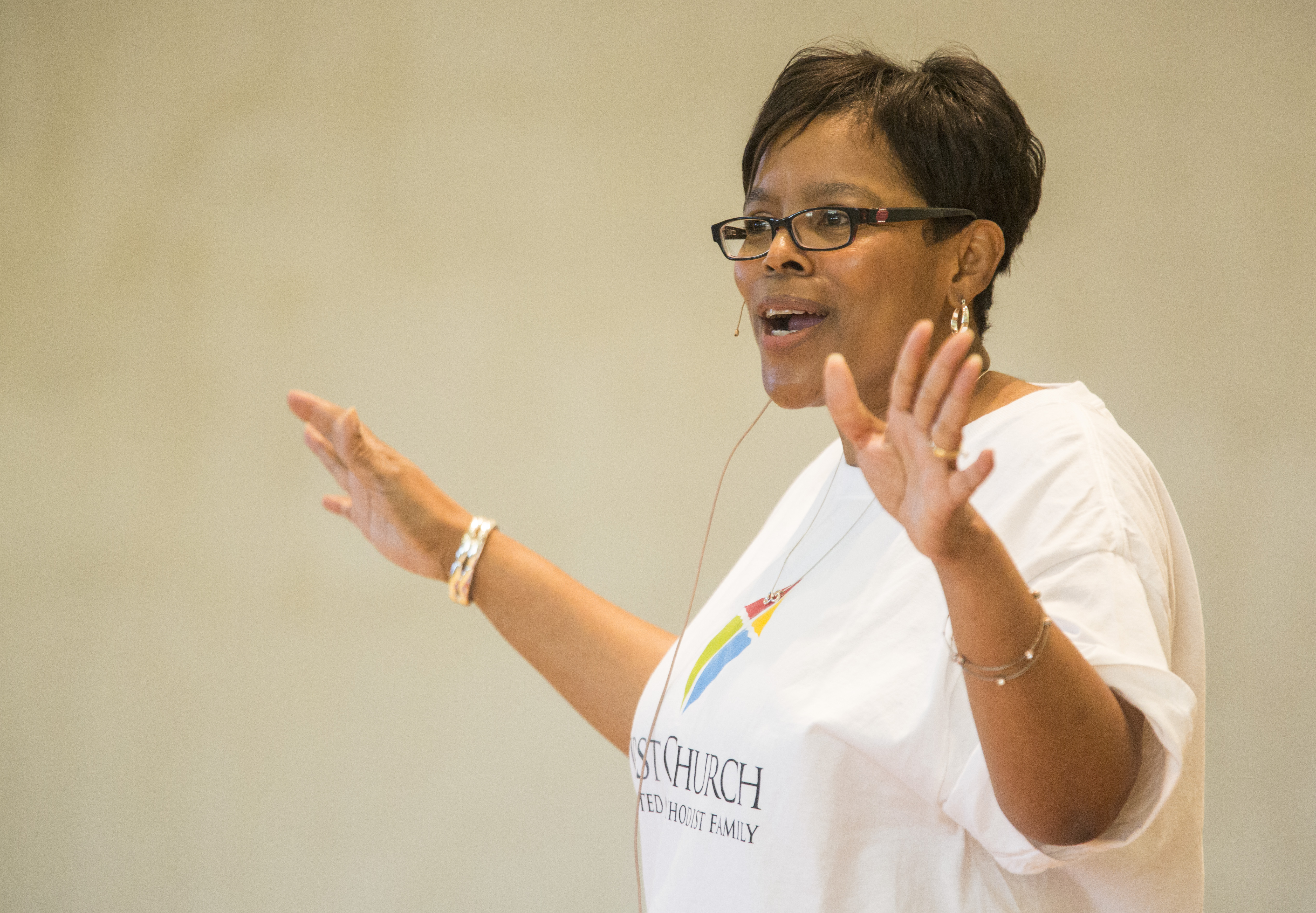
The Rev. Kathy Williams delivers a sermon during services at First United Methodist Church's west campus, 867 Highway 40, last Sunday.
On a recent Sunday morning, the Rev. Kathy Williams stood at the front of a big, modern church on a hill west of Lawrence, talking about the importance of exploration.
“In the church when I was growing up, the elders would often say, ‘God loves you as you are, but God doesn’t want you to stay how you are,'” Williams said. “God has given you amazing gifts. But it takes a desire for you to explore if you want to be able to nurture and build those gifts.”
The crowd, while paying close attention, stayed mostly quiet during the service, even when Williams’ passion caused her voice to rise. While this experience wasn’t anything new for Williams, a black woman who has preached at a predominantly white congregation before, it may have been for some of those in the audience at First United Methodist Church, where Williams is believed to be the first African-American pastor.
On this day, Williams and her flock both appeared to be in their element, comfortable with one another, as if her skin color and gender were the furthest things from anyone’s mind. An African-American woman preaching to a largely white congregation might have been a big deal in Lawrence in 1882, when three black men were lynched by a white mob on the Kansas River bridge, or 1970, when bloody riots followed the police shooting of a black Kansas University student. But not, it seems, in 2014.
A life of exploration
Williams, 51, grew up in Wichita, a member of a predominantly African-American United Methodist church. She attended Kansas State University before doing her graduate work at Emporia State, where she met her husband, Earl, a native of inner-city Chicago. The couple has a 22-year-old son and 17-year-old daughter.
Williams worked as a school psychologist for many years, encountering students who were suffering as a result of violence and abuse and broken families. At times, she believed the only thing that could heal them was faith, a message she knew wouldn’t be appropriate in the secular world of public schools.
She saw that as a sign to join the ministry. So she started serving as a pastoral assistant at a mostly white church in Emporia in the mid-2000s. In the beginning, her husband said, some congregants wouldn’t shake her hand after services; others never came back. But on their last day at the church, six years later, “there wasn’t a dry eye in the place,” he said. The pastor went on to be appointed to historically black churches in Topeka and Kansas City, Mo.
“The reality is, Sunday is the most segregated day in the United States,” said Earl Williams, a benefits specialist for the state of Kansas, who describes his wife as the perfect person to bridge that divide. “White, black, blue, green, it doesn’t matter — one thing she loves is to tap into individuals’ gifts. And when she speaks, she speaks to all people.”
The Rev. Tom Brady, the senior pastor at First United Methodist, met Kathy Williams earlier this year through Ben MacConnell, a community organizer who was bringing local congregations together to work on issues of social justice. Brady needed a little convincing to get his church to join, so MacConnell introduced him to Williams, who had been a founding member of the justice ministry in Topeka when she was a pastor there. As the conversation went on, Brady became more interested in Williams than the justice ministry. After their meeting, Brady turned to MacConnell and laughed: “That was a job interview.” Two months later, the area bishop appointed Williams associate pastor at First United Methodist.
Brady says his interest in Williams had nothing to do with her gender or skin color but the gifts she could bring to the church, which are already bearing fruit.
“She’s smart, funny, very relational. She connects with people really quickly. She has a positive spirit about her,” he said. “It’s been great to see how our congregation has embraced her and appreciated her and just loved her as their pastor. She’s just become part of the family in a quick way.”
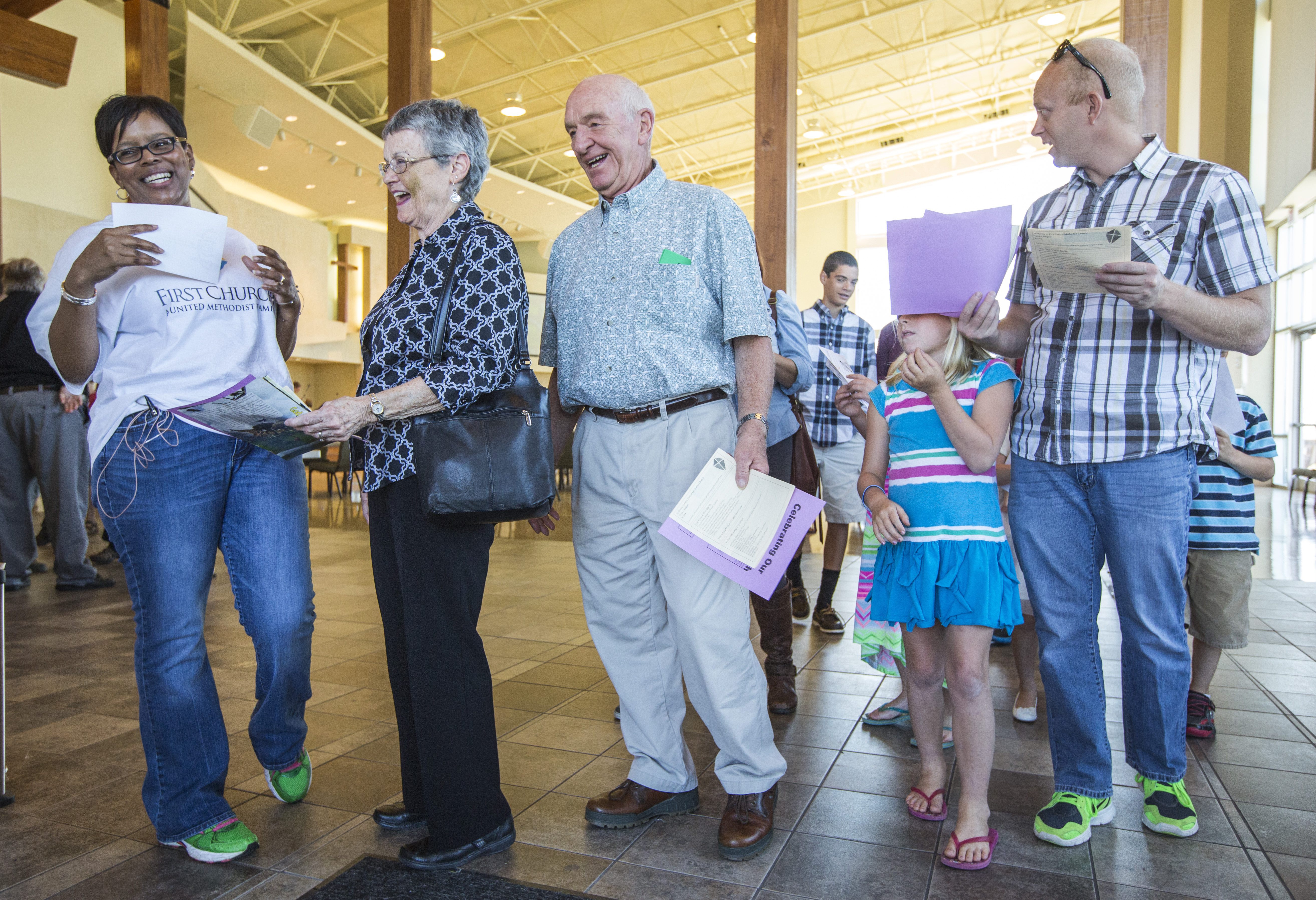
The Rev. Kathy Williams, left, greets members of her congregation at First United Methodist Church's west campus, 867 Highway 40, following church services last Sunday.
Different audience, similar message
MacConnell, who says Williams has a true passion for solving society’s inequities and injustices, has seen her sermons at the Topeka and Lawrence churches and said the only thing that has changed is the audience.
In Topeka, “people are calling and responding. They’re participating in the service as a congregation. They’re saying, ‘Amen!'” he said. “There were maybe one or two of those kinds of voices at the service I attended at First.”
Williams acknowledges that her new congregation is generally a little quieter than her last two.
“Sometimes when I’m preaching I might say, ‘Amen,’ and they’re all kind of looking at me like” — she starts talking in a whisper — “‘OK, amen,'” she said during a recent interview in her downtown Lawrence office. “In the African-American church, the pastor says something and then they kind of wait for the response back. It’s like a conversation you’re having.”
She noted that the energy of black church services evolved from the days of slavery in America.
“Back then, we would worship, but we couldn’t vocalize or be loud. We weren’t allowed to say anything. Everything had to be so undercover,” Williams said. “But then we had the ability to freely express ourselves, to freely share our joy and thankfulness, to freely express ourselves without being bound and chained.
“But God leads however God wants to lead. For some people, it will be a more contemplative, quiet way, and that is still as worshipful as throwing up your hands and saying, ‘Glory! Hallelujah!’ or ‘Amen!’ We’re influenced by how we grew up in church. So if you grew up in that particular context, you bring that experience with you. You think that’s the ‘right way’ or the ‘normal way.’ But as long as it is praise and worship, God welcomes it all.”
Virgie Alexander, who has attended the church with her husband, Dudley, for the past eight years, calls Williams “a breath of fresh air,” a great listener who always tries to greet congregants with a first name and a smile. Alexander says you never know what to expect from the new pastor: One Sunday she might show up in a white dress, the next outfitted like a KU football player.
“I have not talked to anyone who is not thrilled by her appointment,” Alexander said. “The congregational joke is that as she ends her sentence with ‘Amen?’ she gets a lot more ‘amens’ from us than any pastor in our past.”
Encouraging inquiry
Williams says introducing people to different cultures is invaluable.
“We often only know our own neighborhoods and our own communities, so it’s really hard for us to imagine even people in other countries living a certain way or having certain kinds of experiences,” she said. “We want to stay in this little box or this circle, and God is saying, ‘Oh my goodness. I’m so much bigger.’ So when we meet people who are different from ourselves, we begin to grow, our views about things begin tp grow, we become more accepting of people. I believe that’s how God intended us to be.”
On the recent Sunday at First United Methodist’s west campus, Williams preached a similar message.
“Our lives are really made up of a series of explorations, where we’re constantly seeking and constantly searching and investigating new things all around us, so we can learn more than we knew before, so we’re able to understand more than what we previously understood, so we’re able to grow in new ways that are different from what we have experienced in the past,” she said. “The more we explore, the more the veil of darkness is lifted and the light of Christ enters in.
“And the people of God said, ‘Amen.'”
“Amen,” the congregation answered back, quietly but enthusiastically.