

Dalai Lama’s death looms over Tibet
Dharmsala, India ? The question looms over this raggedy hillside town, a place where ancient mysticism constantly brushes against the realities of modern geopolitics. The monks who fled across the Himalayas ask it quietly, as do the exile politicians. Even the angry young activists are careful how they raise the issue.
But as the man at the center of the Tibetan exile movement approaches his 75th birthday, the question has become impossible to escape: What happens after the Dalai Lama dies?
The issue echoes far from Dharmsala, the Dalai Lama’s home since he fled Tibet after a failed 1959 uprising against Chinese rule. It ranges from policy decisions in Beijing to widespread fears inside Tibet and among the 150,000 exiles that their struggle for autonomy may collapse with the death of their icon.
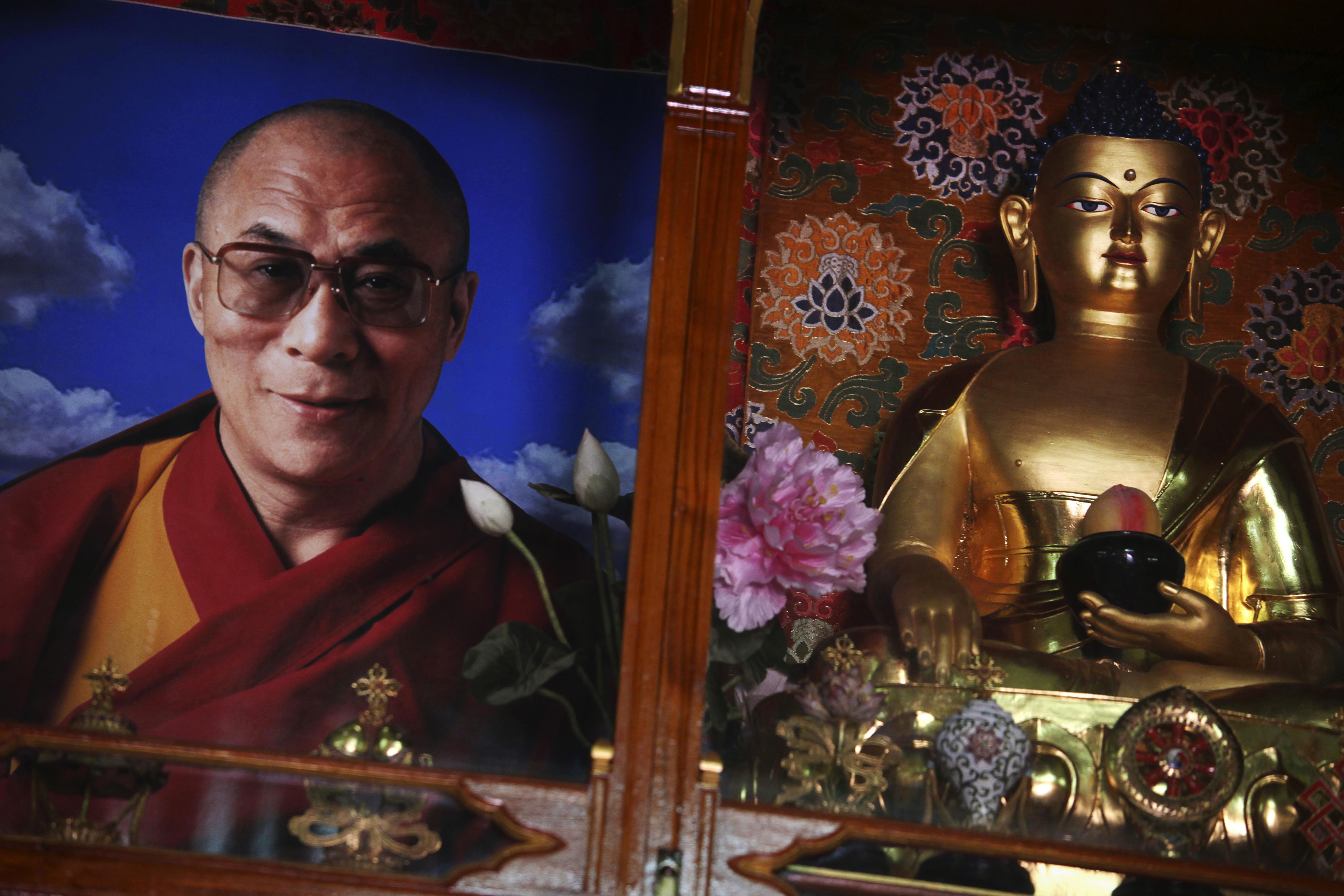
A photograph of Tibetan spiritual leader the Dalai Lama sits next to a statue of Buddha on May 10 at the Nechung Dorje Drayangling Monastery in Dharmsala, Himachal Pradesh, northern India. As the Dalai Lama, the center of the Tibetan exile movement approaches his 75th birthday, the question has become impossible to escape: What happens when he dies?
It is something he thinks about all the time.
“When I pass away, when I die, of course (there will be) a setback. Very serious setback,” the Dalai Lama said quietly in a recent interview in his private hilltop compound, speaking in his often-tangled English. His words spill out in bursts, and he can veer suddenly between resignation and determination. “But then, this younger generation will carry this on. There is no question.”
That younger generation, though, isn’t so sure.
“Right now we are under His Holiness’ leadership,” said Tenzin Norlha, a 29-year-old Tibetan genetics researcher in Dharmsala, her face creased with worry. While the Dalai Lama is thought to be in reasonable health, he has struggled with a series of ailments in recent years and turns 75 in July. “After he passes away, then what will we see? … Who can take care of us as His Holiness has done?”
It is hard to exaggerate the hold that the Dalai Lama, like his predecessors over the centuries, has over Tibetans. To them he is a king, the leader of Tibetan Buddhism and the embodiment of compassion. He is The Presence, The Holder of the White Lotus, The Absolute Wisdom, The Ocean. His presence often reduces his followers to speechless weeping.
For nearly 500 years the tradition has continued, with each dead Dalai Lama reincarnated into the body of a young Tibetan boy. But with Tibet’s leadership in exile and an aging Dalai Lama, Tibetan history is at a precipice.
“Once the Dalai Lama dies, the whole exile structure is going to be under enormous pressure,” said Robbie Barnett, a Tibet scholar at Columbia University.
Among the possible aftershocks: a rival Dalai Lama anointed inside China, home to some 5.4 million Tibetans; squabbling among various Buddhist sects; a plunge in donations; infighting in the exile government and a drop in interest among wealthy foreign supporters and young activists.
In many ways, the Dalai Lama is a man who could be undone by his own charisma. Behind the monk’s robes he might look like a midwestern 1960s retiree — with a buzz haircut, oversized glasses, maroon polyester socks and orthopedic shoes — but decades of visitors have talked about his ability to make intense personal connections. He laughs loudly, he slaps playfully at people he barely knows.
His most fervent Western supporters revere him as a mystical amalgam of Nelson Mandela and Yoda, and his wealthy and powerful allies range from actor Richard Gere to U.S. House Speaker Nancy Pelosi.
He will be a hard man to follow.
“The Tibetan government is now standing on the strength of one man,” said Jamyang Norbu, a writer who once fought for the small, long-disbanded Tibetan guerrilla army. He is one of the most outspoken intellectuals favoring complete Tibetan independence, as opposed to the limited autonomy the Dalai Lama now demands.
Norbu worries about the personality cult that surrounds the Dalai Lama, and the way his god-like status can make it difficult for dissenting voices to be heard. “In many ways I am loyal to him. But it’s difficult to have an independent point of view” in the exile community, he said from his Tennessee home.
The Dalai Lama, the 14th in the line of reincarnations, has at times insisted his reincarnation would be born in exile and has also said the tradition could end with his death. He has talked about dividing his power, with his reincarnation carrying on spiritual duties while someone else — perhaps someone he appoints — takes up the leadership of the exile movement.
He regularly meets with high-ranking monks to discuss his succession. The group includes the Karmapa, a 24-year-old monk known for his daring escape from China and appreciation of PlayStation war games. Many observers believe he is being groomed to take on more power.
Publicly, the Dalai Lama often treats the issue lightly — his advisers “are hoping my life may remain infinite,” he said, laughing — but he is clearly sending up trial balloons, gauging what his followers will accept after he dies.
And always, Beijing’s potential reactions are weighed.
“There’s a fear that unless we can strengthen the exile government before His Holiness passes away, the Chinese will make a strong attempt to control his reincarnation process,” said Norbu.