Masterpiece by chance: Students make unusual raku pieces in annual event
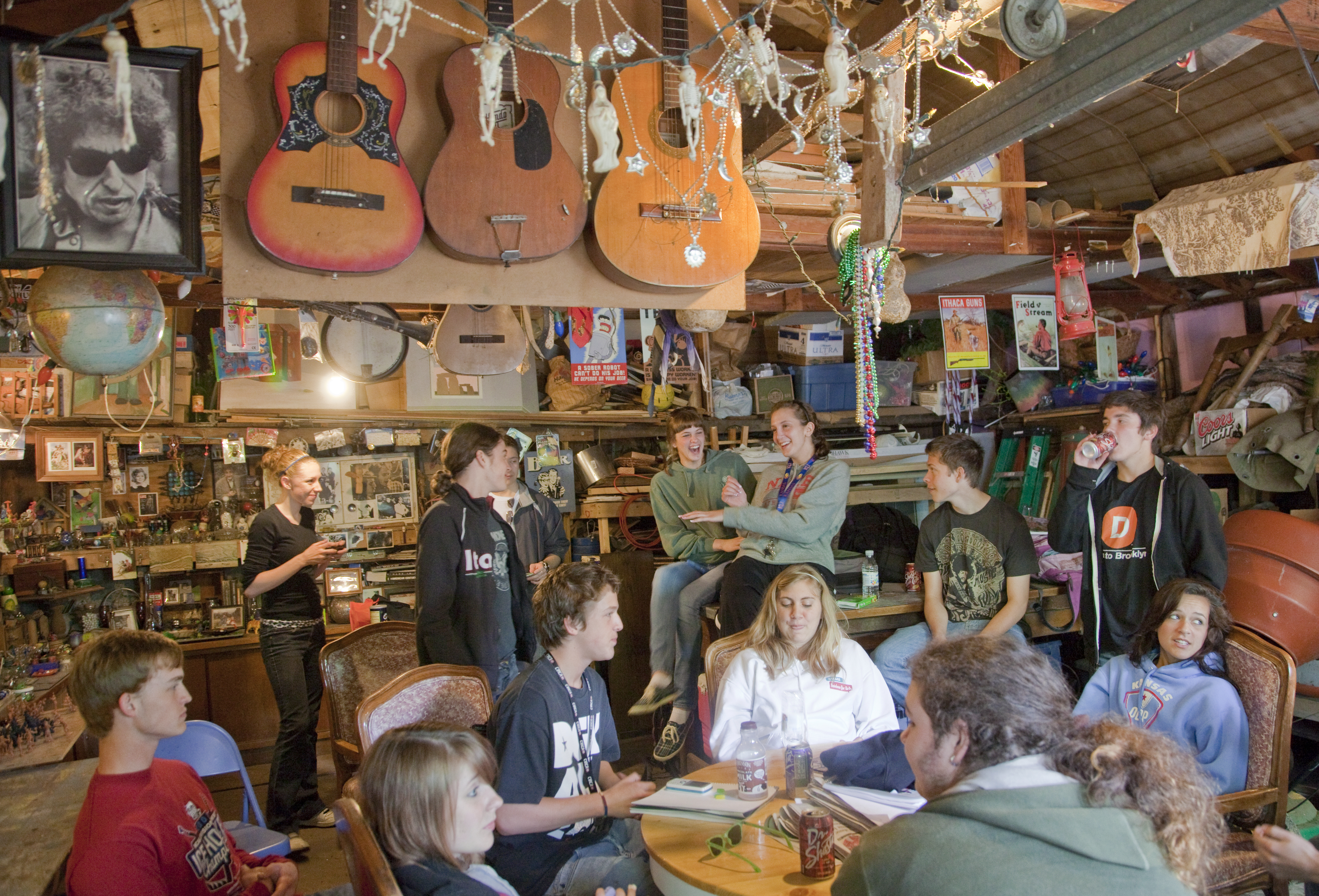
Lawrence and Free State high school students gather at the home of Dave Leach, Lawrence, to learn raku, a ceramics technique.
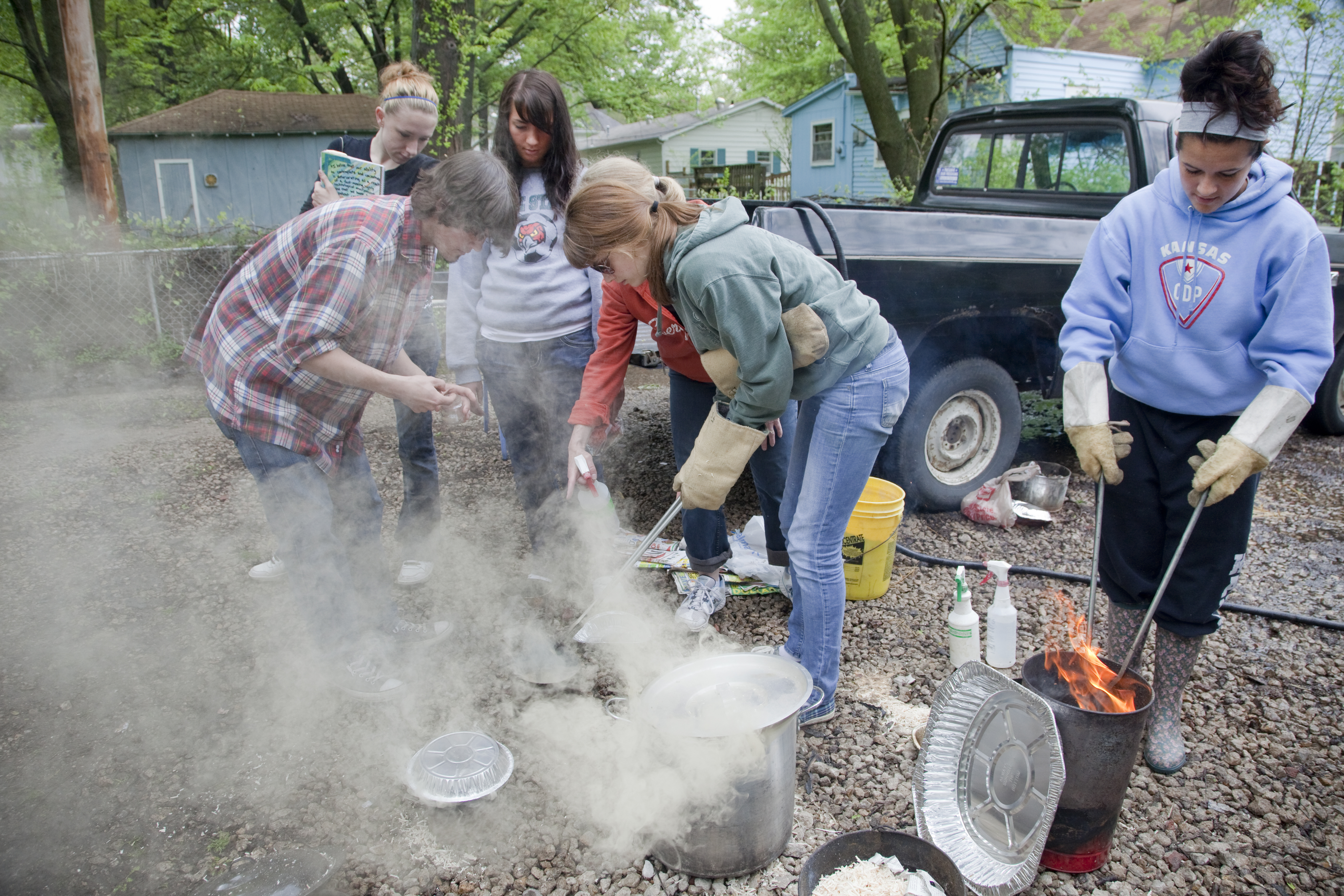
Lawrence and Free State high school students participate in a raku firing at the home of Dave Leach. The students were placing their raku pieces in containers filled with miscellaneous items set on fire that will create random and unpredictable textures and colors on their pottery.
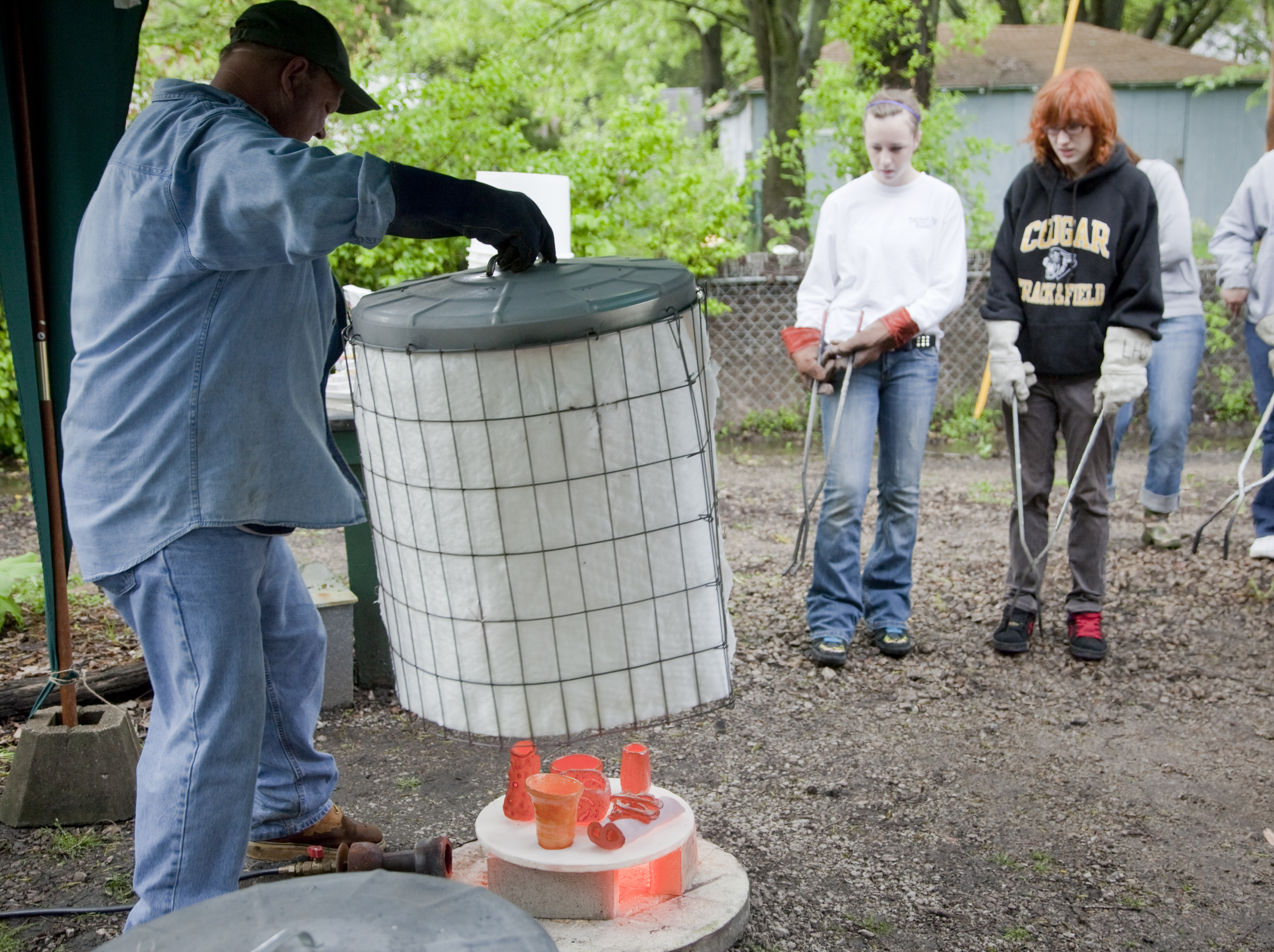
Dave Leach, left, lifts the cover off of one of his two kilns at his house in East Lawrence to reveal fired raku pieces made by Lawrence and Free State high school students.
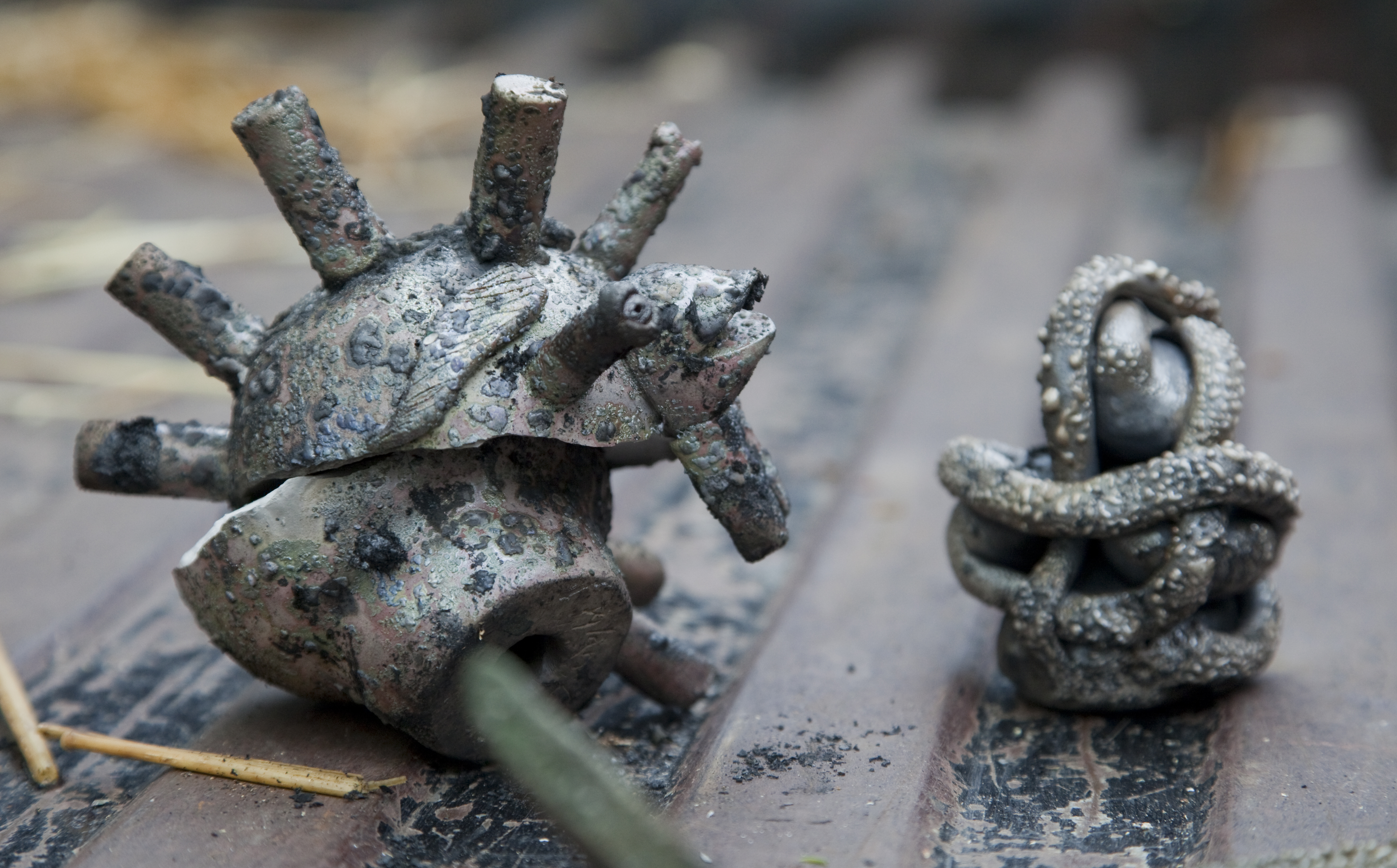
Pieces of raku pottery cool at the property of Dave Leach, Lawrence. The Kansas University safety coordinator opens his home to high school students and teachers once a year to learn raku.
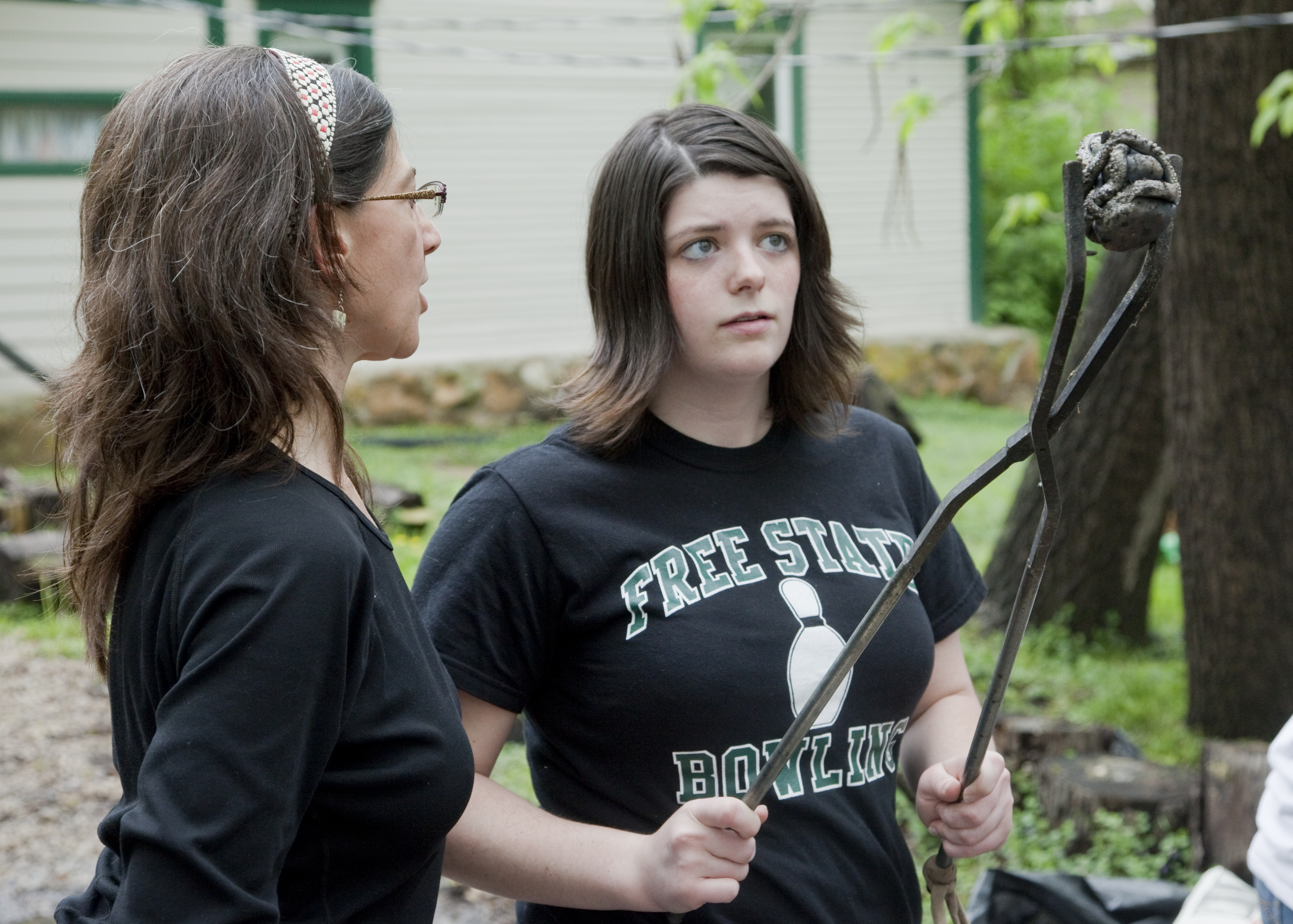
LHS art teacher Deena Amont and Free State senior Elizabeth Love discuss one of Love’s raku pieces.
Wearing thick, protective gloves that climb up to his elbows, David Johnson, 17, grips a long pair of metal tongs and picks up a piping-hot ceramic vase. He then shuffles over to a cluster of coffee cans and cooking pots, releases the tong’s pincers and plops the vase inside one of the cans. The can is filled with newspapers, sawdust, copper washers and coins. All of the combustibles burst into flames when the vase slides inside, and Johnson snaps a flimsy pie pan over the can, periodically flapping it to waft the smoke out and breathe oxygen into the mixture.
Johnson, a senior at Free State, is doing what’s called raku firing, a ceramic technique that has roots in Japan. Every year a group of 25 to 30 students from Free State and Lawrence high schools hop into vans and shuttle to David Leach’s house to learn the ancient art. It’s Johnson’s second time participating.
“I loved doing this last year,” Johnson says. “It was a lot of fun. And I did learn a lot last year. I didn’t really know all the steps at first, but now I know what to expect.”
Rich history
For more than 15 years, it’s been an annual tradition for the high schools to gather at the Leach’s to-do raku. Leach, safety coordinator at Kansas University, welcomes students and teachers into his yard and home for the event, taking a full day off of work to facilitate the firing. It’s something Leach looks forward to every spring.
“I enjoy being able to share it,” Leach says. “There’s an anticipation and an excitement in that you don’t know exactly what (your piece) is going to look like. Then there’s that delight or disappointment when you see it.”
Initially a ceramics major at KU, Leach earned his degree in sculpture but is familiar with raku. And though the tradition has taken place in his yard for the last 15 years, the event, a collaborative effort, is actually the brainchild of Sue Malloy, a former art teacher at Lawrence Alternative High School, which closed in 2005. LAH didn’t have a lot of funds to toss around, so Malloy researched different techniques, with a particular emphasis on firing with little equipment. Her attention instantly flocked toward raku because of its traditional roots and affordability. Malloy, who had once played in a band named Parlor Frogs with Leach, knew Leach had taken ceramics classes and done raku, so she asked him to help.
“I asked Dave if he’d be willing to help me with the first field trip by hosting it in his backyard and helping me with the big propane tanks that were needed to fire the kiln,” Malloy says. “Our first raku field trip was such a success. The kids loved it. We all came back to school at the end of the day filthy, exhausted and smelling like smoke — but invigorated. At that point, I knew we had a ‘tradition’ in the making, especially since students, from that day on, asked, ‘When are we going to do another raku firing?'”
When Malloy retired and the Lawrence Alternative closed, Laurie McClane-Higginson, an art teacher from Free State, and Deena Amont, an art teacher from LHS, kept the tradition alive. “I’ve had kids tell me afterward it was the best field trip of their high school experience,” Amont says.
Element of surprise
The raku method relies heavily on abrupt temperature changes. The idea is to get a piece burning hot, then yank it away from the flaming kiln to put it into a cooler environment. The swift drop in temperature can create unanticipated results.
“One of the translations of raku is ‘happiness through chance,'” says Amont. “I like that translation because it defines the surprise aspect of it. The the raku firing can come out different depending on the interaction of the glaze, the fire and the materials that are used to smoke the piece.”
At this years’ event, the sky was gray from the morning rain and the smoke coiled up and gave the impression of burning leaves. Students put their pieces into the kilns for about an hour. During the kiln stage, Leach gradually cranked up the heat using propane until the ceramics were smoldering. When the pieces were thoroughly heated, Leach called out to the students and they pulled on thick gloves and grabbed some tongs. Then, one at a time, each hustled over to his piece, grasped it with the tongs and slipped it inside a coffee can positioned away from the ovens.
The cans were crammed with stuff: orange peels, newspapers, banana peels, coins, sawdust, leaves — if it was burnable, it was probably in there. The combustibles and chemicals enacted different surface changes on the ceramics, and the students had fun adding more materials to see what would happen. With the blazing ceramics trapped with all of the kindling, small contained fires launched to life. Students then let their pieces burn with the combustibles for a half-hour, before removing them to check the results and wash away the ash.
When Johnson finished his piece, he was more than happy with the end product. The vase had taken on a metallic luster and looked quite distressed.
“I like it,” he says. “I’m happy with it, for sure. This year was a lot of fun, too. Everyone had a lot of really cool pieces.”
Arts and Entertainment

Lawrence Arts Center chooses interim leader to become its new executive director

Events: St. Pat’s celebrations, Eagle Day, theater, dance, music and more
Theatre Lawrence’s production of ‘The Cottage’ is a little bit Noel Coward, a little bit John Cleese

KU’s University Theatre will open spring season with ‘Corners Grove’
City leaders discuss how to strengthen existing public art funding program and make it more flexible