Say what?: Klingon and other ‘crazy ideas’ detailed in book about invented tongues
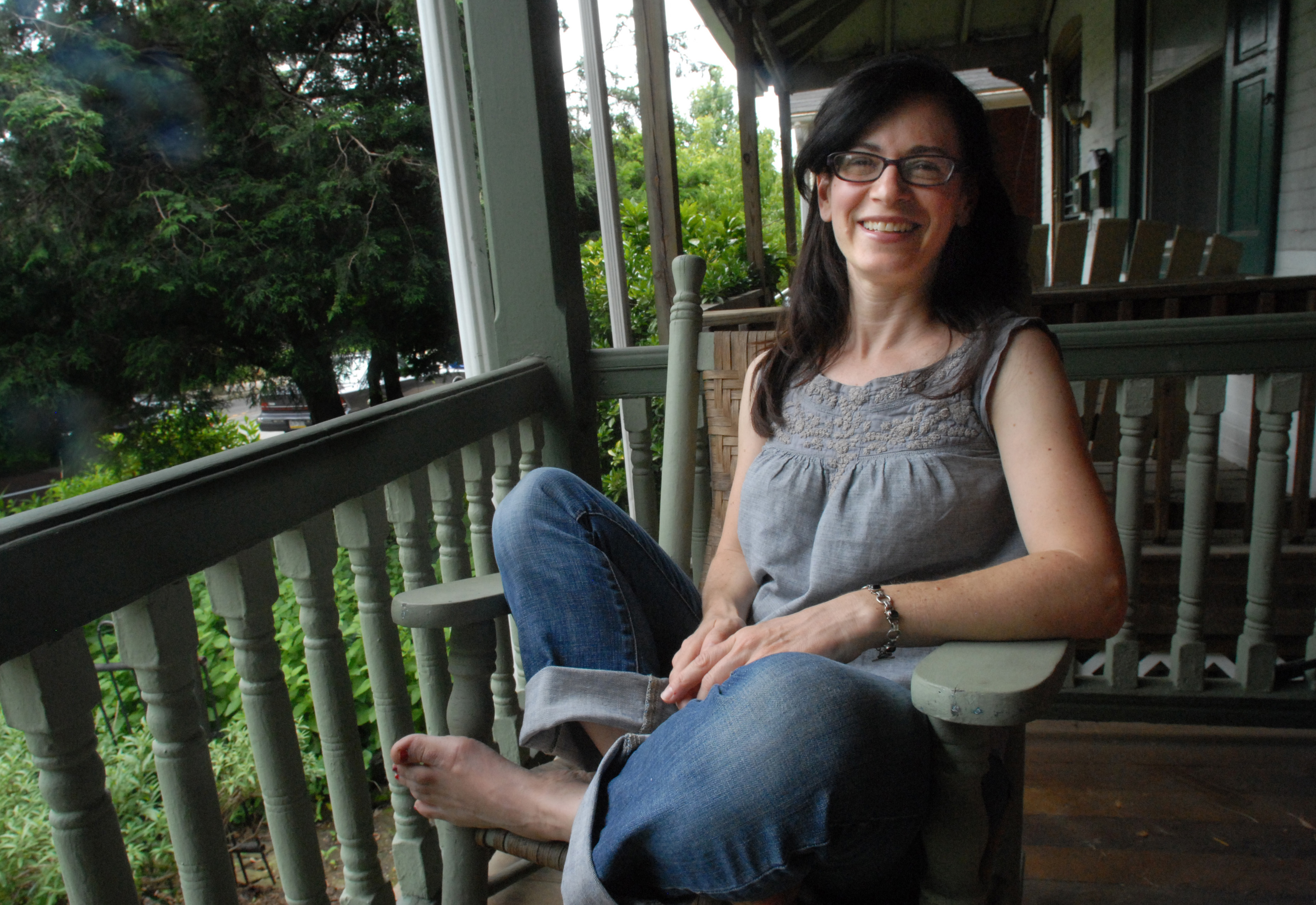
Arika Okrent, author of “In the Land of Invented Languages,” became intrigued by the hidden history of such tongues.
An insult in Klingon, and phrases in other invented languages:
• Esperanto
La amiko povos ludi en la granda urbo.
The friend can play in the big city.
• Klingon
Hab SoSlI’ Quch!
Your mother has a smooth forehead!
• Loglan
.i mi cuxna lepo mi speni tu
I choose the state of being married to you.
• Babm
Y uhqck V.
I request you not to reproach me.
• Solresol
Dore mifala dosifare re dosiresi.
I would like a beer and a pastry.
• Idiom Neutral
Ekse caval, kes mi volu donar a vo.
Here is the horse I want to give to you.
Philadelphia ? Arika Okrent was studying languages at the University of Chicago. The languages people use and how they work. The rules, the changes, the charts. She was in the library, poking around.
“And then,” says Okrent, relaxing in her home in the Germantown neighborhood of Philadelphia recently, “I drifted down to the shelves with all the books on invented languages. It was a sad little collection. I felt sorry for it.”
But something called to her. Tales of made-up languages and their makers. Esperanto, the most widely spoken of all; Volapuk, once the most popular; Klingon, the bark of space invaders.
She learned artificial tongues, then wrote about going to a 2003 Esperanto conference for the American Scholar — and the seed of a book was planted.
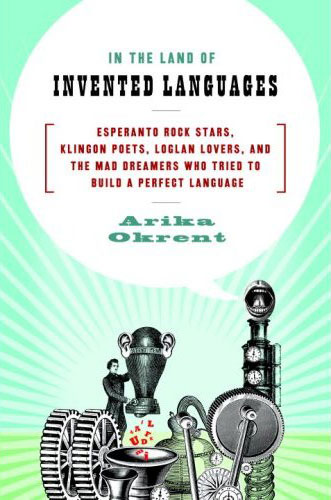
That book is the delightful “In the Land of Invented Languages” (published last month in paperback), which tells tales — often sad, often hilarious — of made-up tongues, Okrent’s forays into the realms of Esperanto, Klingon and Blissymbolics, and the personalities, political battles, and fates of linguistic makers-up.
Niece of the journalist Daniel Okrent, Arika met her husband, research linguist Derrick Higgins, at Chicago. They came east when Higgins got a job at Educational Testing Service in Princeton, N.J. Okrent says, “I did almost all the research for the book before I had kids” — Leo, 5, and Louisa, 1.
“As I got further and further into this world,” says Okrent, 40, “at first, I’d say, ‘Look at all these crazy ideas,’ but I’d also find touching clues about the lives of the inventors.” Her book “reflects the humor and the craziness, but also has compassion and understanding, since I’m a language person myself.”
“Land of Invented Languages’ is a history of a “vast graveyard,” brilliant projects that failed. Some inventors, such as James Cooke Brown, become famous for other things (he created the board game Careers), but not for their pet languages. We meet Suzette Haden Elgin, who in the early 1980s created Laadan, a “woman’s language” (“the only language textbook I know of,” Okrent writes, “that gives the word for menstruate in Lesson 1”). We visit the nutty, simpatico world of Esperanto, and the gestural world of sign languages.
There’s the occasional success, as with Eliezer Ben-Yehuda, who fought in the late 19th and early 20th centuries to resurrect a near-dead priestly language (Hebrew), and retrofit it for a modern age; it is now the national language of Israel. Or Lazar Ludwik Zamenhof, who grew up in the 1860s and ’70s in the Russian Empire town of Bialystok, a Babel of Russian, Polish, German and Yiddish. He dreamed of a language that cut through the tangle — and his brainchild, Esperanto, is still the most widely practiced made-up tongue.
Messiness and ambiguity
Rage for order has led many to remake language. In the late 1940s, Austrian engineer Charles Bliss invented Blissymbolics, which he hoped could become a writing system for all languages, “logical writing for an illogical world.” And Brown invented Loglan, a language that followed the rules of logic. In one of her saddest stories, Okrent recounts how Brown fell into a long-running feud over rights, egos and direction. A project titled Lojban carried on his vision, despite him.
Language makes us human. So — why mess with it?
“Well, there is a lot of messiness and ambiguity in language,” Okrent says. “We need it. We need that wiggle room. But if you have an engineering mind, you’ll see irritating things. Why do words have more than one meaning?” (Look up the word “set” in Webster’s: Its very first entry lists 25 possible meanings.) “Why do we have irregular verbs? Why are pronouns in English so messed up?”
Problem is, language probably isn’t fixable. “When you try to fix the world of ideas, fix the meanings of words,” Okrent says, “it’s hard to keep it steady. Times change, words change, and besides, we tend to mean what we mean not by strict rules, but by agreement.”
That won’t keep people from trying. One motive is the altruistic dream of tearing down the linguistic walls that divide us.
“It’s the dream of oneness,” says Okrent, “the idea that if everyone could communicate with one another, we could eliminate strife — an idea that is, unfortunately, easy to disprove.”
Ludwick invented Esperanto with that idea. Bliss of Blissymbolics grew up in the many-languaged Austro-Hungarian Empire and dreamed of unifying the world through a common system. Even the names for these languages hint at the dream of one, perfect world: Esperanto (“one who hopes”), Volapuk (“world language”), Lingua Komun (“common language”), Unilingue, Unita, Universel.
“One of my favorite figures in the book,” says Okrent, “is Fuishiki Okamoto, inventor of a language he called Babm. It’s a ridiculous language he claims is perfect, and of course it’s not — but he is so humble and modest, hoping it would be for the benefit of humanity. If these people worked that hard in pursuit of a failed dream, I figured they deserved to have their stories told.”
All this categorical, logical, engineering mentality — isn’t this all overwhelmingly male? True, Okrent’s book begins with Hildegard of Bingen, the 12th-century nun who created one of the first known made-up languages. And there’s the aforementioned Elgin. But Okrent doesn’t deny that Klingon conventions and logical-language websites seem to be a guy thing: “Many people have suggested there’s an Asperger’s-like, hyper-male mind-set at work, and there may be some truth to that.”
Art for art’s sake
Invented languages say much about their times. In the 19th and 20th centuries, when the world was falling apart, people invented languages to sew it back together. Today, says Okrent, “it’s a much more playful enterprise, one that reflects the Internet, celebrity-driven popular culture.” Klingon, she says, “is much more in the spirit of the languages J.R.R. Tolkien invented for his ‘Hobbit’ and ‘Ring’ cycle, not trying to fix language but take it in an artistic direction.”
Okrent is, naturally, a certified Klingon speaker, and she tells how she achieved that high distinction — complete with official pin — in her book. The Klingon Language Institute is located in Blue Bell, Pa., along with its founder, psychologist and writer Lawrence M. Schoen.
“In the Land of Invented Languages” ends with Okrent taking and passing a test to certify her as a Klingon speaker. Okrent can see the attraction of an endeavor that might perplex the Terra-ngon (earthling) world: Klingon speakers “are doing language for language’s sake, art for art’s sake. And like all committed artists, they will do their thing, critics be damned.”
Arts and Entertainment
Events: Ballet, cinema, walking tours and lots of Easter egg hunts

Theatre Lawrence’s upcoming season to feature ‘On Golden Pond,’ ‘Pirates!’ and more

Watkins Museum to host traveling exhibition featuring photographs, narratives of the Underground Railroad
Local vendors can apply now for KU’s new monthly on-campus market, Jayhawk Fridays

UPCOMING EVENTS: Easter egg hunts, fee-waived pet adoptions and more