

Two views from the front line: Nearly 66 years after famous battle, former enemies trade war stories
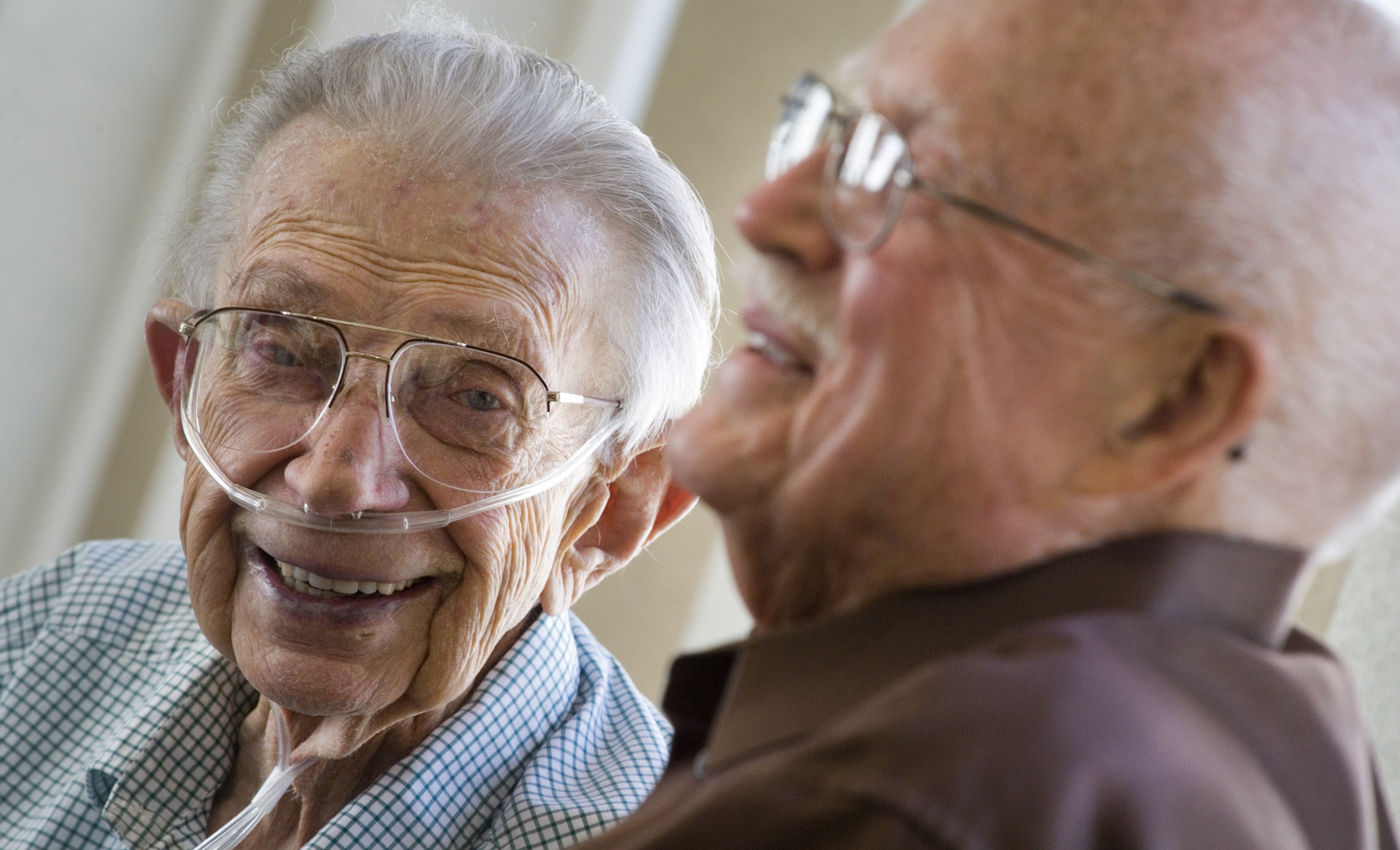
Hans Ressdorf, left, a German soldier during World War II, talks with Jim Osburn, an American soldier, in Colorado Springs, Colo. Both men fought at the Battle of the Bulge.
Colorado Springs, Colo. ? As the “mayor” of his Colorado Springs, Colo., retirement home, Jim Osburn makes it his job to welcome each new arrival at the Inn at Garden Plaza.
Earlier this month, this custom brought him face to face with Hans Ressdorf, a 92-year-old retired contractor with shrewd eyes, a thick German accent and an incredible past.
“I was a German soldier,” Ressdorf told Osburn as they sat down to lunch.
“Tell me more,” said Osburn, 87, a World War II veteran with a story of his own.
Over the course of the meal, the men were stunned to learn of the experiences they shared, albeit from opposing sides in a global conflict.
Both were inexperienced young officers. Both saw their men overrun during the Battle of the Bulge. Both nearly starved as prisoners of war waiting for the war to end. And more than 60 years later, here both were in Colorado Springs, combatants-turned-neighbors in a home where a two-bedroom apartment goes for $4,000 a month and residents enjoy gourmet meals, a putting green and Sunday afternoon ice cream socials.
“It’s interesting how life tosses you around,” said Ressdorf, who moves slowly with the help of a walker.
“Only in America,” Osburn answered warmly.
Ressdorf’s oxygen tank hissed rhythmically one recent morning while the pair recounted their experiences, occasionally shaking their heads in empathy and chuckling over their shared past.
Osburn retired as an Army major in 1961 and settled with his family in Colorado Springs, where he worked as a teacher’s aide in Colorado Springs School District 11 and in real estate. He said he knew early on he wanted to serve in the military.
A native of Fayetteville, Ark., he signed up with the Arkansas National Guard at the age of 17 and left high school when his unit was mobilized in the middle of his senior year. Later, he was commissioned as a second lieutenant and assigned as a forward observer in an all-black artillery battery led by white officers.
He landed on French soil a month after D-Day, and fought through the French provinces of Normandy and Brittany and into Belgium. But his wartime experience was defined by the Battle of the Bulge, the six-week campaign that eventually broke the German Army, at a cost of some 20,000 American lives.
By Osburn’s reckoning, the fighting began Dec. 15, 1944, a day earlier than the date used in history books. His men began taking German artillery fire that afternoon near the tiny Belgian village of Schonberg near the German border, and hunkered down as the shelling continued through the night.
“By daylight on the 16th, it was obvious something really big was going on,” he said.
That day, Osburn’s battery commander, Capt. Bill McLeod, was summoned to battalion headquarters in Schonberg. The officer returned alone, on foot, having lost his jeep and driver. He brought news that a German tank company had seized the town, and that it was time to retreat.
Osburn said McLeod gave him the task of sneaking the unit’s empty trucks through the village while the rest of the men escaped on foot through the woods.
First order
In the hopeless race through Schonberg, Osburn’s driver was killed by a gunshot to the chest, and the vehicle veered into a German Tiger tank that loomed, he said, “like a damn city on wheels.” Incredibly, the truck lodged under the tank’s 88mm gun, pushing its barrel up and out of firing range.
“I bailed out and ran into the back door of a house with 28 other men who had done similarly before me,” he said.
Osburn was the sole officer in a unit of cornered infantrymen. They made their way into the basement, where he sought advice from the noncommissioned officers among the tattered crew.
“One of them, I’ll never forget, says, ‘Sir, you’re as good as a general to us right now,”‘ he recalls.
“About that time, the Germans came in on the upper floor of the house and shot through the floor and threatened to throw grenades if we didn’t surrender.”
Osburn’s gave his first order as the ranking officer: “I surrendered,” he said.
For more than four months, he struggled to survive as a POW. By the time he was liberated, on May 2, 1945, he had been shelled by Americans, held in an explosives-lined bunker — rigged to explode should Allied forces attack — and nearly starved to death during a days-long ordeal in which he was crammed into a stationary box car with scores of other American prisoners.
None had food or water, but they were young and strong, he said.
“The first guys out hit the ground like meatballs. They had lost the ability to stand,” he said.
Osburn, who was reunited with McLeod in a POW camp, was told that Germans captured nearly half the men who attempted to escape Shonberg on foot, though he never learned the fate of the other half. He believes that nearly all the drivers in the trucks he was escorting were killed during or shortly after the escape attempt he led.
Lost cause
Ressdorf, for his part, said he never wanted a life in the military.
As a boy, his family moved to Brazil, and he and his brothers were put to work on a coffee plantation. He returned to Germany as a teenager intending to train as an architect, but the German Army got to him first. He said he was drafted in 1937, after applying for a passport to return to Brazil.
Seven years later, he found himself dug into a foxhole in Belgium, a first lieutenant watching his company of paratroopers get cut to pieces by Canadian artillery near the Albert Canal.
Their mission, he said, had been to secure a bridge and prevent the advance of a Canadian tank unit.
The Germans stood little chance without antitank weapons, but the men followed orders and “dug in” in a bid to repel the Allied soldiers, he said. The men were lucky if they survived the opening salvos.
“Within one hour, the field went from green to brown,” he said.” “It looked like a farmer had plowed it.”
Advancing tanks rolled over his men’s positions, burying some alive, and American infantrymen soon followed, winnowing the entrenched paratroopers to just a handful of survivors.
“After that, we were just a corpse of unit,” he said. “There was nothing left.”
Ressdorf said he withstood the attack for more than two days in a foxhole dug between sturdy groves of oak trees. He remembers being showered by splintered wood as shells erupted around him.
American soldiers eventually spotted him, likely from the flash of his field glasses. They threw heavy bricks at him until he surrendered, he recalled: “I knew it was over. I knew it was a lost cause.”
Back in the U.S.A
As a prisoner of war, Ressdorf endured a period in which his daily ration was a can of vegetable soup and a can of water to be split with another soldier. He ultimately was taken to a prison camp in Scotland.
Upon his release, Ressdorf returned to Germany, and assisted the Americans with the Berlin Airlift that dropped supplies to West Berlin amid a tense confrontation with the Soviet Union.
By his account, he impressed American officers, and they were instrumental in arranging his immigration to the U.S.
In America, he said, he became an ambitious immigrant, determined to establish himself and build a life. He built houses in New Jersey, and in the 1970s moved to Colorado Springs, where he raised two stepchildren with his second wife and grew his construction career.
“I was a general contractor for McDonald’s (restaurants). I built McDonald’s all over the West,” he said proudly.
Osburn, who never stopped thinking about the tragedies he endured in the war, pumped his fist in solidarity as his former enemy described himself as a “full-blooded American.”
“I’m on his team now,” Osburn said with a smile.