

Graves cover ‘Freedman’s Village’
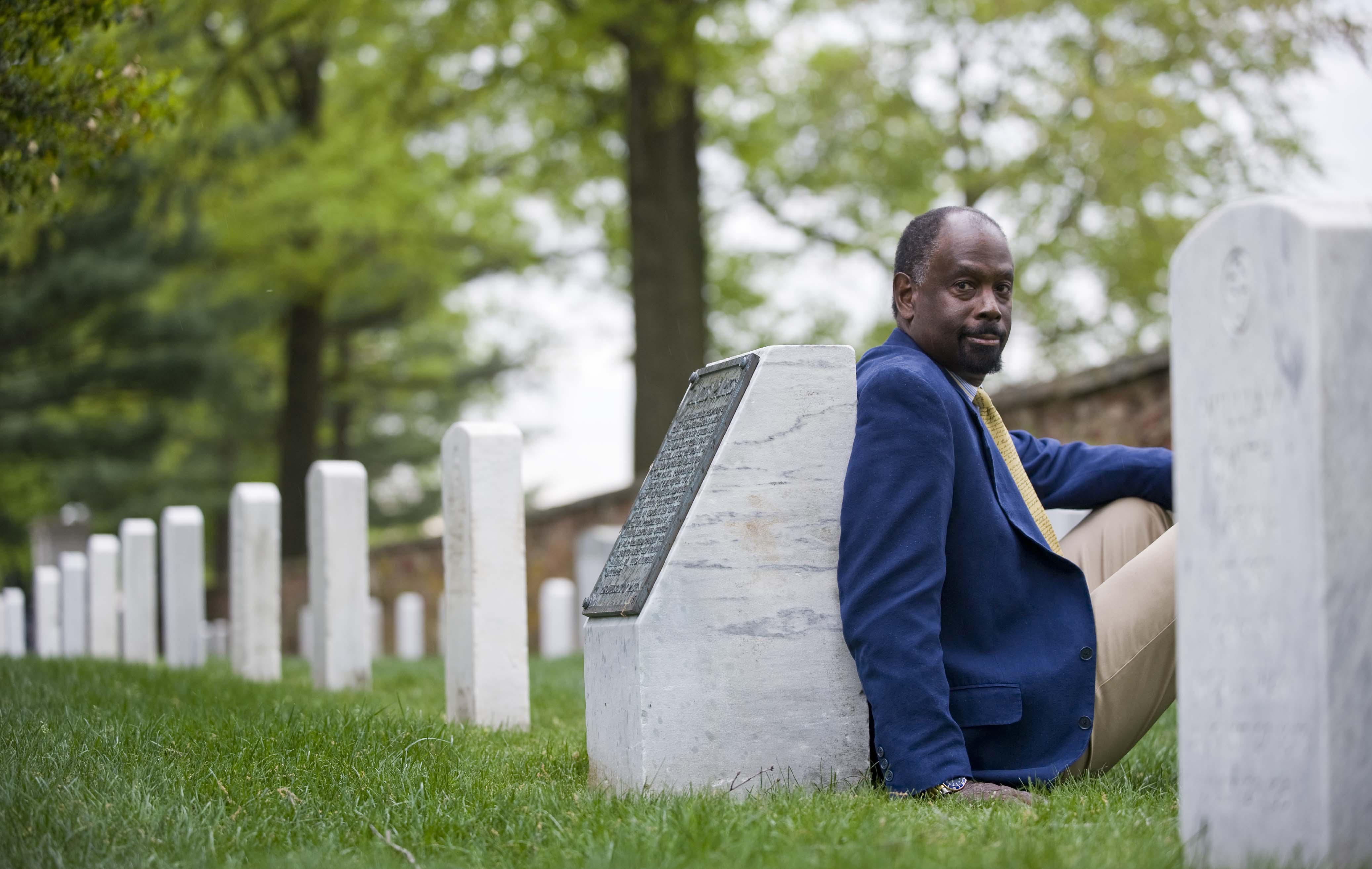
Wayne Parks leans against his great-grandfather’s grave marker last week in Arlington National Cemetery. In one area of the cemetery, rows of small, unassuming white tombstones are the only visible reminders that part of the nation’s most storied burial ground sits atop what used to be a thriving black town — “Freedman’s Village,” built on land confiscated from Confederate Gen. Robert E. Lee.
Arlington, Va. ? Charter buses roll up to Arlington National Cemetery every day, depositing tourists who scramble uphill to see the eternal flame on President John F. Kennedy’s grave. People stream in all directions, toward the Tomb of the Unknowns or to remember at tombstones of loved ones lost to war.
Few, however, head downhill to a quiet corner near the Iwo Jima Memorial.
Down here, there are no memorials to ancient battles, no ornate headstones honoring long-dead dignitaries. There are only rows of small, unassuming white tombstones, many engraved with names like George, Toby and Rose.
They are the only visible reminders that part of the nation’s most storied burial ground sits atop what used to be a thriving black town — “Freedman’s Village,” built on land confiscated from Confederate Gen. Robert E. Lee.
Milton Rowe recently shuffled around the famous grounds, slowly making his way up a hill with Wayne Parks. There’s nothing here now to tell visitors that freed slaves once lived here, but the two men say they feel a kinship, a connection with this land because they can both trace their ancestors to Freedman’s Village.
Parks said he remembers his grandfather repeatedly bringing him to the cemetery as a child to explain the bond. Parks’ great-grandfather, James Parks, lived in Freedman’s Village and other locations around the cemetery after being freed from servitude to the Lee family.
“I was sitting on this wall gazing out over the cemetery and all of a sudden I got it,” Parks said. “Our DNA is intrinsically intertwined in this property, integrated in this property. The spirits of my ancestors continue to exist here in this property, so I find like my grandfather, I now come here for strength, I come here to commune with them.”
Cemetery’s history
Arlington National Cemetery was established on land confiscated from Lee and his family in 1861 after the general took command of the Confederate forces.
The Civil War leaders of the Union buried dead soldiers on the property in hopes that Lee would never want to return, and Parks’ ancestor dug the very first grave near the Freedman’s Village burial site. The federal government turned some land about half a mile north of Lee’s mansion into a town specifically for freed slaves, referred to as contraband, who had nowhere to go.
Freedman’s Village was no ramshackle camp. At its height, more than 1,100 former slaves lived in a collection of 50 one-and-a-half story duplexes surrounding a central pond.
Although the town was supposed to be temporary, the freed slaves put up churches, stores, a hospital, mess hall, a school, an “old people’s home” and a laundry — to make a life for themselves.
“I think it would have very much resembled a town anywhere in America today with that population. They had the same needs as anywhere, and they sustained themselves by working,” said Thomas Sherlock, historian at Arlington National Cemetery.
Living in Freedman’s Village wasn’t free. Workers with government jobs on nearby farms or those doing construction were paid $10 a week, but half their salary was turned over to the federal government to pay for running the town. Everyone else who lived on site was charged between $1 and $3 rent.
Dignitaries from around the nation came to see — and sometimes stay — with residents. The most famous was Sojourner Truth, the fiery black abolitionist and preacher, who spent about a year at Freedman’s Village as a counselor and teacher.
Truth taught courage and urged residents to stand up to nearby white landowners who had taken to raiding the village to kidnap children for slave labor. Freedman’s Village parents who had reported the kidnappings earlier had been thrown in jail.
But when authorities came to jail Truth for encouraging parents to keep complaining, she swore to “make this nation rock like a cradle” if they tried to silence her. They backed down, and the raids soon ended.
End of the town
Life was difficult. Virginia residents resented the villagers, and threats were made against their lives.
Freedman’s Bureau records show that on July 27, 1865, an Army assistant commander ordered “the arrest of W. J. Miner (white man) near Freedman’s Village for threatening the lives of colored people, collection of unjust claims” and other crimes. There’s no indication an arrest was ever made.
Eventually, the village site, with a spectacular view of the nation’s capital and the Potomac River, became more and more desirable for development. Despite impassioned protests from the freed slaves, the federal government paid the residents $75,000 for the buildings and property, and tore down the town in 1900.
“Unfortunately our government didn’t see the historic value of some of those things,” Sherlock said.
National
A bright moon may dim the Eta Aquarid meteor shower made up of Halley’s comet debris
NEW YORK (AP) — The Eta Aquarid meteor shower soon will light the sky with debris from Halley's comet. But a ...
Trump task force report alleges anti-Christian discrimination under Biden administration
US to withdraw 5,000 troops from Germany in next 6-12 months
WASHINGTON (AP) — The United States will withdraw about 5,000 troops from Germany in the next six to 12 months, ...
FEMA workers who sounded alarm over disaster preparedness reinstated
Trump gives go-ahead to major new Canada-US oil pipeline
Trump signs bill funding the Department of Homeland Security, ending record shutdown
WASHINGTON — President Donald Trump swiftly signed a bipartisan legislation Thursday to fund much of the ...