

Brazilians flee anacondas, alligators amid floods
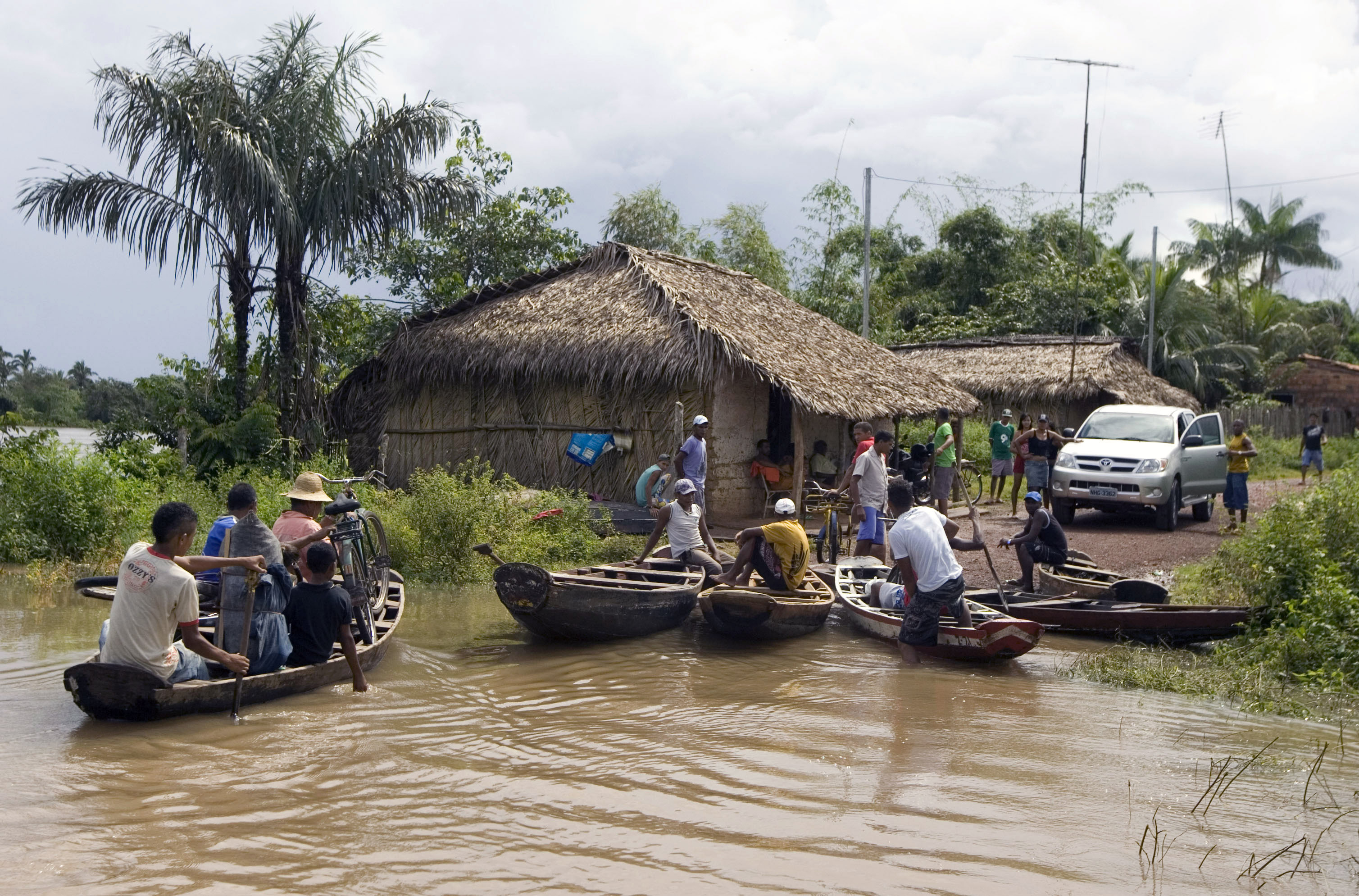
People cross a flooded road with canoes Thursday in Rosario, in the northeast state of Maranhao, Brazil. Floods have killed at least 36 and left more than 200,000 homeless across a vast region stretching from the Amazon jungle to the northeastern Atlantic coast, and meteorologists predict the bad weather could last for weeks.
Corimata da Cima, Brazil ? The dirt road that runs in front of her house is a river. Her fields of rice and manioc lie ruined underwater. And with water seeping into her mud-brick, thatched-roof home, Maria do Remedio Santos knows it’s time to join her neighbors.
Like 218,000 others across a swath of northern Brazil three times the size of Alaska, the neighbors have fled the worst rainfall and flooding in decades, braving newly formed rivers teeming with anacondas, alligators and legless reptiles known as “worm lizards” whose bite is excruciating.
They have made their way into shelters, some of which are already packed with people, pets and livestock with little food or medical supplies. But Santos said Thursday there is no other choice for the nine people — relatives and neighbors — camped out in her shack.
“For now we’re all sleeping in the living room, but we’re going to have to leave,” she said. “There’s no other way out.”
Already, 36 people have been killed in the flooding, sparked by unusually heavy rains that have been falling for two months on 10 of Brazil’s 26 states, an area stretching from the normally wet rainforest to coastal states known for lengthy droughts. Meteorologists blame an Atlantic Ocean weather system that typically moves on by April.
They forecast weeks more of the same.
Downriver from Santos’ home in the town of Sao Miguel de Rosario, adults waded through waist-deep, muddy water covering the main road — though they kept children in boats to protect them from rattlesnakes and anacondas swimming nearby.
Also driven from their burrows and swimming through the water were rodent-eating reptiles known as a “worm lizards” that look like giant white earthworms.
“So far no one has been bitten here. The main thing you tell the kids is to stay out of the water,” Palmeiro da Costa said from a canoe.
Alligators swam through the city of Santarem, civil defense official Walkiria Coelho said. Scorpions congregated on the same high ground as people escaping the rising water. No injuries were reported.
But authorities worried about thousands of people isolated for days with little food or clean water, rushing aid to towns and cities. In some places, aid was stuck because there were no local workers to distribute it, said Maj. Wellington Soares Araujo, head of civil defense logistics in the hardest-hit state of Maranhao.
Rivers were still rising as much as a foot a day in Maranhao. The surging torrents wrecked bridges and made it too dangerous for relief workers to take boats onto some waterways. Globo TV said planes were unable to land in remote areas of Piaui state and roads were impassable, leaving boats as the only option because helicopters were not available.
“It’s really hard for some areas that don’t have any civil defense infrastructure,” Araujo said.
The army evacuated thousands of people from two Maranhao towns where tiled roofs barely poked above swirling waters. Residents packed into gyms and schools and huddled in tents.
“There are no houses, there isn’t enough food, they even have a shortage of tents,” Araujo said.
Television images showed hundreds of people with pets and chickens crowded inside an abandoned hospital-turned-shelter with only one working bathroom. Isolated cases of looting were reported in communities cut off by high water.
The mighty Rio Negro River that feeds the Amazon was just three feet below a record set in 1953 near the jungle city of Manaus, and experts said the record could be broken by June. In the jungle city of Altamira, more rain fell in three hours than normally falls in two months, Mayor Odileida Sampaio told the state-run Agencia Brasil news agency.
“We don’t know yet, but this could end up being the worst flooding ever in the region,” said Joaquim Godim, a specialist with Brazil’s National Water Agency. “It certainly is among the worst ever.”