When time is short, air ambulances make haste
‘Flying emergency room’ can save patients
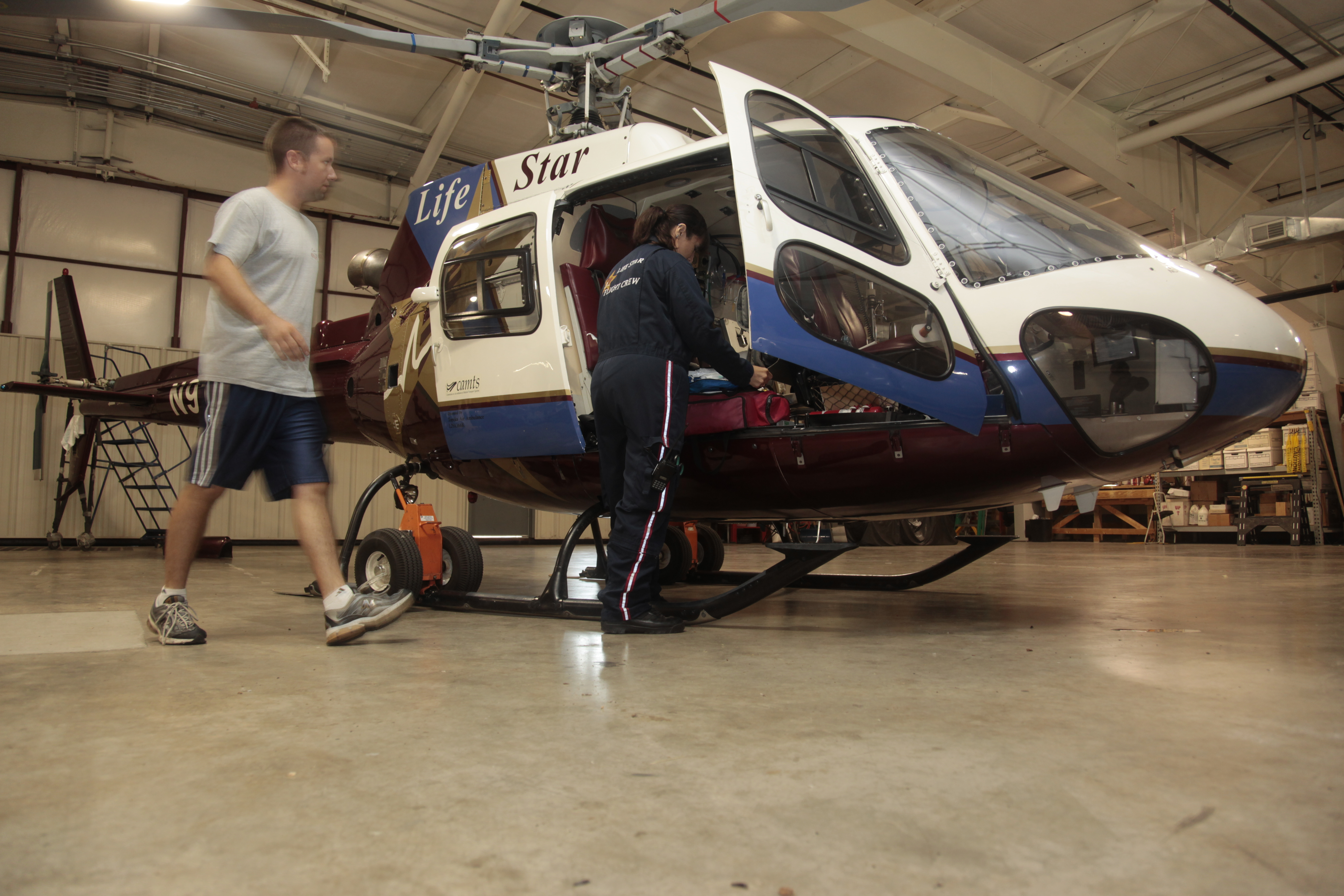
Life Star employees mechanic Paul Isabell and flight nurse Angela Clark service a Lifestar helicopter at Lawrence Municipal Airport in North Lawrence. Life Star has medical staff and a flight crew ready at all times to respond to emergencies in 30 Kansas counties.
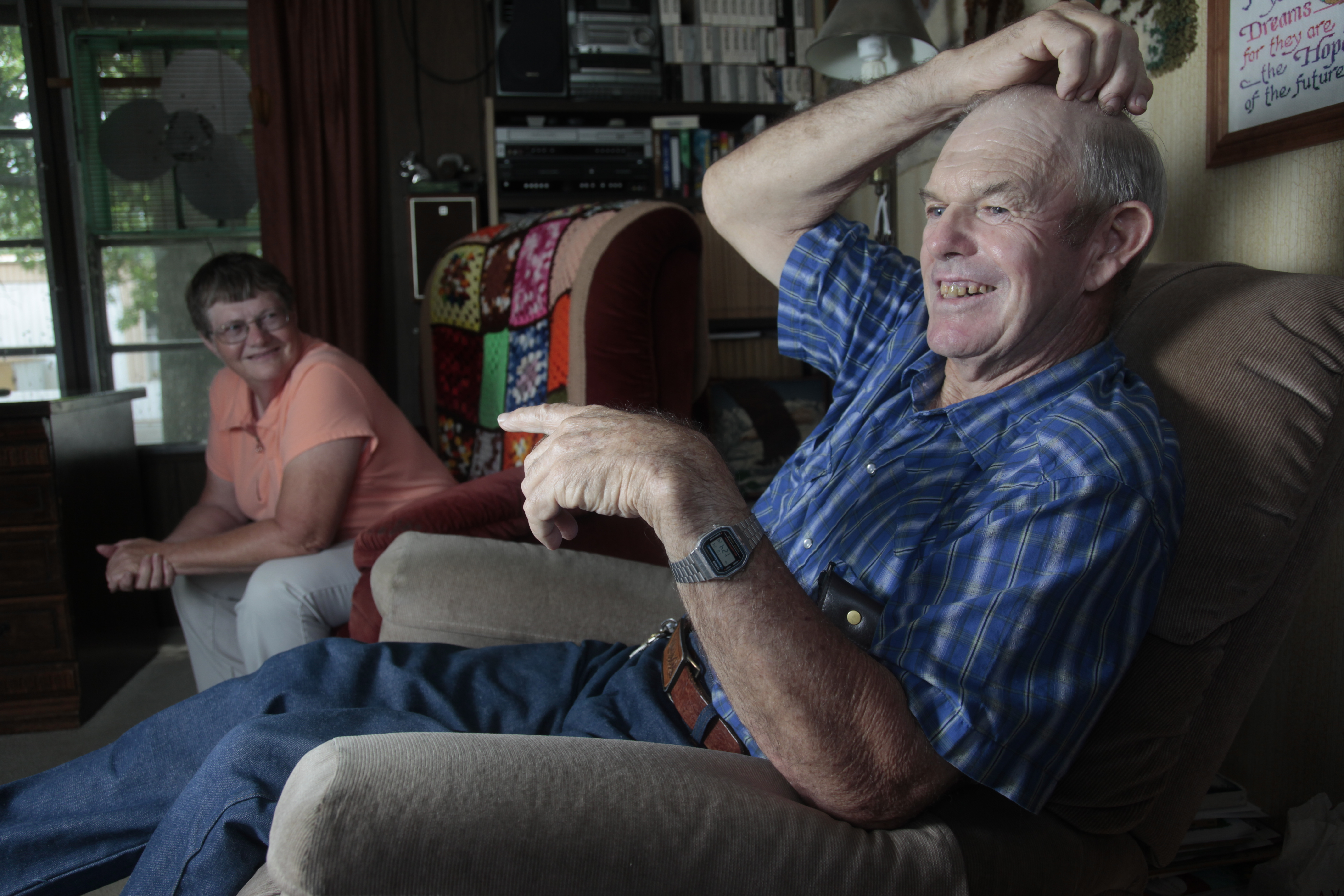
Dennis Jones, 69 Ottawa shares the story of his heart attack as his wife Vernas 65 listens. Jones was flown by air ambulance from Lawrence Memorial Hospital to St. Luke's in Kansas City, Mo., and eventually recovered after flat lining five times and was in a coma.
Last October, KU doctoral student Maria Thorson Feeney was test driving a car along Kansas Highway 10 when she was hit head-on by a driver going 65 mph.
The other driver died. Feeney, badly bleeding and with broken bones, had to be extricated from the wreckage. Her passenger — the car salesman — believed she had little chance of surviving.
While the accident changed Feeney’s life in seconds, the ability to get Feeney from the roadside to a trauma center within minutes helped save her.
“I know that time was of the essence. And I think there was probably a good chance that I would not be here if I had not had the air ambulance to take me to the hospital,” Feeney said.
‘Flying emergency room’
Feeney was one of 40 people for whom Lawrence Douglas County Fire Medical arranged transport by air ambulance in 2008.
Each year, 400,000 helicopter medical missions are made nationwide, according to the Association of Air Medical Services. The number has increased each year for the past three decades.
Since 2002, Life Star has had a helicopter based at Lawrence Municipal Airport in North Lawrence, where a nurse, paramedic and pilot are stationed 24 hours a day.
Once a call for help goes out, the crew can load up a helicopter, roll it out of the hangar and lift off in less than eight minutes to respond to an accident site or to Lawrence Memorial Hospital.
It takes about one minute for the helicopter to fly from the airport to LMH. After loading the patient, the helicopter can reach Kansas University Hospital within 15 minutes, a distance that takes a ground ambulance between 35 to 45 minutes to cover.
“If you can get someone to a trauma center by air in 12 minutes versus 40 minutes, that is a big deal,” said Scott Robinson, medical director for Lawrence-Douglas County Fire Medical and president of Lawrence Emergency Medicine Associates.
The other benefit of an air ambulance is the level of care provided, Life Star paramedic Steve Gill said. Working in tight quarters, the medical crew can often offer more medicines and use more advanced medical apparatus than a typical ground ambulance.
“We really are a flying emergency room,” Gill said.
Calling for help
Rarely do paramedics call for an air ambulance once they get to the scene of a major accident, Robinson said. Usually calls coming into the communication dispatch center or reports from law enforcement give the paramedics enough information to gauge whether a helicopter is needed.
“There are times that they are circling above before we can get there to tell them where to land,” Lawrence-Douglas County Fire Medical Chief Mark Bradford said.
On-scene protocol has been established to determine when to transport a patient by air. Paramedics consider the patient’s blood pressure, respiratory rates and level of consciousness. They also look to see whether the patient’s injuries could necessitate amputation.
“It’s not willy-nilly,” Robinson said of the decision to use an air ambulance.
The paramedics have the discretion to send someone by air if they show no signs of major injuries but were involved in an accident where someone else died or they were thrown out of a vehicle. In those cases, internal bleeding or head injuries are a concern.
Bradford admits there are instances when patients are flown to a trauma center, examined and released the same day.
“We are ruling for the worst case scenario,” he said. “And they are at the proper location so if they needed that type of care they would have been able to get it quickly.”
For the most severe injuries, patients are sent to one of three hospitals in Kansas City designated as a Level 1 trauma center. By virtue of its proximity to Lawrence and its designation, Kansas University Hospital is often the first place paramedics look to transport patients.
Hospital patients
Air ambulances aren’t just used for vehicle accidents; sometimes they are transporting patients from hospital to hospital. Those patients may have suffered a heart attack, stroke, complications from diabetes, respiratory problems or trauma.
The speed of an air ambulance can help save lives or prevent further damage when heart attack or stroke patients have to go from an emergency room into surgery.
“When you are having a heart attack, there is no blood supply going to portions of the heart. So the longer that blockage is there, the more damage you will have to the heart,” LMH emergency department director Joan Harvey said.
Such was the case with Dennis Jones. Late one night in February, the 69-year-old Ottawa man suffered a severe heart attack.
By the time he arrived to LMH’s emergency room, the doctor gave him 30 minutes to live. As crews were taking him out of the helicopter at St. Luke’s Hospital in Kansas City, Mo., he flatlined. In the week that followed, he flatlined four more times and was in a coma. After three stents and lots of medicine, he was on his way to recovery.
Five months later, Jones can do 30 jumping jacks and walk two and half miles.
Saving lives
Unfortunately, air ambulances aren’t always available when needed. Such was the case last month when two men and a 16-year-old boy were injured in a rollover accident on the South Lawrence Trafficway.
Lawrence-Douglas County Fire Medical initially requested two helicopters to the scene, but after dispatchers spent several minutes searching for nearby air ambulances, emergency crews decided it would be faster to transport one of the men by ground.
Of the more than 100 calls that Life Star’s three bases receive each month, three or four have be turned down because crews are not available, Life Star Executive Director Greg Hildenbrand said.
In those instances, there are other services to call. Backups come from LifeFlight Eagle, which has four helicopter bases near the Kansas-Missouri border, and LifeNet in St. Joseph, Mo.
For both Lawrence-Douglas County Fire Medical and LMH, Life Star handles about 95 percent of the air ambulance calls.
Helicopters can also be grounded because of severe weather.
Back on track
Feeney is thankful that an air ambulance was available back in October.
The accident left her with a broken femur, pelvis, collarbone and eye socket. She also had liver lacerations, bruised lungs and cracked ribs.
But most concerning was that she was going in and out of consciousness and losing blood.
“I was very touch-and-go when I made it to the hospital,” she said.
Within 15 minutes after she was freed from the car, Feeney was flown to KU Hospital, where she went into surgery.
After the accident, Feeney, who is working toward her doctoral degree in pharmaceutical chemistry, spent three weeks in the hospital, three months bedridden and much of the school year at home. She recovered in time to walk down the aisle for her April wedding in Milwaukee.
Now, she’s back at KU. She still walks with a limp and uses a cane on occasion but is expected to make close to a full recovery.
“The air ambulance was a very important part of saving my life and letting me be in as good as shape as I am,” Feeney said.
City Government

Instead of funding clawbacks, 2 Lawrence affordable housing developments get another chance

Ninth Street’s closure will soon extend through Mississippi Street for final phase of stormwater work

North Lawrence’s underpass will soon have a warning system to alert drivers when it floods

Lawmakers push through bill that invalidates Lawrence ordinance regulating landlords

How Lawrence’s parking garages are transforming from ‘dark and intimidating’ to places for art