‘Public Enemies’ a beguiling crime drama
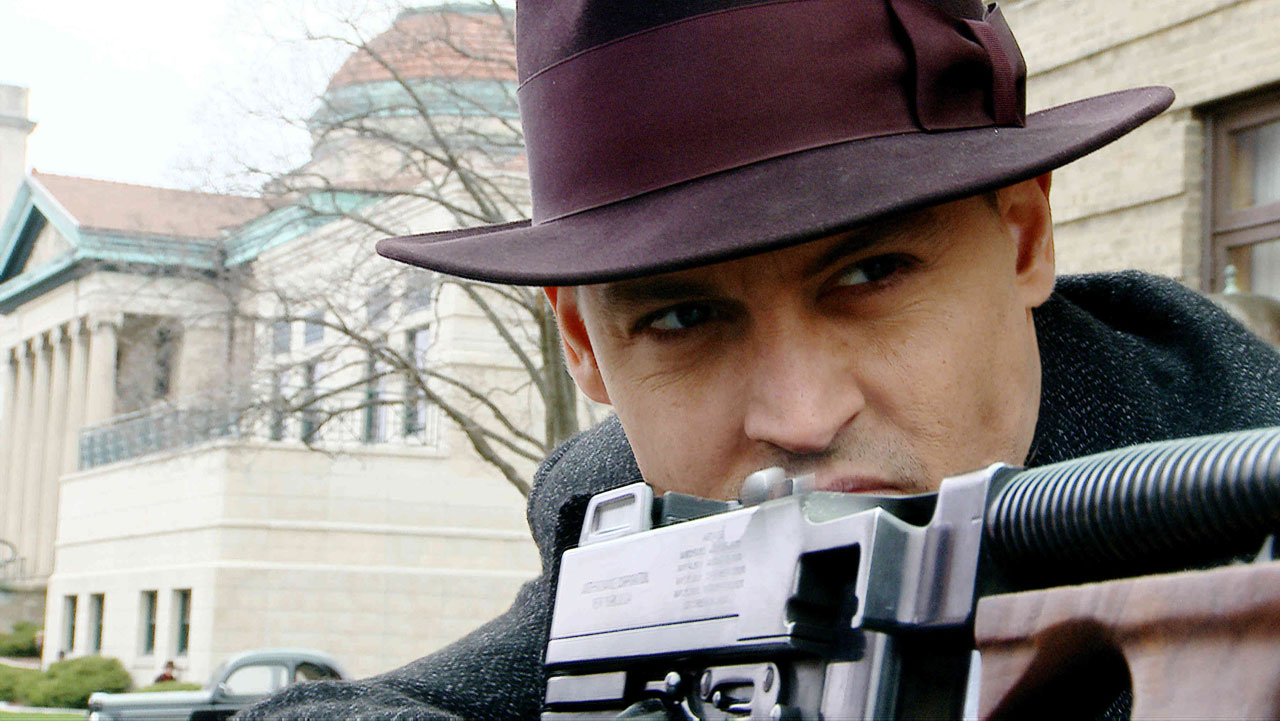
Johnny Depp stars as infamous criminal John Dillinger in “Public Enemies.”
In “Public Enemies,” two threats to law and order loom over Depression-era America. One is John Dillinger, a gallant bank robber, and his gang. The other is a new national police force being assembled by an ambitious administrator named J. Edgar Hoover.
Michael Mann’s new film is a white-hot crime drama, but just beneath its bullet-pocked surface are substantial insights about the limits of law enforcement, the point at which society’s guardians do more damage than its thieves. It fits neatly on the shelf with “Bonnie and Clyde” and “The Godfather.”
The film covers the hectic final year of Dillinger’s life, beginning in 1933. It was not a time when citizens held bankers in high esteem. “Some will rob you with a six-gun, and some with a fountain pen,” goes a line in one of Woody Guthrie’s Dust Bowl ballads. Dillinger, an Indiana farm boy who let bank customers keep their own money during his raids and never killed anyone, was considered a folk hero making war on the banks.
With his trademark move, vaulting over a bank counter with one hand while brandishing a Thompson machine gun, he seemed to incarnate swashbuckling bravado. Although he was declared Public Enemy No. 1, many people cheered him on, harboring his gang in their homes. “Mister, take me with you,” a bedraggled farm woman says when Dillinger takes his leave. Since he is played by a very dapper Johnny Depp, it’s easy to understand her impulse. His basic pick-up line is “I like baseball, movies, good clothes, fast cars and you. What else you need to know?”
A bold leader and strategist, Dillinger made a mockery of Hoover’s promised “war on crime.” Hoover, played with prissy malice by Billy Crudup, appoints a special task force to take down the outlaw. He places Special Agent Melvin Purvis in charge, with orders to bring Dillinger in by any means necessary. “As they say in Italy these days, ‘Take off the white gloves,”‘ Hoover snarls, with a nod to Mussolini.
Christian Bale plays Purvis as a straight arrow twisted beyond all recognition in his battle against the elusive Dillinger gang. He hopes to use sophisticated, scientific crime-fighting techniques, tracking down the robbers by the label in Dillinger’s abandoned overcoat. He has no qualms over wiretapping and pressuring the criminals’ families and associates. But he’s sickened to find his men trying to beat information out of suspects, and to participate in fumbled ambushes that leave civilian bystanders riddled with lead.
Although Depp’s Dillinger works out his bank raids in detail, he’s wild and impulsive in daily life. He has no overall plan. Stage a heist, spend the money on nightclubs, cars and women, drive across the country, get caught, break out of jail, steal the sheriff’s car and repeat. He says he just wants to make one more big score and “slide off the edge of the map.” He knows better. The law was closing in on him from one side. Organized crime was squeezing him on the other.
A substantial subplot focuses on his exile from the increasingly sophisticated Cosa Nostra, whose bookie operations were becoming far more profitable than Dillinger’s risky robberies. By the end of his 13-month spree, Dillinger met and lost the love of his life Billie Frechette (fetchingly played by Marion Cotillard) and saw most of his gang killed.
Depp’s Dillinger is too shrewd to think he’d evade Hoover’s G-Men forever. In one nerve-tingling scene, he strolls into the Chicago Police Department’s Dillinger Investigation bureau, examines mounted photos of his lost comrades (and Billie) and asks the cops listening to a ball game, “What’s the score?” But he already knows the score. When he settles in at the Art Deco Biograph Theatre to watch “Manhattan Melodrama,” his eyes gleam with identification as Clark Gable goes to the chair.
The acting is top drawer from the stars to the little roles. British actor Stephen Graham makes such an antic psychopath of Baby Face Nelson that you wish he’d survive to the end of the film (though that would deny us his jaw-dropping death scene). Channing Tatum makes a handsome Pretty Boy Floyd, and Giovanni Ribisi, Leelee Sobieski, Lili Taylor and singer Diana Krall pop in for brief but effective appearances. With its soundtrack of suave standards and growling guitar blues sounds, the film sounds as good as it looks.
Mann shot the film in high-definition video, giving it a richly textured look distinct from most period films, which favor celluloid for a glossy romantic effect. Mann makes a more imaginative choice, plunging us into the thick of the action. There are two hellacious firefights that will knock your socks off and straight into the hamper.
“Public Enemies” proves that excitement and intelligence aren’t mutually exclusive values, but the yin and yang of blockbuster entertainment.
Arts and Entertainment

In new CNN docuseries, Kara Swisher examines the science, tech and business of living longer

How Lawrence’s parking garages are transforming from ‘dark and intimidating’ to places for art

Lawrence Jewish Community Congregation to host Yiddish Poetry Night featuring readings from local poets

Lecompton Historical Society to host panel discussion about legacy of African-American cemetery in rural Douglas County

Go, See, Do: Farmers market’s first day, KU powwow, Dole Lecture and more