Essence of cool: Aguas frescas quench summer thirst
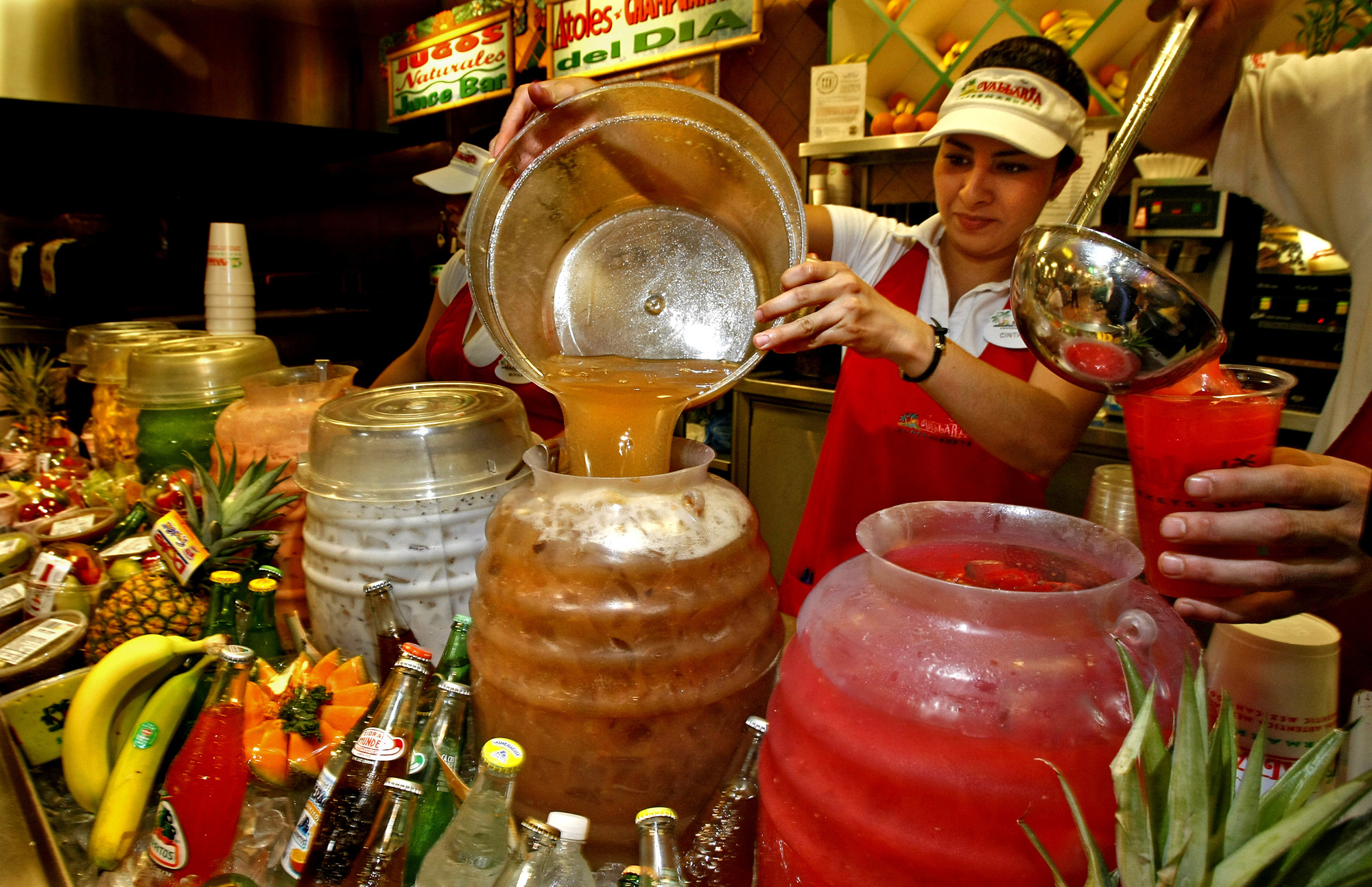
Aguas frescas, such as these at the Vallarta Supermarket in Burbank, Calif., are traditional iced Mexican fruit juices served fresh and icy. The kinds of fruit available depends on the season.

Natural summer coolers, clockwise from top: cucumber-lime, watermelon-lime, peach-lavender and the classic horchata.
Los Angeles ? On counters of neighborhood “taquerias” and Oaxacan restaurants, at Salvadoran farmers market stands and East Los Angeles backyard parties, even at swank Hollywood restaurants, you can see the huge glass “vitroleros,” beehive-shaped jars filled with “aguas frescas” in a spectrum of stunning colors. Each flavor is like a point of reference on a color wheel: the deep magenta of “jamaica” (a variety of hibiscus flower), the pale green of honeydew melon or cucumber-lime, the scarlet of just-made “sandia” (watermelon), rice-based “horchata’s” milky white.
Aguas frescas have a long tradition in Mexico and Latin America, where the “fresh waters” – made with fresh fruit or rice, tamarind pods or dried hibiscus flowers, sugar and water – are the perfect thirst-quencher for hot weather and sometimes-hotter cuisine. In the pre-Columbian 15th century, the story goes, Aztec farmers would paddle their canoes into Tenochtitlan (now Mexico City) with fresh fruit that they would mash and mix with water for a refreshing drink.
Just what’s in the gorgeous, ice-loaded jars depends on what fruit is in season. Right now, you might find cantaloupe, a pretty watermelon laced with lime, maybe a pale honeydew melon or peach, or a combination of more than one fruit. Year-round, you’ll usually find the classic trinity of aguas frescas not made with fruit: “tamarindo,” horchata and jamaica.
These are neither sodas nor fruit juices, but subtly flavored drinks that are balanced, light-bodied – and not overly sweet.
Southern California’s best aguas frescas makers, traditionalists and modernists alike, rely on the little touches, either personal or regional. An agua fresca is a minimalist’s drink: With so few components, the quality of the ingredients and the simple twists (a squeeze of lime, a shot of agave nectar) make all the difference.
Juan Antonio, owner of the cafe Oaxacalifornia in downtown Los Angeles, uses his grandmother’s recipe for horchata, which many people consider the most refreshing agua fresca. Horchata is made by soaking rice overnight in water, then pureeing the mixture in a blender, straining it and adding flavorings such as cinnamon, vanilla or almonds.
Antonio serves the drink over ice with a sprinkle of diced toasted pecans and fresh cantaloupe – topped with a scoop of his house-made cactus pear sorbet. The sorbet slowly melts in the glass, painting the pale horchata in pink and orange hues, and adding a terrific flavor counterpoint. He also likes to add a scoop of lime sorbet to a glass of tamarindo or, when he’s made a jar, a “chilacayota” agua fresca. (Chilacayota is a Mexican squash.) Using the sorbet, Antonio says, “is a typical way of serving (aguas frescas) in Oaxaca.”
Traditional tamarindo – made by boiling, soaking and straining tamarind pods, with water and a little sugar – can also be jazzed up.
Near the University of Southern California, at the busy taqueria La Taquiza, Anthony Medina adds pints of fresh strawberries to his jamaica agua fresca (also a family recipe), first steeping hibiscus flowers to make tea, then blending it with berries and a little sugar.
Over at the Hollywood restaurant the Hungry Cat, bartenders take their aguas frescas as seriously as their cocktails – a plus for kids and non-drinkers – and if you sit at the bar, you can watch as your agua fresca is created. Aguas frescas aren’t on the bar menu, but offered as daily specials. A peach agua fresca is sweetened with lavender-infused simple syrup. Another Hungry Cat favorite is a cucumber-lime, and before cherry season ends, look for a Bing cherry agua fresca, spiked with lemon and Fresno chile-infused simple syrup.
Aguas frescas shouldn’t have much sugar – they’re refreshing thirst-quenchers, not sweet drinks – so it’s key to use the sweetener judiciously and to make sure it’s fully dissolved. And, depending on what kind of fruit you’re using, macerating the fruit can also work wonders. Macerating – tossing cut-up berries, for example, with sugar and allowing them to sit for half an hour – brings out the fruit juices, accentuates the flavors and dissolves the sugar, all at the same time.
Sweetening the aguas, says Ivan Calderon, co-owner with his brother Marco of the Taco Mesa and Taco Rosa restaurants (in six Southern California locations), “enhances the flavor of the fruit; it does the same thing that salt does to food.” But he suggests using agave nectar instead of sugar, as he does with all his restaurants’ aguas frescas. The nectar is less cloying than sugar and more healthful (higher in fructose, lower in glucose than sugar), and it dissolves instantly.
If you don’t have agave syrup on hand, take a tip from bartenders and make a quick simple syrup by briefly boiling equal parts sugar and water in a pan. You can flavor the simple syrup with lavender, as the folks at the Hungry Cat do, or with other herbs or spices (a trick used by pastry chefs as well as bartenders).
Use ripe fruit for aguas frescas, even fruit that’s slightly past its prime. You’re throwing it in the blender, after all, and you want the sweet rich notes of the fruit rather than its perfect appearance.
Cucumber-lime aqua fresca
5 whole cucumbers, coarsely chopped (not peeled or seeded)
1/2 cup fresh lime juice
1/2 serrano chile, seeded and minced (or more to taste)
1/8 cup agave syrup
Sea salt
In a blender, in batches, puree the cucumbers with 2 1/4 cups of water, the lime juice, chile, agave syrup and a generous pinch of sea salt on high speed. Strain through a fine-mesh strainer lined with a triple layer of cheesecloth (or use a chinois), discarding the solids. Serve over ice. Makes 2 quarts.
– Inspired by Jimmy Shaw of Loteria Grill, Los Angeles
Strawberry-Jamaica agua fresca
2 cups dried hibiscus (jamaica) flowers
2 pounds strawberries, hulled and quartered
1 cup sugar
Combine the hibiscus flowers with 4 cups of water in a medium saucepan and bring to a boil. Boil for 5 minutes, then allow to steep for about 2 hours. Strain and reserve the hibiscus water. Place the strawberries in a large bowl, toss with the sugar and macerate for 30 minutes.
In a blender, puree the strawberries (and any syrup) with the hibiscus water; this may need to be done in batches.
Strain the mixture with a standard sieve into a large pitcher; stir in 2 quarts water. Adjust consistency as desired with additional water; add more sugar if desired to sweeten. Serve over ice. This will keep for 2 days, refrigerated. Makes 2 1/2 quarts.
– Adapted from Anthony Medina of La Taquiza in Los Angeles
Food
The seafood industry is betting on fish that looks more like meat
This minty pea soup with ham is a creamy, chive-packed upgrade for puréed soups

Rural winery in Leavenworth County that won $22,000 state grant for tourism hopes to grow to be bigger part of community