

Indonesian ex-dictator Suharto mourned, scorned at funeral
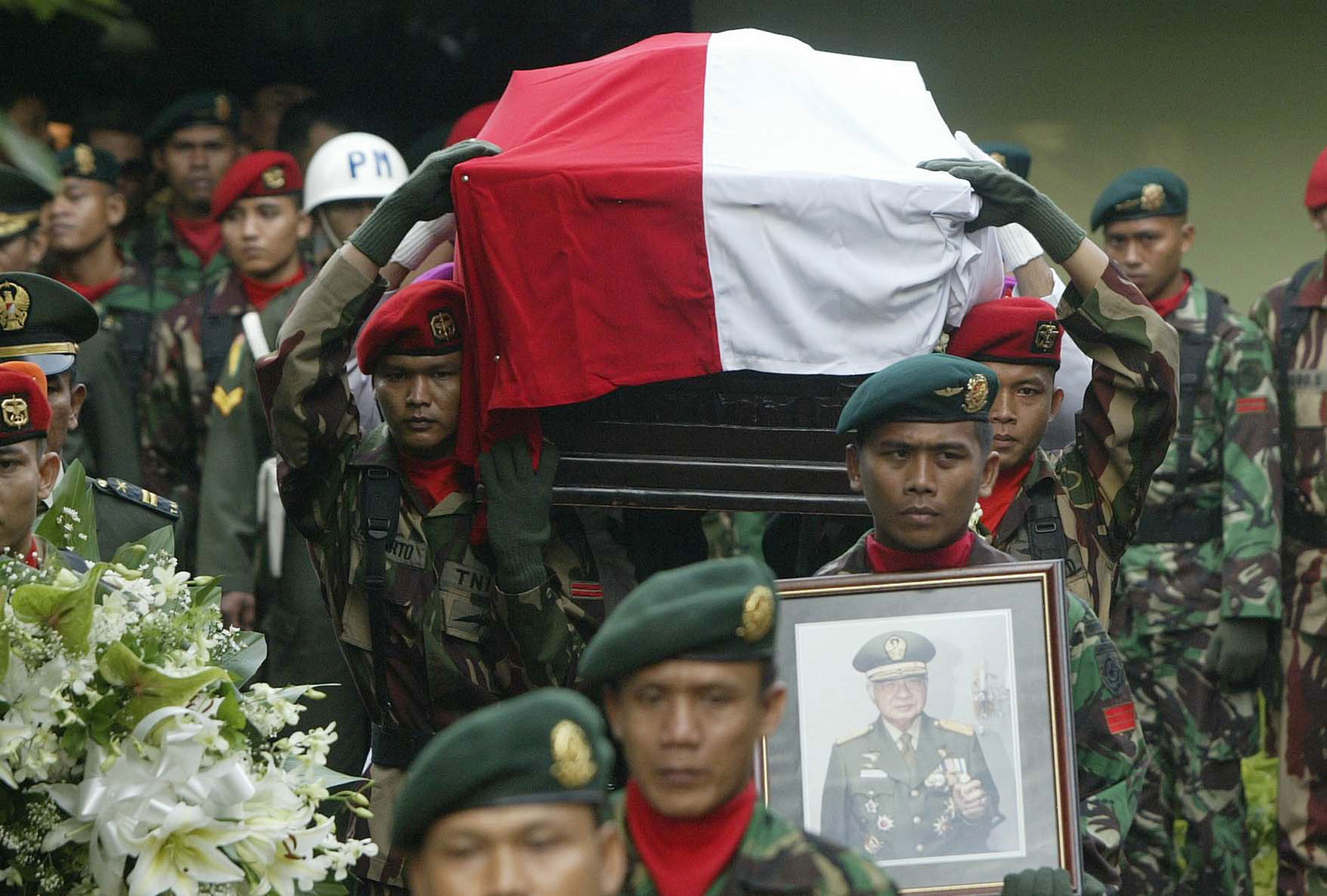
The coffin of former Indonesian President Suharto, draped with an Indonesian flag, is carried to an ambulance to be taken to an airport in Jakarta this morning for the journey to his family's hometown, Solo, where his state funeral was conducted later in the day. The former dictator died Sunday at age 86.
Solo, Indonesia ? Tens of thousands of people mourned former Indonesian President Suharto during his state funeral today, with many praising the Cold War ally of the United States whose brutal military regime killed hundreds of thousands of left-wing political opponents.
Suharto died Sunday of multiple organ failure after more than three weeks on life support at a Jakarta hospital. He was 86.
As mourners watched a motorcade carry the former dictator’s body to the Suharto family mausoleum, many sobbed and called out the name of the man whose rule, though harsh, brought economic growth and stability to Indonesia.
“He was a great man,” said Sumartini, a 65-year-old woman. “His death touched us deeply.”
President Susilo Bambang Yudhoyono began the ceremony just before noon at the mausoleum near the city of Solo, Suharto’s hometown, some 250 miles east of the capital. The president had already declared a week of national mourning and called on Indonesians “to pay their last respects to one of Indonesia’s best sons.”
Suharto loyalists, who run the courts, called for forgiveness and a clearing of his name. But survivors want those responsible for atrocities to be held accountable.
“I cannot understand why I have to forgive Suharto because he never admitted his mistakes,” said Putu Oka Sukanta, who spent a decade in prison because of his left-wing sympathies.
Suharto was finally toppled by mass street protests in 1998 at the peak of the 1997-1998 Asian financial crisis.
His departure from office opened the way for democracy in this predominantly Muslim nation of 235 million people, and he withdrew from public life, rarely venturing from his comfortable Jakarta villa.
Suharto ruled with a totalitarian dominance that saw soldiers stationed in every village, instilling a deep fear of authority across this Southeast Asian archipelago that stretches across more than 3,000 miles.
Since being forced from power, Suharto had been in and out of hospitals after strokes caused brain damage and impaired his speech. Poor health – and continuing corruption, critics charge – kept him from court after he was chased from office.
The bulk of killings occurred in 1965-1966 when alleged communists were rounded up and slain during his rise to power. Estimates for the death toll range from a government figure of 78,000 to 1 million cited by U.S. historians Barbara Harff and Ted Robert Gurr, who have published books on Indonesia’s history.
During Indonesia’s 1975-1999 occupation of East Timor, up to 183,000 people died due to killings, disappearances, hunger and illness, according to an East Timorese commission sanctioned by the U.N. Similar abuses left more than 100,000 dead in West Papua, according a local human rights group. Another 15,000 died during a 29-year separatist rebellion in Aceh province.
Some noted Suharto also oversaw decades of economic expansion that made Indonesia the envy of the developing world. Today, nearly a quarter of Indonesians live in poverty, and many long for the Suharto era’s stability, when fuel and rice were affordable.
But critics say Suharto squandered Indonesia’s vast natural resources of oil, timber and gold, siphoning the nation’s wealth to benefit his cronies, foreign corporations and family like a mafia don.