

Sicilians decide Mafia protection an offer they can refuse
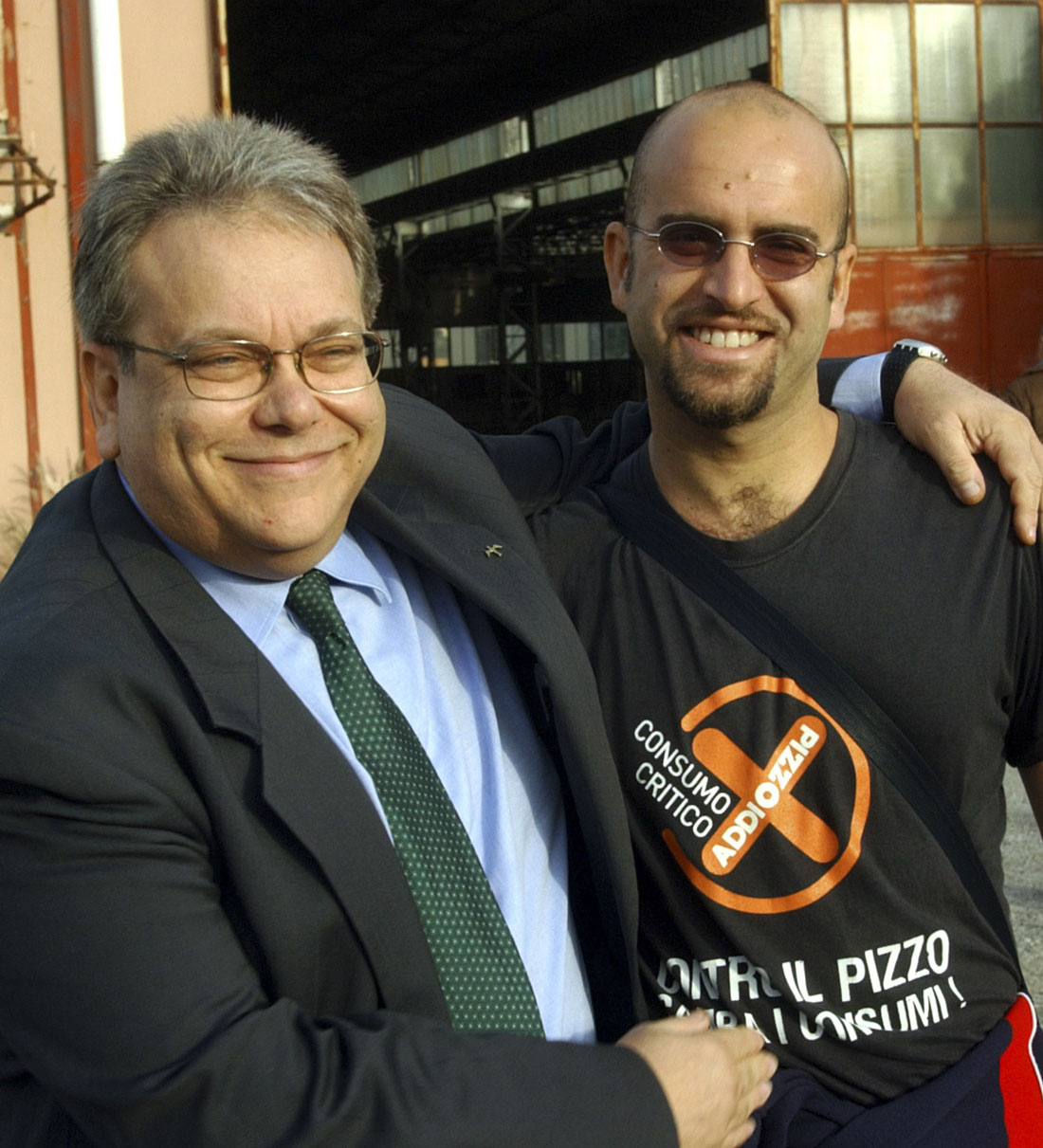
Rodolfo Guajana, left, whose company is a wholesaler for hardware stores across Sicily, hugs an unidentified member of the association Addiopizzo (Goodbye Pizzo), which brings together businesses that are saying no to Mafia extortion, in Palermo, Sicily.
Palermo, Sicily ? When it came down to business, Cosa Nostra could always count on fear.
No more.
In a rebellion shaking the Sicilian Mafia to its centuries-old roots, businesses are joining forces in refusing to submit to demands for protection money called “pizzo.”
And they’re getting away with it, threatening to sap an already weakened crime syndicate of one of its steadiest sources of revenue.
The Mafia has a history of bouncing back from defeat, but this time it is up against something entirely new: a Web site where businessmen are finding safety in numbers to say no to the mob.
At the same time, businessmen ranging from neighborhood shopkeepers to industrialists are being emboldened by arrests of fugitive bosses, and the discovery in raids of meticulous Mafia bookkeeping on who paid the “pizzo” and how much.
“This rebellion goes to the heart of the Mafia,” said Palermo prosecutor Maurizio De Lucia, who has investigated extortion cases for years. “If it works, we will have a great advantage in the fight against the Mafia.”
Mob’s downward spiral
These latest gains build on other successes in the fight to break Cosa Nostra’s stranglehold on Sicily. In the last two decades, the syndicate has been battered by testimony from turncoats, who helped send hundreds of mobsters to prison in the late 1980s, and a fierce state crackdown a decade later after bombs killed two Palermo anti-Mafia prosecutors.
The number of rebels on the Web site is still tiny compared with Palermo’s businesses overall, but their movement has helped to chip away at the Mafia’s psychological hold on Sicilians – long conditioned to believe that defiance would bring ruin or a death sentence. And any consistent crumbling of that culture of fear could ultimately lead to Cosa Nostra’s undoing.
The businesses are openly defying the Mafia by signing on to a Web site called “Addiopizzo” (Goodbye Pizzo), which brings together businesses in the Sicilian capital that are resisting extortion.
The campaign was launched in 2004 by a group of youths thinking of opening a pub. They started off by plastering Palermo with anti-pizzo fliers, reading “An ENTIRE PEOPLE WHO PAYS THE PIZZO IS A PEOPLE WITHOUT DIGNITY,” and eventually brought their campaign online where it struck a profound chord with Sicilians fed up with Mafia bullying.
Confindustria, the industrialists’ lobby, has also boosted the movement with a threat to expel members who pay protection money. Its Sicilian branch has gone through a list of pizzo-paying companies found in a raid on a top Mafia boss’ hideout, and this month began summoning heads of those companies to demand to know whether they indeed had been paying and should be drummed out of the politically influential lobby.
Roots of rebellion
Prosecutors trace the extortion rebellion back to the scramble for power after Bernardo Provenzano, the alleged “boss of bosses,” was captured last year near his hometown of Corleone.
For years, Provenzano – who reputedly took the helm of Cosa Nostra in 1993 – had employed an extortion strategy of “let them pay a little but make everyone pay,” according to Piero Grasso, a former Palermo prosecutor who is now Italy’s national anti-Mafia prosecutor based in Rome.
The Mafia chief feared excessive greed and violence would draw a fierce police crackdown, Grasso said in an interview.
But in the struggle to succeed Provenzano, Palermo area boss Salvatore Lo Piccolo ruthlessly dispensed with the low profile.
Under Lo Piccolo, according to Grasso, the small army of henchmen who shake down merchants was doubled, from 500 to 1,000 men, judging from entries in confiscated extortion ledgers. The extortionists received monthly “salaries” worth $3,000, generous by Sicily’s standards, plus an extra month’s pay as a Christmas bonus, Grasso said.
A rash of arson attacks on businesses this past year apparently reflected Lo Piccolo’s determination to press extortion demands.
The strategy appears to have backfired: The harder the Mafia squeezed, the more their victims resisted. Crucially, no businessmen or their relatives have thus far been killed for their defiance.
Selective punishment
When Lo Piccolo was arrested in November outside Palermo, police found a list of hundreds of names of those who paid the “pizzo” plus a breakdown of how the money was divvied up – a treasure trove of information on how the mob operates.
“For a street vendor, ‘pizzo’ ranges from 50 to 100 euros a month, a neighborhood bread store 150-250 euros, a simple clothing store 250 euros, a jewelry store, 1,000 euros, your local mini-mart 500 euros,” said Attilio Scaglione, one of the researchers. A euro is worth roughly $1.50.
These days, the Mafia appears to be trying to pick symbolic targets rather than punish the pizzo-refusers en masse. At Rodolfo Guajana’s company, a wholesaler for hardware stores across Sicily since 1875, attackers this summer punched a hole in the roof, poured in gasoline and torched the warehouse.
Guajana believes the Mafia attacked him because it was known that his family had a history of refusing to pay.
“What happened here was the Mafia was saying to all merchants: ‘What happened to Guajana can happen to you if you don’t pay,”‘ Guajana said.