Stripped bare, winter scenes reveal the artistry of nature
In End
Photos online
The gardener ponders winter’s paradox: The sun’s rays now grow stronger and the days grow longer, but the worst of the season’s weather is yet to come.
There is another odd reality to consider, that the garden is not dead and perhaps not even dormant in its capacity to yield scenes of gripping beauty.
Snow-dusted conifers provide the Currier & Ives moment, but for Roger Foley, a landscape photographer from Arlington, Va., and for many other keen observers of the bleak spectacle, it is the time for the naked shade trees to shine. Foley might be found in public gardens at this time of year with his camera, as he says, “looking at the trees, the gestures of the trees, the feeling of how long they have been there and the stateliness of them.”
All this and more is conveyed at an exhibit of winter landscape photography, “Glorious Winter,” on display at the U.S. Botanic Garden until Jan. 27. In the West Orangerie, visitors will find 12 of Foley’s winter images along with seven by photographer Barbara Southworth of Alexandria, Va.
It is not the trees alone, though, that convey the melancholy spirit of January. It is the sky, sometimes limpid blue, or golden and weak, or leaden before the snowfall. Vistas open up against the bare trees and shrubs, and yet the world becomes smaller, too. Often the slightest thing captures the essence of January: a dried, opened seed pod, its germ long gone, or the slender tracery of astilbe stalks against the snow.
That last image is the subject of Foley’s “Astilbe in Snow,” taken in a Baltimore garden and composed to create the minimalist power of a Japanese print. Foley is an established garden photographer, working for book publishers, magazine editors, landscape architects and, occasionally, for The Washington Post. The images on display, though, were taken not as commissioned commercial or editorial work, but as a personal exploration of photography as art.
“A fine-art picture has to be more ambiguous and more abstract to be interesting enough to have on the wall,” he said. Foley has studied hundreds, perhaps thousands, of gardens in the past 20 years, and he knows that the best gardens, like the finest pictures, are simplified. “You design by subtraction,” he said. “You distill.”
His favorite photos from the show include “After the Falls,” the mirrored reflection of a backwater of the Potomac River, below Great Falls, where a placid scene of water, rock and trees seems all the calmer by the notion of the water raging upstream.
The second image, “Winter Red,” is of a cropped, almost panoramic haze of red berries. They are the winter fruit of the deciduous holly Ilex verticillata. Foley took the picture one winter at the National Arboretum. Winter pictures tend to look black and white, so the layering of color here was something special.
It is possible, of course, to plant for winter effect, not just deciduous hollies such as Winter Red or Sparkleberry (for a sunny, damp spot, and don’t forget a male pollinator). The coral bark maple glows in winter, as do the colorful yellow- and red-twig dogwoods. You can even plan for flower with winter jasmine, winter-flowering cherry, witch hazels and hellebores, but their performances are hit-or-miss in so volatile a season, and a witch hazel that blooms with the January snow one year may not do much until late February in another.
It is better to find winter beauty in more subtle ways.
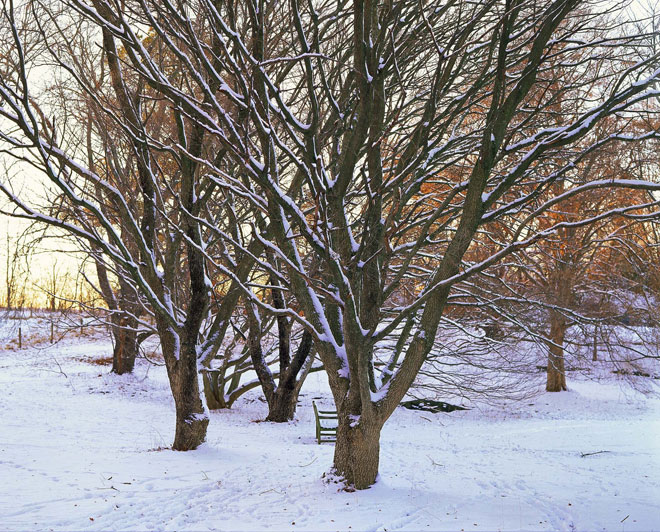
Another standout from the show is of a grove of trees captured by Foley at the State Arboretum of Virginia in Boyce. The trees have a short, stout quality, and Foley shot them from an elevated spot to show their limbs dusted with snow. Behind them, a veiled setting sun lends a golden backlight. Foley describes the mood: It’s January, there’s been a snowfall, now all is still and very cold, and the day is drawing rapidly to a close.
“There’s something about the winter light that is beautiful in its own right,” said Southworth, a fine-art photographer who favors wilder landscapes over gardens. “I don’t know if there’s a correlation between getting to be of a certain age and feeling more comfortable and at home in winter.”
Water, rendered soft-edged and flowing, is a recurring subject, and she is drawn to the vibrant green hues of winter found in lichens and mosses. Nature, she says, can tell us a lot about how plant communities grow and coexist, good lessons for the gardener, even in winter.
“What we are saying here is that nature doesn’t die, it’s just a time for getting ready for coming back, the quiet before things break loose and the delirium of spring in Washington,” Southworth said.
“Glorious Winter” runs until Jan. 27 at the U.S. Botanic Garden in Washington. www.usbg.gov.
Arts and Entertainment

Sculptor who turns junk into gems is featured artist for Lawrence Art Guild’s studio tour event

Functional compass rose with sunflower design will be ‘a really wonderful focus point’ for Lawrence airport

Eat, drink and meet with dozens of Kansas authors at this weekend’s Free State Book Festival

Go, See, Do: Music, markets, big rigs, kite festival and more

In collaborative show ‘Breeders,’ Lawrence artists capture the chaos and the fun of parenthood