

Families displaced by Katrina get new start in ‘Canadaville’
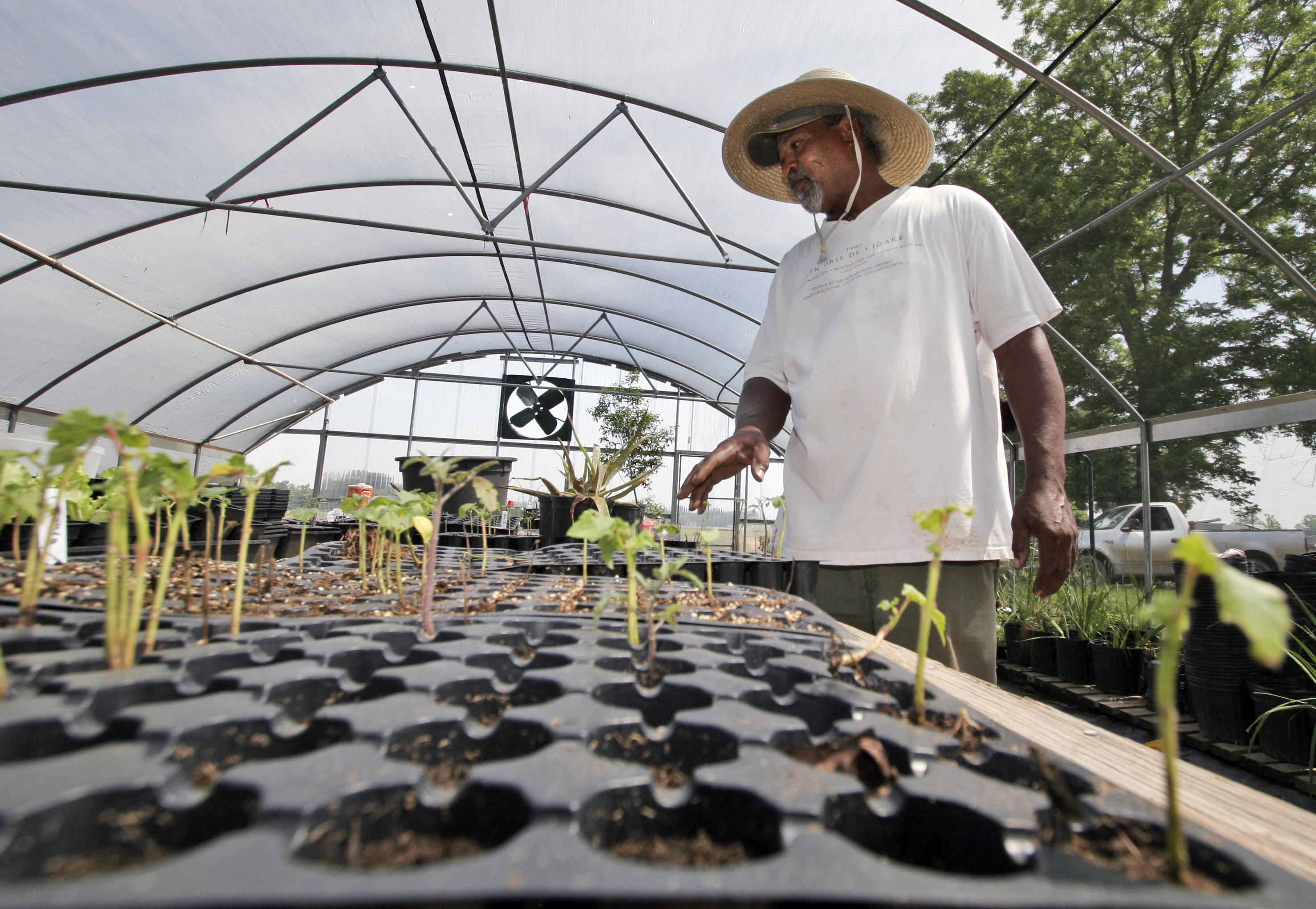
Eli Bryant checks the plants in the greenhouse in Canadaville, a rural community created as a refuge for families displaced by Hurricane Katrina, in Simmesport, La.
Simmesport, La. ? When her husband first told her about Canadaville, Dawn Charbonneau worried it might be a cult.
A place in the country, built by a Canadian industrialist, where hurricane-displaced families could live rent-free if they followed the rules. It sounded too good to be true.
Yet she was taken with Canadaville, a sprawling property where squirrels scurry in open fields and the songs of birds and bleats of goats carry on the breeze. It was a curative tonic for the cramped FEMA trailer park where the Charbonneaus and their three children had lived after Hurricane Katrina.
The slower pace of life, uncrowded nearby schools and corn-country peace have been good for the children, ages 5 to 13. “They can sleep at night without hearing gunshots,” said Dawn Charbonneau, whose family fled both Katrina and the violence of New Orleans about 150 miles away.
‘A hand up’
Her initial reservations about Canadaville, she says, were long ago put to rest.
Canadaville, with its goats and chickens, gardens and fishing holes, is the brainchild of Frank Stronach, chairman of Canadian autoparts maker Magna International. After Katrina hit in August 2005, Magna sheltered hundreds of evacuees at its Palm Meadows thoroughbred training center in Florida. But Stronach also wanted land in rural Louisiana, outside the hurricane zone, where families could start over and build their futures.
“It’s a hand up, not a handout,” Magna spokesman Dan Donovan said.
Stronach, who was not made available for an interview, bought 900 acres in September 2005, and Canadaville opened three months later. Total initial investment was estimated at $7.5 million.
Officially named Magnaville, the site was dubbed Canadaville as a nod to its Canadian benefactors. Canadian and U.S. flags fly side by side at the welcome center. “This is just neighbor helping neighbor,” Magnaville President Dennis Mills said.
People can live at Canadaville rent-free for five years if they follow a “charter of conduct.” Among other things, they must work or go to school, volunteer at least eight hours a week, participate in the community council and stay away from drugs, project manager Shane Carmichael said.
There are after-school and tutoring programs for children, computer and job-training classes for adults and plans to operate an organic farm. While Magna provides housing and other activities, residents do not receive cash payments.
Background checks are done on prospective residents, many of whom are referred by the Red Cross or word of mouth. Once at Canadaville, they can be tested periodically for drugs. Their guests must check in and get a pass if they’re staying overnight.
Quiet town a culture shock
Quiet, paved streets with names like Pelican Place and Honey Bee Road wind past the 49, three-bedroom modular homes, each of which is about 1,200 square feet and has a close-cropped lawn. In parts of New Orleans, swaths of neighborhoods remain in ruins, with houses empty or molding, still-devastated by the floodwaters.
It’s a very different life for most of the former urban dwellers.
Eli Bryant sees Canadaville as a blessing, with the laid-back lifestyle and outdoors work he longed for. For Barbara Stewart, it’s been a culture shock: a Wal-Mart several towns away is the nearest major shopping venue.
The influx of Katrina evacuees also was culture shock for nearby Simmesport, a town of 2,200 people where outsiders are easily spotted.
That was a big deal when plans for Canadaville were first proposed, Carmichael said. Some Simmesport residents worried murderers and rapists would be coming to their town, he said, alluding to reports of violence in New Orleans after Katrina.
Nearby town displeased
So Magna pledged to buy patrol cars for the Simmesport police, pay for three more police officers for five years and build a sports complex and a recreation center that would double as an evacuation center. Mills estimates total corporate, private and nonprofit investment could reach up to $12 million. Canadaville has received no state or federal funding, he said.
Carmichael said the patrol cars have been purchased, and ground broken on the sports center. Still, he said there has been friction with Simmesport Mayor James Fontenot.
Fontenot told The New York Times he was frustrated by fights and break-ins in town, which he blamed on the new residents. The mayor refused to speak to The Associated Press, referring questions to the town attorney, Bart Hebert. The police chief also did not return repeated phone calls for comment.
Residents start new lives
Many in town have welcomed Canadaville residents, and the dollars they spend on groceries and at general stores. Some have hired the newcomers.
Bryant, a former construction worker from New Orleans’ tough Central City neighborhood, says the rules aren’t hard to live by. He’d been hoping to leave New Orleans before Katrina. The storm took most of his possessions, but also gave him the final reason to leave town.
At 56, Bryant feels he’s found his calling: farming. He is content in figuring out what seeds grow in the clay soil and weeding rows of fruits and vegetables, and in gathering eggs from the hen house.
“I enjoy it,” he said as he stuck cantaloupe seeds into planting pods in the greenhouse.
National
How rural voters are feeling as the midterms approach, according to a new AP-KFF poll

‘You should not be here,’ Trump tells CNN at UN as standoff with media persists

Lawyer says prosecutors haven’t offered details of teen’s alleged ties to San Diego mosque shooters

Where’s a person facing deportation being held? ICE has stopped telling families, attorneys, AP finds

Iran war’s cost grows to $43.6 billion in new US military estimate
Judge orders Kennedy Center to provide 30 days’ notice before any major physical changes
WASHINGTON (AP) — A federal judge on Thursday ordered the Kennedy Center to provide 30 days' notice before making ...