

Calming influence
Expecting parents seek doulas for guidance through birth process
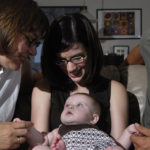
Stefanie Olson, left, was Erica and Brett Bittel's doula for the birth of their now 4-month-old daughter, Eleanor.
Erica Bittel didn’t want to do it alone.
She was preparing to give birth to her first child, and she knew she and her husband, Brett, needed help.
So she turned to a doula, a hired birth-helper.
“She was such a comforting presence, reminding me to relax,” says Bittel, who gave birth to a daughter, Eleanor, in March. “Everything worked out exactly as I had hoped. I wouldn’t have changed a thing. It was perfect.”
That’s the goal for doulas, a field that has been around for centuries but is beginning to catch on with more popularity in the Midwest.
Nationally, Doulas of North America (DONA), one of the largest accrediting agencies, says its membership increased from 2,000 to 6,600 in the past decade.
Even Brett Bittel says he found the couple’s doula, Stefanie Olson, a benefit in the process. After all, he says, he could tell his wife that “everything’s OK,” but he wouldn’t have much credibility as a first-time dad.
“Erica always trusts other people before me, anyways,” he says with a laugh.
More options
For some couples, doulas provide a calming voice in the midst of one of the most stressful experience of their lives. For others, they offer an advocate for birthing methods that aren’t usual hospital procedures.
“They’re amazed at what you can get if you just ask,” says Olson, who has been a doula for four years through her company, Complete Doula Services. “Being at a hospital without a doula is more of a challenge.”
Doulas typically meet with families several times before labor begins, discussing preferences including:
¢ Whether they want pain medications during labor.
¢ What types of comfort techniques, such as walking around, using a birthing ball or taking a shower, the mother wants to use.
¢ What role the husband or partner wants to take.
¢ What to do with the couples’ other children during labor.
¢ What, if any, photos the couple wants taken in the delivery room.
After the birth, doulas are available to answer questions related to breast-feeding or other newborn issues.
Olson, who has attended 68 births, not including the births of her own two children, says a good chunk of her job is to let mothers and partners know what is considered normal during labor. For example, she notes that a baby’s heart monitor often gives inaccurate readings as the baby moves during labor, which often causes distress for prospective mothers and fathers.
“It’s scary,” Olson says. “The mothers always have some level of fear. There’s always the unknown, and there’s so much at stake.”
Hospital-friendly
Though doulas sometimes ask medical staff to do procedures that aren’t default for the hospital, the head of prenatal and parenting programs at Lawrence Memorial Hospital says there are rarely conflicts with doulas.
In fact, Melissa Hoffman says, the staff likes having doulas around. After all, nurses often are busy with multiple patients or attending to other medical needs.
“It’s a huge help to everyone involved in the birth experience,” says Hoffman, a registered nurse. “It’s another pair of hands, another person with good ideas, who can provide emotional and physical support needed to have a happy and healthy birth experience.”
That might mean suggesting a new position for the mother to alleviate pain, providing food or water, giving a massage or just about anything else.
DONA, the trade organization, says women who use doulas are 26 percent less likely to give birth by cesarean section, 41 percent less likely to give birth with a vacuum extractor or forceps, 28 percent less likely to use pain medications and 33 percent less likely to say their labor was a negative experience, all compared with the general population.
Births with doulas also tend to go faster than those without.
“If the mother is relaxed and coping well, things tend to go faster,” Olson says. “If you’re tense, you’re going to experience pain more powerfully than if you’re relaxed.”
Hired help
Julie Hudson, who has owned Special Delivery Doula Services for more than three years, says she thinks the rise in doulas is related to families being more spread out than they were in the past.
“Families are farther away than they used to be,” Hudson says. “The role of the doula is being filled by a birth professional, while in the past it might have been filled by a mother, sister or sister-in-law who had been through childbirth before.”
And Hudson says it’s unfair to ask a husband to shoulder the burden by himself. But, at the same time, doulas don’t want to do too much.
“I think a lot of times the biggest fear when families are considering a doula is that they’re going to replace the partner,” Hudson says. “That’s not at all the case. Doulas are there to complement the family, and to play whatever role they want the doula to play.”
Leslie Newman and her husband, Ruben Flores, talked about that fear before deciding to hire a doula for their first child three years ago in California.
“He said, ‘You don’t need a doula. You’ll have me,'” Newman recalls. “I said, ‘How many babies have you delivered?'”
Now living in Lawrence, the couple opted to have a doula when they had their second son in June. They interviewed around five doulas before settling on Olson.
The biggest help, Newman says, was having Olson encourage her to move around during labor and not just sit in the hospital bed.
“I literally can’t imagine my labor and delivery without her,” Newman says. “She helped be a bridge between me and the medical staff.”
Peace of mind
Rachel Harmon, who is expecting her first child Aug. 28, says she didn’t even know what a doula was until she took a prenatal yoga class this spring.
She decided to use a doula, in part, because she wants to go through labor without pain medication.
“I know how difficult and challenging it might be,” Harmon says. “And to have this person with you who is professional, trained, certified and experienced – most importantly, experienced – guide you through it would be great.”
She and her husband, Gunar, also hired Olson, and they’re hoping she can convince medical staff to put off doing the typical diagnostic testing and shots following labor for around an hour while the family spends its first time together.
Those sorts of moments, Olson says, is why she loves being a doula. She says birth is as much about the “empowering” experience as it is the finished product of a healthy, happy baby.
“I never get tired of it,” Olson says. “I really like to see that process of people changing from a couple to a family, and knowing they had this really good, helpful experience.”