

Texting shaping today’s language
Text messaging
Text Messaging
If a generation’s lingo defines the times, then the language in today’s text messages reveals there is no time to waste.
Sitting on a couch during a morning break at the Boys and Girls Club, Kelsey Johnson, 12, was texting her friend, who she said was taking too long to respond. She types letter combinations such as “TU” for thank you, or just uses the letter “u” for you.
The avid text messager said the abbreviations for common words are easy to understand.
“The human mind only needs to read the first and last letter to understand a word,” she said. “I read that in an e-mail.”
Today’s mobile phone technology is catering to speed and efficiency. Some maintain that it’s cheaper to send texts than to make calls. On average, text messaging costs between 10 and 15 cents, or about $15 per month, depending on the service plan.
Of course, there’s a word of caution necessary: Frequent texting can drive up cell phone bills dramatically if you haven’t signed up for an unlimited texting plan.
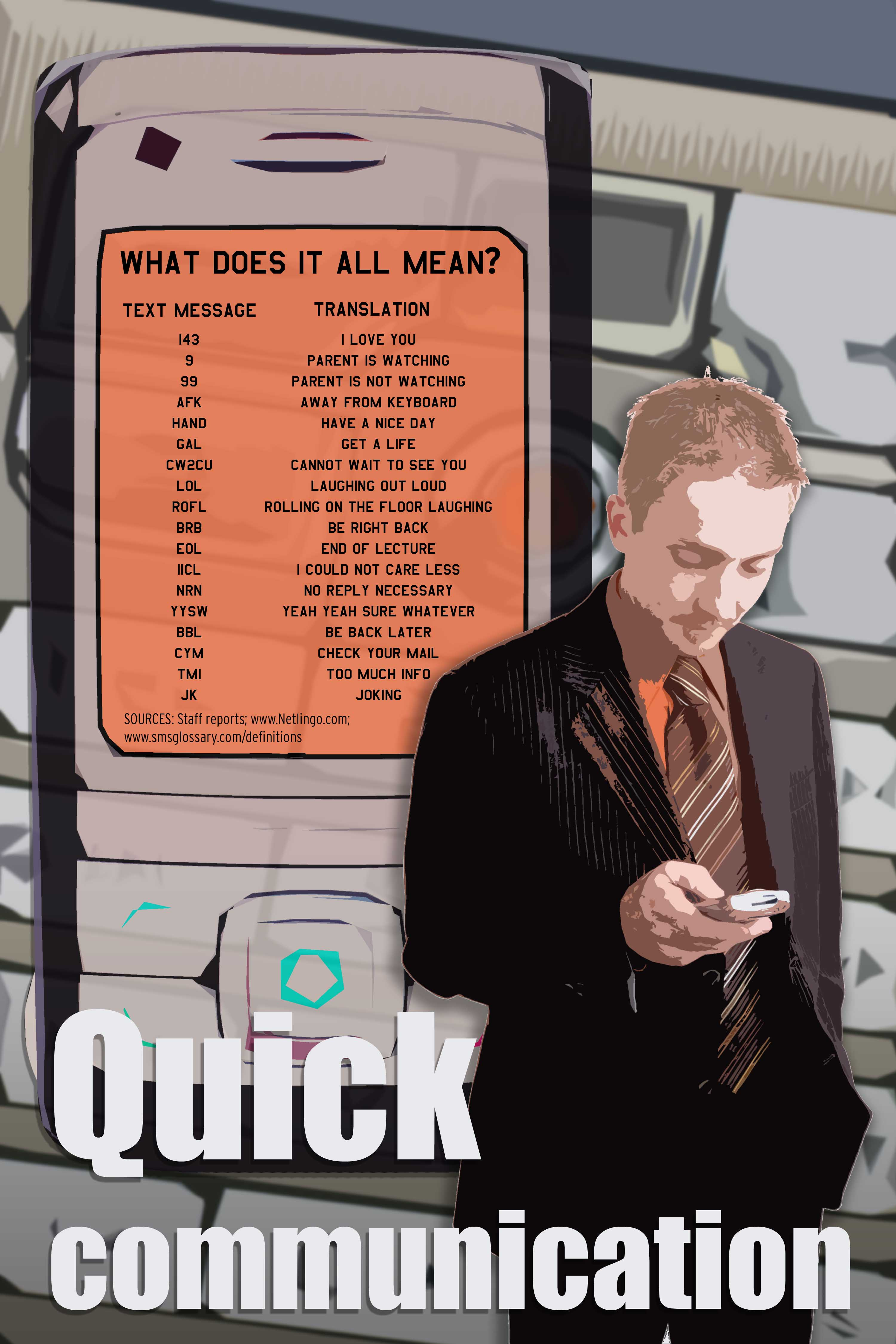
Texting is a quick method to relay information and – to make the process even speedier – users often omit letters or use acronyms, in essence creating a language within circles of friends.
They are refining a lingo that one Kansas University communications professor said has been around for decades.
“Youth are into slang in general,” said Nancy Baym, KU communications professor who specializes in interpersonal and Internet communication. “It’s a way of setting yourself apart, especially with teenagers, less so with college students. It’s a way to have private time with friends even when you’re stuck with your family. Secret language is a way to make it that much more private and special.”
‘Internet speak’
Many phrases seemed to have sprouted from what Andrew Cornwell, 21, Lawrence, calls “Internet speak.”
In online chat rooms he learned phrases such as BBIAM (be back in a minute) and AFK (away from keyboard) which has turned into AFP (away from phone).
Baym said text messaging lingo today has roots in the 1920s and really sprouted during early Internet chats.
“BTW (by the way) showed up in the original form of a fanzine, a do-it-yourself magazine in 1920s,” she said. “A lot of these things, TTYL, LOL and ROFL go back to early days of the Internet.
“The funny thing with new technology is people think it’s new and no one has ever done it, but it’s already been done,” Baym said. “Someone comes up with it and it spreads.”
Texting in the U.S.
Text messaging didn’t spread in America until recently, trailing far behind other countries, Baym said. A few years ago in her online class, she asked students if they knew about text messaging and the only response she received was blank stares. She said once cell phone price plans changed about three years ago, it “shifted drastically.” Baym also said the X and Y generations are new enough to the technology that she isn’t concerned it’s ruining the English language, as some critics have said.
“It’s part of a great tradition,” Baym said. “People coming up with their own strategic ways to communicate that marks them as members of a group.”
According to the Cellular Telecommunications and Internet Association, 158 billion text messages were sent in the United States in 2006 and approximately 300,000 text messages are sent per minute.
Text prediction
Zach Sims, 21, of Lawrence, who sends and receives anywhere from 500 to 1,000 messages a day, said he shortens most words by weeding out vowels and punctuation. Anything that starts with a number, he’ll use the numeral instead. He uses “prolly” instead of probably and prefers “ha” to LOL.
“I think girls are supposed to put LOL and K,” he said. “It’s feminine.”
Sometimes he has to explain lingo to friends, but they soon catch on.
Sims also has taken advantage of text prediction software called T9 (text on nine keys).
“It took awhile to get used to it,” he said. “When I send slang words, it doesn’t predict them.”
Text prediction is a feature on his and many cell phones that recognizes words when the user types and it automatically completes the word. Tegic Communications developed T9 in 1995. The idea is to make it easier and faster to type on numeric keypads. T9 software combines groups of letters on each keypad with a fast-access dictionary of words and recognizes words the user wants to type.
Learning the lingo
For those who haven’t deciphered the language of text messages, Baym’s advice is to visit a texting dictionary at www.netlingo.com.
For some users, any help is welcome.
Brady Wyatt, 20, from Washington, Kan., said he tries to use the lingo.
“My girlfriend confuses me sometimes,” he said. “She sent me a message that said ‘NBD.’ I had no idea what that meant. It’s ‘no big deal.’ I had to ask my roommate, and he laughed at me.”