

Amish begin to bury school shooting victims
Georgetown, Pa. ? They came from across the Pennsylvania countryside dressed in black, bearded men in hats and suits, women in dresses and bonnets. Famous for keeping the surrounding society out, their mourning was remarkable for what they let in: forgiveness.
The Amish gathered for two-hour funerals in the homes of their friends before climbing into horse-drawn buggies and making their way, one by one, to a wind-swept, hilltop cemetery.
They did it three times Thursday for four young girls killed by a gunman Monday in the one-room West Nickel Mines Amish School. A fifth victim’s funeral was set for today, and the community faced the prospect that at least one of five wounded girls will die.
A 6-year-old girl was disconnected from life support Wednesday and taken home to die, officials confirmed. Of the other four hospitalized, two remain in grave condition.
State troopers blocked off all roads into the village of Nickel Mines and led the buggies and black carriages holding the girls’ hand-sawn wooden coffins. Funeral processions passed the home of Charles Carl Roberts IV, the 32-year-old milk truck driver who took the girls hostage, tied them up and shot them before killing himself.
The attack was so traumatic the school house may soon be razed to obliterate the memories. Even so, many Amish have embraced Roberts’ relatives, who may receive money from a fund established to help victims and their families.

A horse-and-buggy Amish funeral procession heads down Mine Road toward Bart Cemetery after services for 7-year-old Naomi Rose Ebersol near Georgetown, Pa. Naomi was one of the Amish girls killed Monday by Charles Carl Roberts IV, a 32-year-old milk truck driver who laid siege to their one-room schoolhouse.
The family of 13-year-old victim Marian Fisher even invited Roberts’ widow, Marie, to her funeral; it was unclear whether she attended. Marie Roberts’ family said Thursday that the families knew each other because the Fisher farm was a regular stop on Charles Roberts’ milk route.
A brave stand
Marian Fisher was the eldest of the 10 girls shot Monday. She faced death with remarkable bravery, according to new details that emerged Thursday after one of five surviving witnesses was removed from a ventilator and could speak again.
“Shoot me first,” the girl told Roberts, bravely offering up her life in an attempt to save her terrified younger classmates.
Then another of the older girls stepped up and said, “You can shoot me second,” according to Mennonite midwife Rita Rhoads.
“They were hoping maybe if they offered themselves, the younger girls would either be saved or rescued in time,” Rhodes said. “It really showed a tremendous amount of courage. It’s really amazing that girls of that age would offer themselves up. I know a lot of adults who wouldn’t do that.”
She said she heard the account from Marian’s grandfather, Bishop Ruben Fisher, who talked to Marian’s 12-year-old sister, Barbie, in her hospital bed.
Barbie Fisher also related that after Roberts cleared the schoolhouse of the boys and adults, and tied the 10 trembling girls together by the ankles in a row by the blackboard, he began a rambling discourse.
“At some point, the shooter asked the girls to pray for him. The girls were kind of amazed and surprised by that,” Rhoads said.
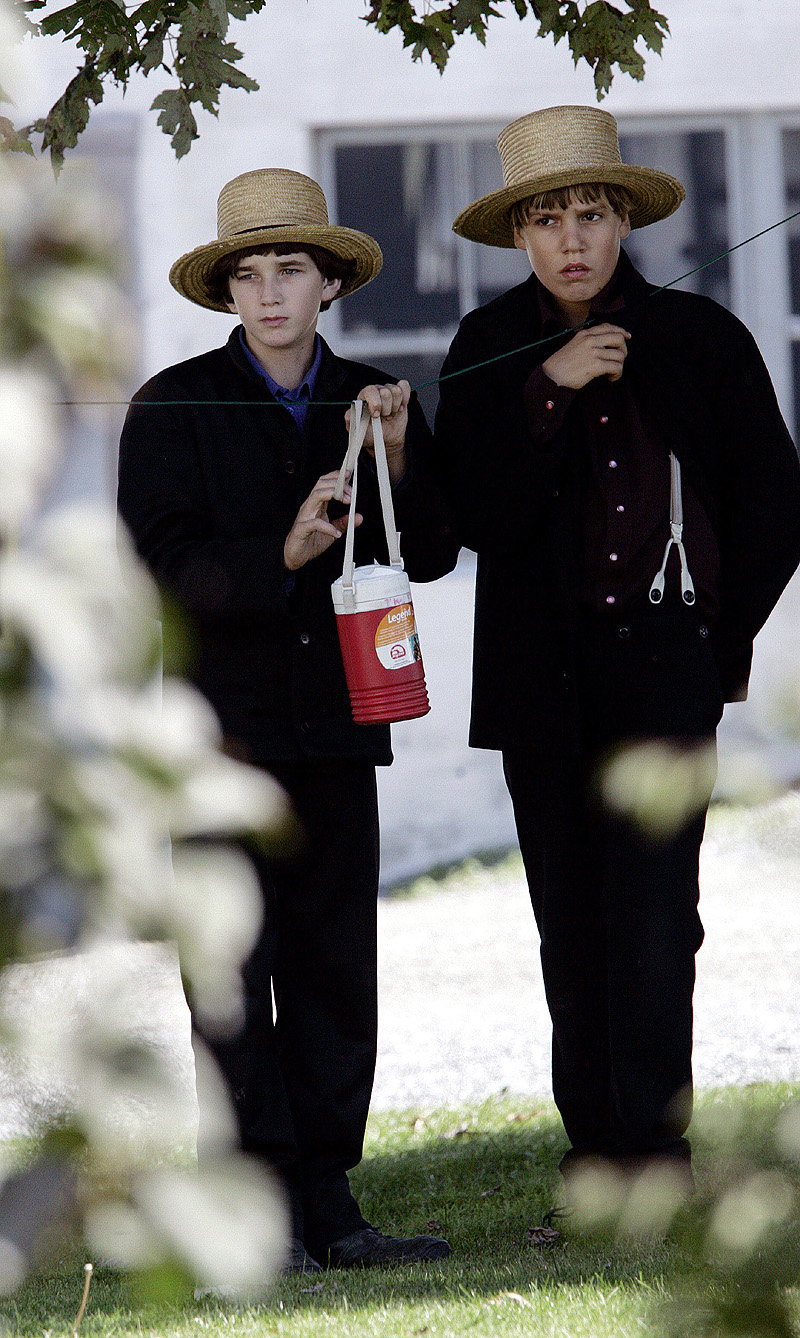
Two young boys stand in a yard Thursday along Lancaster Road in Bart, Pa., where the first of four funeral processions passed for Amish schoolgirls killed Monday.
Simple services
Funerals also were conducted Thursday for 7-year-old Naomi Rose Ebersol, and sisters Mary Liz Miller, 8, and Lena Miller, 7. The funeral for 12-year-old Anna Mae Stoltzfus was scheduled for today.
The girls, in white dresses made by their families, were laid to rest in graves dug by hand in a small burial ground bordered by cornfields and a white rail fence. Amish custom calls for simple wooden coffins, narrow at the head and feet and wider in the middle.
Media were blocked from the funerals and the burials, and airspace for 2 1/2 miles in all directions was closed to news helicopters. During the slow processions, the clip-clop of the horses was broken up only by the roar of official helicopters enforcing the no-fly zone.
Tragedies such as the massacre at Columbine High School in Colorado have become moments of national mourning, in large part because of satellite and TV technology. But the Amish shun the modern world and both its ills and conveniences, including automobiles and most electrical appliances.
“I just think at this point mostly these families want to be left alone in their grief and we ought to respect that,” said Dr. D. Holmes Morton, who runs a clinic that serves Amish children.
Amish funerals are conducted in German and focus on God, not on commemorating the dead. There is no singing, but ministers read hymns and passages from the Bible and an Amish prayer book.
A couple who attended Naomi’s and Marian’s funerals said there were two ministers at each service, which is customary. The first minister spoke for about 10 minutes, the second for about 45 minutes, said the couple, who provided only their first initials and last name, King.
The husband, A. King, quoted one of the ministers as saying, “The person that died isn’t here anymore. We have to think of the people who are still living.”
State troopers who responded to the shootings were present at one of the burials, the Kings said.
“That was really touching for us,” A. King said.
Donations pour in
Donors from around the world are pledging money to help the families of the five dead and the five wounded in amounts ranging from $1 to $500,000. The families could face steep medical bills.
Though the Amish generally do not seek help from outside their community, Kevin King, executive director of Mennonite Disaster services, an agency managing the donations, quoted an Amish bishop as saying: “We are not asking for funds. In fact, it’s wrong for us to ask. But we will accept them with humility.”
At the behest of Amish leaders, a fund has also been set up for the killer’s widow and three children.
National
New York subway stabbings hurt 3; police kill knife-wielding man, officials say
NEW YORK (AP) — A man with a machete who attacked three people randomly at a major New York City subway station ...

What one campaign rally in Michigan reveals about young voters ahead of the midterm elections
Judge told to reconsider national security implications of halting Trump’s ballroom
WASHINGTON (AP) — A federal judge must reconsider the possible national security implications of halting ...

Artemis II’s moon-traveling astronauts return from record-breaking trip

Eight states, three time zones and a ton of history: Take a trip down Route 66 as it turns 100
Family sues US over 8-year-old’s death in custody
McALLEN, Texas — The Honduran family of an 8-year-old girl with a heart condition who died in U.S. custody after ...