Theater guru puts world onstage
Show examines life in remote Indian community
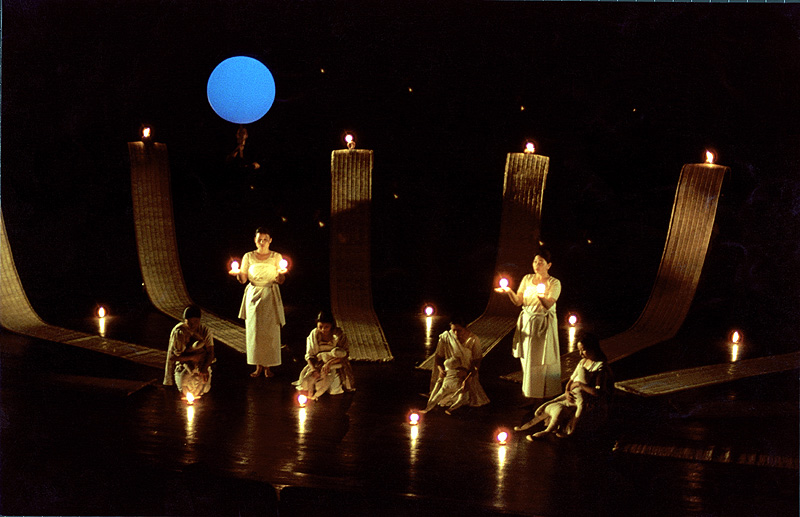
Nine
Even if many Americans haven’t heard of Manipur, Ratan Thiyam says they’re familiar with the story of its people.
It’s a story of oppression, violence and poverty, one that could apply nearly anywhere in the world.
“I believe in one thing,” Thiyam says. “Though I belong to a very small community in a very small state, I’m a human being, after all, living in this contemporary world. Everywhere we are longing for peace. Everywhere mothers are looking past the killings, the murders, and looking for a brighter future for their children.”
That’s the theme of “Nine Hills, One Valley,” Thiyam’s latest work for stage that opens tonight and continues Thursday at the Lied Center. He calls his theater “composite artwork,” a mix of traditional acting, dance, music and martial arts.
The work examines the history and contemporary life of Manipur, the remote Indian state where Thiyam is from and where he founded Chorus Repertory Theatre.
The theater company started in 1976 and made its U.S. debut in 2000 to rave reviews, including one in The New York Times. The troupe has toured in more than 30 countries since its inception.
On its second trip to the United States, the 26-member Chorus Repertory Theatre is visiting five locales: Brooklyn Academy of Music, Carolina Performing Arts at the University of North Carolina-Chapel Hill, University of California-Davis and the University of California-Berkeley, in addition to the stop in Lawrence.
Thiyam is spending this week working with Kansas University students through a residency program. But he maintains he’s not here to teach, either through the residency or through his art.
“I’m not a philosopher or scholar or expert or intellectual, to give advice to people,” he says. “It’s the kind of discussion that’s being carried out throughout the performance, unit by unit, and it is trying to portray the agonies, the pain and the suffering of the lower strata, the poorer section of the people that are affected by many things – maybe sometimes starvation, maybe sometimes war, maybe sometimes with economical problems.”
“Nine Hills, One Valley” isn’t a traditional theater piece in that it does not have a cohesive story line.
Rather, it presents a series of ideas about Manipur’s history and culture. Manipur, which was established around 50 years ago, has more than a dozen ethnic armies in conflict with Indian soldiers. Often blockades have hurt the common people, and heroin addiction and AIDS are common there.
But Thiyam says the same reactions apply to other issues around the world.
“All these issues come as headlines,” he says. “I open the newspaper in the early morning, and then I want to have a cup of tea or coffee, and then suddenly I see there’s quite a lot of murder and violence in every region. Everywhere, the war is broken out, and so the tea or the coffee becomes bitter.”
More information
“Nine Hills, One Valley” includes subtitles that help explain what’s happening on stage. But Thiyam says much of the work is done in archaic languages and in poetry that cannot be translated literally.
He’s hoping the work presents a broader experience than mere words. Specifically, he’s hoping it sparks a conversation.
“Art has to serve its own purpose, but it has to serve its own purpose while taking up many of the human issues which are more important to discuss,” Thiyam says. “So it is like just making a discussion. I don’t want to teach anybody in this world, because I might still be the student.”
Arts and Entertainment

Sculptor who turns junk into gems is featured artist for Lawrence Art Guild’s studio tour event
Functional compass rose with sunflower design will be ‘a really wonderful focus point’ for Lawrence airport
Eat, drink and meet with dozens of Kansas authors at this weekend’s Free State Book Festival

Go, See, Do: Music, markets, big rigs, kite festival and more
In collaborative show ‘Breeders,’ Lawrence artists capture the chaos and the fun of parenthood