New rules bring tighter chains for tiger owners
“I think tigers are a great pet to have. I’ve always wanted one my whole life.”
“I’m looking for a tiger. Prefer Siberian. A few years ago I had a tiger. I kept her outside during the day and in my heated garage at night.”
William Pottorff cringes when he hears about messages posted on the Internet by people wanting to buy big cats such as tigers, lions and leopards.
“You can’t take a 500- or 600-pound cat on a leash. Trying to walk one of these around on a dog rope is stupid. You just don’t do it,” said Pottorff, owner of Cedar Cove Feline Conservation Park near Louisburg.
Time may be running out for people who buy and sell big cats over the Internet or transport them across state lines or the U.S. border without meeting certain exceptions.
On Jan. 31, the U.S. Fish and Wildlife Service published a proposed rule in the Federal Register that would implement the Captive Wildlife Safety Act signed by President Bush two years ago. A 30-day public comment period about the rule just ended.
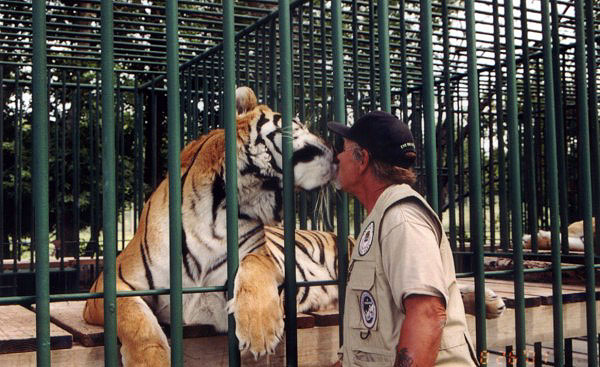
William Pottorff, owner of the Cedar Cove Feline Conservation Park near Louisburg, nuzzles one of his captive Siberian tigers.
Fish and Wildlife will spend the next three or four months reviewing those comments and then decide whether changes need to be made before the rule is published one more time, spokeswoman Sandra Cleva said. She declined to characterize the comments the agency received or say how many were received.
Pottorff, who has owned Cedar Cove since it opened in 2000, said he had no problem with what the federal agency was trying to do. His park is a preserve and refuge site for tigers and other big cats that have been abandoned or neglected by owners unable to care for them. There are several tigers at the park Pottorff has raised from cubs.
“My cats, they know me, they love me, but there is not a one of them that wouldn’t kill me if I did something wrong,” he said.
Pottorff has other trained animal caretakers working for him. The park is licensed by the U.S. Department of Agriculture and accredited by the American Association of Zoo Keepers. The park is open to the public.
The proposed federal rule would exempt individuals and businesses such as Cedar Cove and other zoos and transporters licensed or registered with the U.S. Department of Agriculture and state-licensed rehabilitators, veterinarians and wildlife sanctuaries.
The rule would not ban private ownership of big cats, but it will make it more difficult for owners to sell, buy or move them.
In Kansas, legislation was introduced recently that would require all owners of big cats as well as bears to obtain a license from USDA. Owners also would have to carry $250,000 worth of insurance.
The legislation was sponsored by the Senate Ways and Means Committee and backed by Chairman Dwayne Umbarger, R-Thayer. It is in response to the death last year of a teenager at a southeast Kansas wildlife sanctuary near Parsons. Haley Hilderbrand, 17, was bitten by a Siberian tiger and died from her injuries. She was having her high school senior picture taken with the tiger.
The legislation would require exotic animals to be kept in cages, and they could not be leashed, tethered or chained outside the fence.
Moreover, for the last two years the Kansas Department of Wildlife and Parks has been considering its own regulations for big cat ownership. The new regulations are to be discussed April 27 in Junction City and then voted on in June in Scott City by the Wildlife and Parks Commission.
Those regulations are currently being reviewed by the Kansas Attorney General’s Office and the Kansas Department of Administration, said Kevin Jones, KDWP director of law enforcement.
The proposed regulations would not ban ownership of big cats, but it would involve a registration and permit process. There is concern that a ban would drive individual exotic animal owners into deeper secrecy about their pets.
Kansas requires owners to get permits for bears, mountain lions and wolves, though Jones said he knew not everyone bothered to get those permits. But there are no requirements for permits to own African lions, tigers, cheetahs or leopards.
“Right now we don’t know how many owners of big cats are out there,” Jones said.
Pottorff doesn’t know either, but he thinks there are many. He recalled a phone call he once received from a woman in Linn County. She wanted him to take her leopard.
“It was only three months old, but it was already chewing on her rottweiler and her furniture,” he said.
Some counties and cities have passed their own laws about exotic animal ownership. Lawrence and Douglas County do not allow big cats.
City Government

Lawrence City Commission could start the process of finding a construction manager for new fire station

Lawrence is charging water, sewer customers a special tax not required by state or city law

Lawrence housing market strains residents as development fails to keep up, city’s affordable housing study finds

Property tax protest bill would let a few dozen voters block tax increases in some parts of Douglas County
Portion of 19th Street to close during much of April for stormwater structure replacement