KU plays star role in sea monster film
Every kid knows the tyrannosaurus or the triceratops. But few likely know the mosasaur.
The ferocious prehistoric sea reptile that roamed the seas over what is now Kansas is among the creatures depicted in an upcoming IMAX film shot Thursday at Kansas University.
“This to us was the dinosaur story that’s never been told,” said Lisa Truitt, a producer of “Sea Monsters 3D.”
When dinosaurs dwelled on land, an inland sea stretched from the Arctic to the Gulf of Mexico, from Utah to Minnesota. It contained a strange and awesome ecosystem – viewed by those who study it as both beautiful and terrifying.
“If humans had been alive 80 million years ago, that ocean would have not been a friendly place to go swimming,” said Leonard Krishtalka, KU professor of ecology and evolutionary biology and director of the Biodiversity Institute.
Over the years, the sea creatures seem to have lost the public popularity contest to dinosaurs, said Mike Everhart, author of “Oceans of Kansas: A Natural History of the Western Interior Sea.”
“I think people related better to the things that walk on land than things that swim in the ocean,” Everhart said.
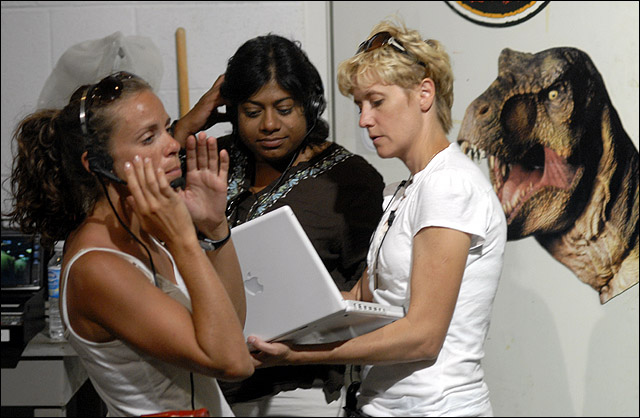
Leslie Ann Aldridge, left, announces that cameras are ready to film and for the crew to clear the area, as producer Jini Durr, center, and production manager Kaylene Carlson confer during the filming of a National Geographic project in Kansas University's Dyche Hall. The film will be a 3-D movie about sea monsters based on fossils that have been found in Kansas, once a prehistoric interior sea.
National Geographic published an article about the Sea Monsters in its December 2005 issue. The 3-D IMAX film, expected to be released in October 2007, is a National Geographic project.
The film will follow one sea reptile while interweaving the history of the creatures, how they lived and how they were uncovered millions of years later.
There’s no better backdrop for such a film than Kansas, Truitt said.
“This is where it happened,” she said. “This is where the finds were made.”
Thousands of specimens have been excavated from Kansas land, particularly the chalk beds of western Kansas.
The film will tell the tale of the Sternberg family of fossil hunters, whose name adorns the Sternberg Museum of Natural History in Hays.
It also will include the story of Everhart, though played by a professional actor. The film recounts Everhart’s 1996 find of the oldest known specimen of Tylosaurus proriger, a large mosasaur.
The film crews have traveled to Russell Springs, Castle Rock and Monument Rock.
They stopped Thursday at KU’s Dyche Hall to shoot scenes for a subplot about the finding of neonatal reptile remains without shells. In the film, the remains are studied in a lab.
KU is home to one of the finest collections of sea monster fossils, Krishtalka said.
“It is the fossils from the chalk beds that put KU on the map as the center for paleontology,” he said.
A 45-foot replica of a mosasaur hangs above the entry way to KU’s Natural History Museum. Ranging in length from 30 to 50 feet, the mosasaur was a giant lizard with a big mouth and sharp teeth – one of the baddest on the block in its day.
The remains of prehistoric giant fish, giant crocodilelike creatures and giant flying reptiles are on display, some still baring their ferocious teeth.
“It’s a very unappreciated resource that we have here,” Everhart said of Kansas. “This is a great place for fossil collecting and learning about the history of past.”
KU

University of Maine leader named as a finalist for KU journalism dean position
Self announces he will continue as KU coach

KU faculty union ratifies first-ever labor contract with 92% voting yes; contract now needs Regents approval

KU researcher excited to bring prestigious NASA fellowship to university as way to mentor students, expand research opportunities
Local vendors can apply now for KU’s new monthly on-campus market, Jayhawk Fridays