Guantanamo camp described in movie
Subjects of film describe repeated suicide attempts
London ? Three British men formerly detained at the U.S. military prison in Guantanamo Bay and now the subjects of a new film about their experiences say they were driven to desperation knowing others had tried to kill themselves at the camp.
In an interview with The Associated Press, Shafiq Rasul and his two friends – Ruhal Ahmed and Asif Iqbal – describe how they were held at Guantanamo for more than two years without charge. Many of the some 460 detainees accused of links to Afghanistan’s Taliban regime or the al-Qaida terror network have been held for more than four years without charge.
“There is no hope in Guantanamo. The only thing that goes through your mind day after day is how to get justice or how to kill yourself,” Rasul, 29, who waged a hunger strike at the camp to protest alleged beatings, said Saturday. “It is the despair – not the thought of martyrdom – that consumes you there.”
Two Saudis and one Yemeni who had been held at the camp since it opened in 2002 killed themselves Saturday by using their sheets and clothes to hang themselves.
The deaths could prove a turning point for the camp, which has become a legal conundrum for the U.S., with rights groups and leaders like British Prime Minister Tony Blair calling for its closure. The U.S. military has been accused of prisoner abuses and heavy-handed interrogations that have led to a string of hunger strikes and suicide attempts among detainees.
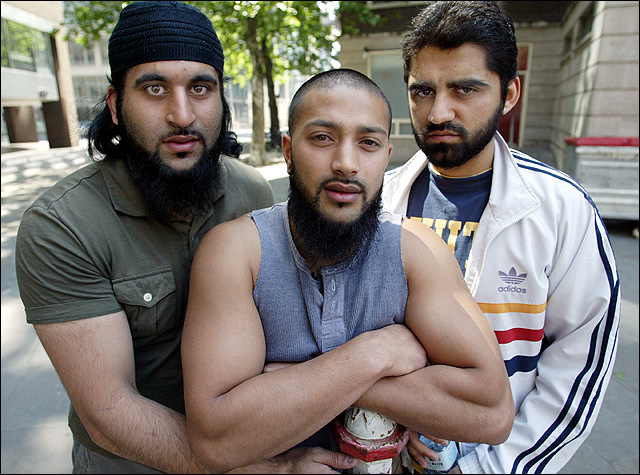
Shafiq Rasul, from left, Ruhal Ahmed and Asif Iqbal took a trip to Pakistan for a wedding and ended up in the desolate military outpost at Guantanamo Bay, Cuba. The three former detainees are the subject of the new movie Road
In “Road to Guantanamo,” which premieres in New York on June 23, filmmakers Michael Winterbottom and Mat Whitescross retrace the footsteps of the three British men as their trip to Pakistan for Iqbal’s wedding ends at the desolate military outpost in Cuba.
At the camp, the men say they were beaten and saw troops throw Qurans in the toilet. They also say they were forced to watch videotapes of prisoners who had allegedly been ordered to sodomize each other.
There are no scenes of attempted suicides in the film, but the men say they knew of several.
“A Saudi detainee in the cell in front of us had had enough,” said Ahmed, 24, whose family is Bangladeshi. “We could hear him rip up his sheets and tie it to the wire mesh roof of the cell. He jumped off his sink and tried to hang himself. We shouted to the military police, and they came and saved him.”
The British men were released in March 2004.
National
Judge halts order requiring colleges to show they aren’t considering race in admissions
BOSTON — A federal judge has halted efforts by the Trump administration to collect data that proves higher ...

Artemis II toilet acts up again as astronauts speed toward the moon

Trump budget seeks $1.5T in defense spending alongside cuts in domestic programs

At least 1 crew member missing after 2 US aircraft shot down

Trump loyalist Bondi out as attorney general