

No job too dirty – or smelly – for cleaning company
Salina ? Jay Minear and his employees spent 10 hours one day sucking 6,000 pounds of bat guano from the attic of a Beloit church.
He has cleaned fish heads and guts from a fish-cleaning station at Wilson State Park, grease and restaurant waste from concrete pits, human waste from vault toilets at various parks and mud and other gunk from pits at car and truck washes.
As Minear, owner of DJ Environmental, likes to say, they’re dirty jobs, but somebody has to do them.
“If it stinks and it needs to be cleaned, we’ll do it,” Minear said.
In fact, Minear doesn’t remember turning down a single job since he opened his company in March 2000 with a silent financial partner and his son-in-law, Jeff Lyne. Minear, a salesman for 25 years, developed his idea for the company while selling vacuum trucks for a company based in Gulfport, Miss.
He traveled from the Texas Gulf Coast to the Canadian border and met all kinds of people who did all kinds of jobs using vacuum trucks.
“I started seeing a need in central Kansas for this sort of service,” Minear said.
One of the first things he did was talk to Don Hoff, who then was the director of utilities for the city of Salina.
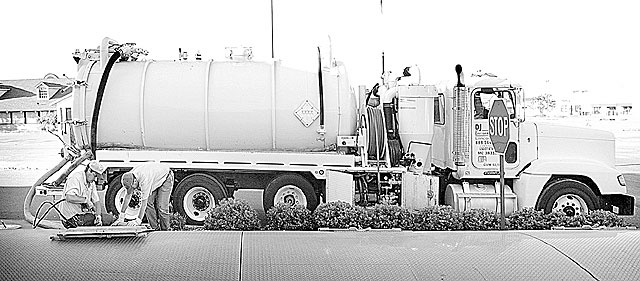
Jeff Lyne, left, and Jesse Minear remove mud from a pit at car wash in Salina. From grease and restaurant waste to bat guano in a church attic, DJ Environmental removes all sorts of waste.
“He was excited,” Minear said. “He knew there was a need. They were having a hard time making people clean their grease traps and take care of things because there was no business close enough to provide the service.”
Minear explained that the grease traps don’t carry just the discarded grease from french fry cookers. “It’s all the stuff they discard when they rinse off the dishes,” he said. “The grease interceptor is the opposite of a septic tank, where the solids go to the bottom and gray water goes to the top; in the grease interceptor, the grease floats on top, and the outlet is lower than the inlet.”
Martha Tasker, Salina’s current utilities director, said that if the pits aren’t kept clean, the waste can get into the city’s sewer lines.
Recycling the waste
Minear developed a business plan and worked with the federal Small Business Administration and the Bank of Tescott. He’s a native of Culver, and his wife, Deb, is from Lincoln, so the two opened the business in Lincoln.
Instead of just “pumping and dumping,” Minear’s plan was to treat the waste he collected and use it in some way. Then, he saw a system in Dallas in which the waste collected from grease traps was treated, the water extracted and the dry product applied to crops as a fertilizer. Minear contacted the company that installed that system and had a similar wastewater treatment plant installed in Lincoln.
So far, he said, farmers aren’t paying him for the fertilizer, which they apply on brome. But Minear is looking at buying a fertilizer spreader so he can spread not only that waste but chicken litter from a chicken farm in southeast Kansas.
Business booming
Minear and Lyne have come a long way since the early years, when they had one vacuum truck and knocked on doors of restaurants, looking for business. These days, they have two vacuum trucks, a tanker and a tractor-trailer – and two employees.
He estimates he has $1.2 to $1.5 million invested in equipment; he won’t reveal the company’s annual income. The company’s specialty is cleaning pits – whether they be restaurant grease pits or pit toilets, septic tanks or underground fuel tanks – clear to the concrete, then cleaning the sides of the pit. Some companies just skim the grease off the top, leaving at the bottom solids that eventually fill up the pit.
The thoroughness of the company’s work has impressed Kenneth Wade, operations project manager for the U.S. Army Corps of Engineers at Perry Project.
Wade used DJ Environmental to clean vault toilets when he was at Wilson Lake, and he now uses the company at Perry.
“I know it’s not the most glamorous job in the world, but we found that a lot of the companies were only doing really half the job,” Wade said. “They were doing what they needed to do to get paid, and that was it. They weren’t doing a detailed clean-out.
“With DJ, they remove everything, from the 2-by-4s to you name it. If it’s in there, they’re going to get her out of there.”
Immune to smells
And whether it’s mud from a car wash or human waste, the gunk stinks. Minear said the workers don’t wear masks, though.
“You get used to the smell,” he said. “If you were to come into our plant, you’d say it stinks, but we really don’t smell it.”
Minear said the workers did wear masks while sucking up the bat guano, not because of the smell, but because of the threat of contracting bat fever from the waste.
So what’s the nastiest job he has ever done? Minear said grease interceptors for pizza restaurants are pretty bad, with the pepperoni and tomato paste. Restaurants that sell hamburgers and ice cream also are pretty rank, what with the hamburger grease and milk. Rest homes, which fry very little, are the cleanest, he said.
But the worst, Minear said, had to be the bat guano in the attic of St. John’s Catholic Church in Beloit.
John Lackey, a church member overseeing a recent restoration project, said the 100 years worth of bat waste had to be cleared out before the restoration could begin.
“It was very smelly,” Minear said. “It had a very different odor. It’s like nothing you’ve ever smelled before, and it’s very dry.”
State Government

Property tax protest bill would let a few dozen voters block tax increases in some parts of Douglas County

Lawmakers pass bill to create sports authority to oversee new Chiefs stadium in Kansas

Kansas Legislature passes a bill that would give 10% of voters the power to stop some property tax increases
Kansas Senate, House pass budget bill that pegs raises at 1% for most state employees

U.S. Supreme Court Justice Sonia Sotomayor to visit KU next month; will speak to students, select guests
