Shelley Winters, 2-time Oscar winner, dies at 85
Beverly Hills, Calif. ? Shelley Winters, the forceful, outspoken star who graduated from blond bombshell parts to dramas, winning Academy Awards as supporting actress in “The Diary of Anne Frank” and “A Patch of Blue,” has died. She was 85.
Winters died of heart failure early Saturday at The Rehabilitation Centre of Beverly Hills, her publicist Dale Olson said. She had been hospitalized in October after suffering a heart attack.
The actress sustained her long career by repeatedly reinventing herself. Starting as a nightclub chorus girl, she advanced to supporting roles in New York plays, then became famous as a Hollywood sexpot.
Still working well into her 70s, she had a recurring role as Roseanne’s grandmother on the 1990s TV show “Roseanne.”
“I am so sad. She was a great person and a genius to work with,” Roseanne Barr said in a statement. “We will all miss her.”
In 1959’s “The Diary of Anne Frank,” she was Petronella Van Daan, mother of Peter Van Daan and one of eight real-life Jewish refugees in World War II Holland who hid for more than a year in cramped quarters until they were betrayed and sent to Nazi death camps. The socially conscious Winters donated her Oscar statuette to the Anne Frank House in Amsterdam.
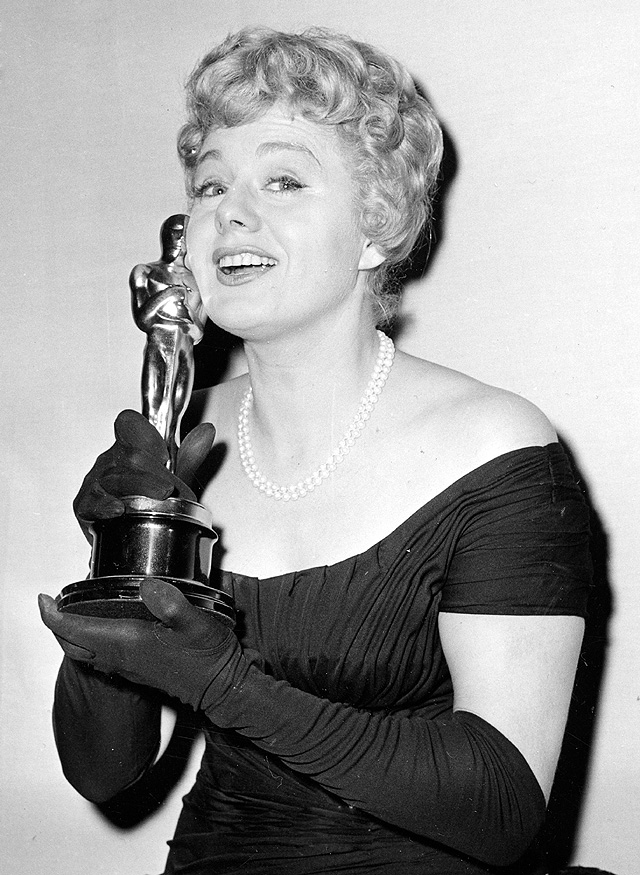
Shelley Winters poses with her Oscar backstage at the Academy Awards at the Pantages Theater in Hollywood on April 4, 1960. Winters won best supporting actress for her role in The
In 1965’s “Patch of Blue,” she portrayed a hateful, foul-mouthed mother who tries to keep her blind daughter, who is white, apart from the kind black man who has befriended her.
Winters, whose given name was Shirley Schrift, was appearing in the Broadway hit “Rosalinda” when Columbia Pictures boss Harry Cohn offered her a screen test. A Columbia contact and a new name – Shelley Winters – followed, but all the good roles at the studio were going to Jean Arthur in those days.
Winters’ early films included such light fare as “Knickerbocker Holiday,” “Sailor’s Holiday,” “Cover Girl,” “Tonight and Every Night” and “Red River.”
The only hint of her future as an actress came in 1948’s “A Double Life” as a trashy waitress strangled by a Shakespearian actor, Ronald Colman. The role won Colman an Oscar.
“A Place in the Sun” in 1951 brought her first Oscar nomination and established her as a serious actress. She desperately sought the role of the pregnant factory girl drowned by Montgomery Clift so he could marry Elizabeth Taylor.
Winters received her final Oscar nomination, for 1972’s “The Poseidon Adventure,” in which she was one of a handful of passengers scrambling desperately to survive aboard an ocean liner turned upside down by a tidal wave. By then she had put on a good deal of weight, and following a scene in which her character must swim frantically she charmed audiences with the line: “In the water I’m a very skinny lady.”
Among her other notable films: “Night of the Hunter,” “Executive Suite,” “I Am a Camera,” “The Big Knife,” “Odds Against Tomorrow,” “The Young Savages,” “Lolita,” “The Chapman Report,” “The Greatest Story Ever Told,” “A House Is Not a Home,” “Alfie,” “Harper,” “Pete’s Dragon,” “Stepping Out” and “Over the Brooklyn Bridge.”
During her 50 years as a widely known personality, Winters was rarely out of the news. Her stormy marriages, her romances with famous stars, her forays into politics and feminist causes kept her name before the public. She delighted in giving provocative interviews and seemed to have an opinion on everything.
The revelations in her autobiographies provided endless material for interviewers and gossip writers.
She told of a dalliance with William Holden after a studio Christmas party. In a glamorous, real-life version of the play “Same Time, Next Year,” they continued their annual Yuletide rendezvous for seven years.
She wrote that despite their intimacy, they continued to refer to each other as “Mr. Holden” and “Miss Winters,” and when they met on the set of the 1981 film “S.O.B.” she said, “Hello, Mr. Holden.” He smiled and replied, “Shelley, after your book, I think you should call me Bill.”
Shirley Schrift was born on Aug. 18, 1920, and grew up New York, where she appeared in high school plays.
During the Detroit run of a musical revue, she married businessman Paul “Mack” Mayer on Jan. 1, 1942. He entered the Army Air Corps, and after the war, the pair found they had little in common. They divorced in 1948.
Winters’ second and third marriages were brief and tempestuous: to Vittorio Gassman (1952-54) and Anthony Franciosa (1957-60). The combination of a Jewish Brooklynite and Italian actors seemed destined to produce fireworks, and both unions resulted in headlines.
A daughter, Vittoria, resulted from the marriage to Gassman. She became a successful physician.
Arts and Entertainment

Events: Ballet, cinema, walking tours and lots of Easter egg hunts

Theatre Lawrence’s upcoming season to feature ‘On Golden Pond,’ ‘Pirates!’ and more

Watkins Museum to host traveling exhibition featuring photographs, narratives of the Underground Railroad
Local vendors can apply now for KU’s new monthly on-campus market, Jayhawk Fridays

UPCOMING EVENTS: Easter egg hunts, fee-waived pet adoptions and more