

Constitution Hall has new coat of paint as anniversary nears
Lecompton to celebrate landmark's 150th year
Lecompton ? Constitution Hall is getting a facelift.
For the first time since the building was constructed in 1856, contractors are peeling away layers of paint and working their way down to the original wood siding. Then they are repairing and repainting the wood so the two-story building can continue its historic life at 319 Elmore.
It is already the oldest wood frame building in Kansas.
“It’s really amazing that this old structure has lasted 150 years,” said Tim Rues, a historian and curator of the hall. “There are very few of these buildings left.”
Work on the hall began in late October and only recently was discontinued because of constant bad weather.
Workers from J.A. Lyden Construction Co. in Topeka will resume work at an appropriate time, and the project should be done before summer, when Lecompton will mark the 150th anniversary of the building, the start of Territorial Days and “Bleeding Kansas” pre-Civil War conflicts.
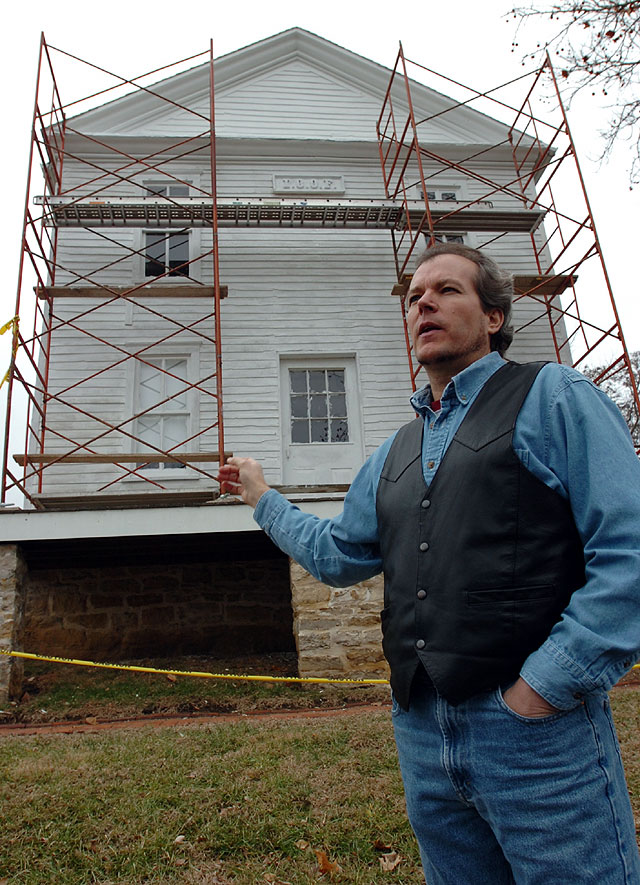
Tim Rues, curator at Constitution Hall in Lecompton, discusses the restoration project that began in October. For the first time since the building was constructed in 1856, contractors are removing all of the exterior paint and repainting the structure.
The building was the site of the 1857 Lecompton Constitutional Convention, where pro-slavery men drafted a constitution that would have made Kansas, then a territory, become a slave state. The constitution was rejected in Washington and never went into effect.
The building also housed the United States land office on the first floor, where thousands of settlers and speculators filed claims. On the second floor was the district courtroom where attempts were made to enforce territorial law. Federal troops often had to be called in as peacekeepers between the pro- and anti-slavery groups.
“This was at the heart of ‘Bleeding Kansas,'” Rues said. “This led to the Civil War.”
National landmark
The hall was built with black walnut. When the paint was removed much of it remained intact.
“I was surprised that over 70 percent of it on the east facing Elmore Street is still there,” Rues said. “Three sides still have most of the original black walnut.”
The original wood on the south side of the building was replaced in 1906 when the building was being used by the International Order of Odd Fellows, Rues said. Instead of new walnut, cedar was used.
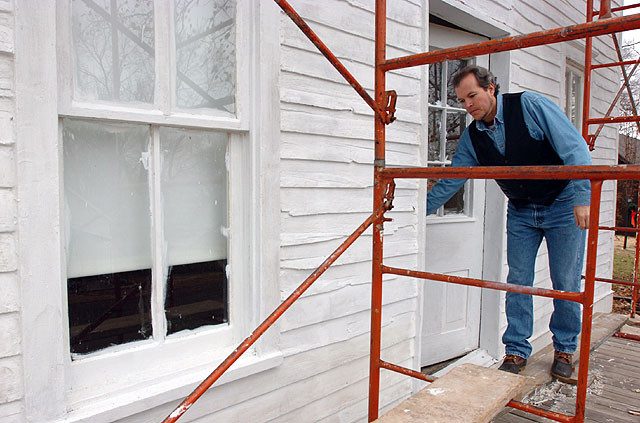
Tim Rues, curator at Constitution Hall in Lecompton, looks at the building's exterior paint. For the first time since the building was constructed in 1856, contractors are removing all of the exterior paint and repainting the structure.
Rues credits social organizations such as the Odd Fellows and Rebekah Lodge for maintaining the building when they controlled it during the late 1800s. It was designated a National Historic Landmark in 1974.
Once the old paint is removed, workers immediately paint over the original wood and use wood epoxy to make repairs. The job requires painstaking care, said Bill Lyden, owner of the construction company.
“It’s very hard work because of the age of the material,” Lyden said. “You have to be very careful, and we do use some special tools.”
Some deteriorated areas were repaired with modern walnut, but trying to match it to the original isn’t easy, Lyden said.
“It still takes a little bit of time to find the right materials and then get the people to mill and cure it so that it meets what you are replacing,” he said.
The cost of the renovation is $47,860, Rues said. The Douglas County Community Foundation contributed $10,000 to help pay for the work and the Kansas State Historical Society’s Cultural Resources Division contributed $19,980. The historical society’s preservation office also contributed $17,820 in federal funds. Total contributions were $47,800.
In addition to the painting, new outside steps and a walkway were constructed to meet Americans with Disabilities Act requirements.
History events to begin Jan. 29
Constitution Hall will be the site for a series of talks and dramatic interpretations on violence and conflict over the slavery issue in Kansas Territory from 1854 to 1861.
The presentations will take place at 2 p.m. Sundays starting Jan. 29 and continuing through March 5. Admission is free.
The schedule:
Jan. 29: “Hell Bent to Lawrence: D.R. Anthony Rides With News of Kansas Statehood,” by historian and state Rep. Candy Ruff, D-Leavenworth.
Feb. 5: “The Civil War Started Here: The National Impact of Events in Territorial Kansas,” by John Sacher, Emporia State University.
Feb. 12: “A Newspaperman in Bleeding Kansas,” Edward Hoover, proprietor of the Kansas Territorial Press Museum.
Feb. 19: “Touched by Fire: Bleeding Kansas,” by Ken Spurgeon and Jonathon Goering, filmmakers, Lon Chimney Productions.
Feb. 26: “Doctor Blunt in Kansas Territory: Life of Gen. James G. Blunt,” by Robert Collins, historian and author.
March 5: “Revolutionary Heart: Clarina Nichols and the Pioneering Crusade for Women’s Rights,” by teacher, author and historian Diane Eickhoff.